


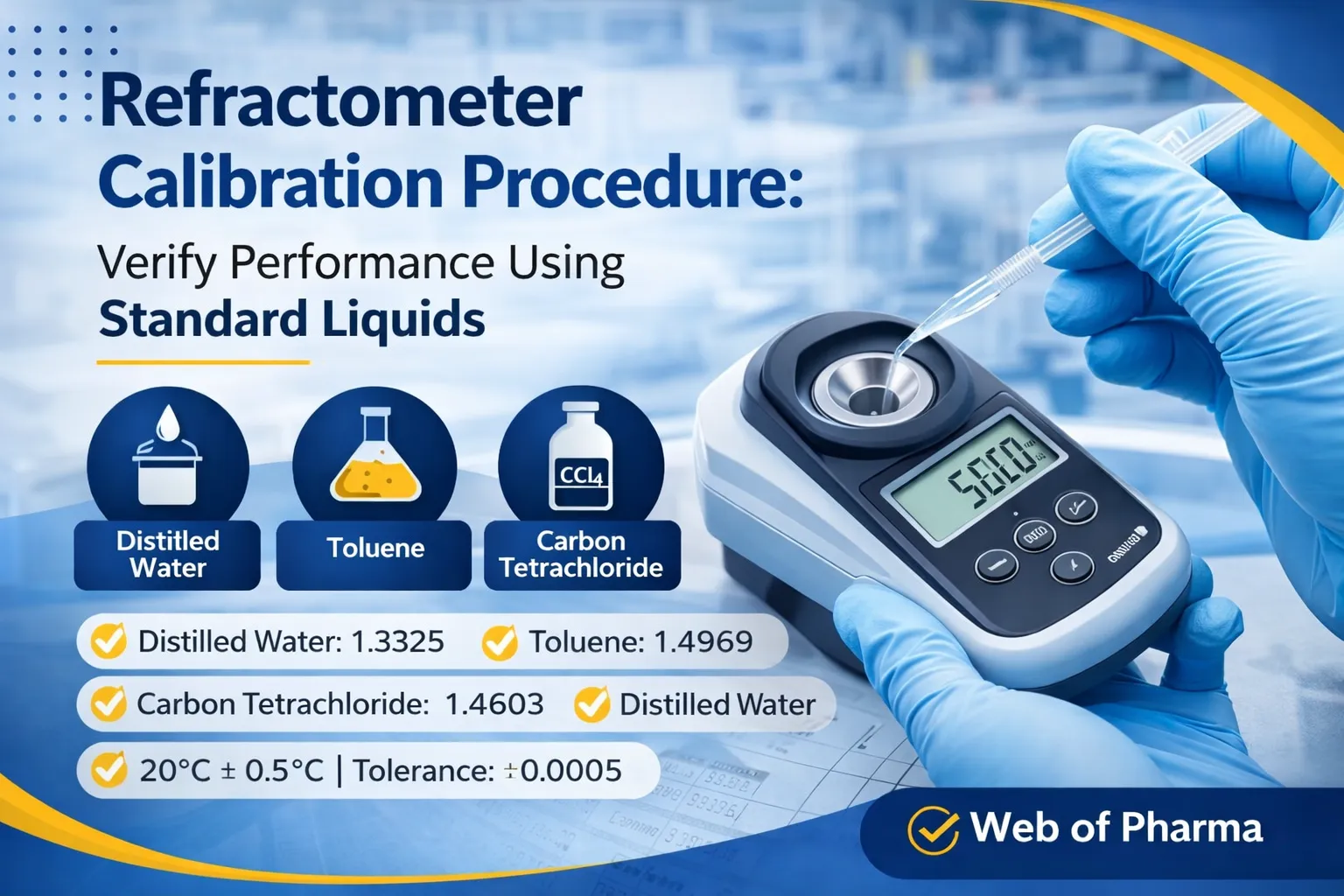

Learn how to verify the performance of refractometer using distilled water, toluene and carbon tetrachloride as standard. Step-by-step calibration procedure, tolerance limits, and QA documentation.
In pharmaceutical quality control, accurate measurement of refractive index is essential for material identification and purity analysis. This guide explains how to verify the performance of Refractometer using Distilled Water, Toluene and Carbon Tetrachloride as standard, ensuring reliable and compliant results.
🎯 Purpose of Refractometer Calibration
Calibration ensures that the refractometer:
- Provides accurate refractive index readings
- Meets GMP and QA requirements
- Maintains consistency in analytical results
- Detects instrument deviations
⚙️ Calibration Procedure
To calibrate the refractometer, use certified standard liquids with known refractive index values at controlled temperature conditions.
🧪 Standard Calibration Liquids
| Liquid Name | Refractive Index | Temperature Condition |
|---|---|---|
| Distilled Water | 1.3325 | 20°C ± 0.5°C |
| Toluene | 1.4969 | 20°C ± 0.5°C |
| Carbon Tetrachloride | 1.4603 | 20°C ± 0.5°C |
📝 Step-by-Step Procedure
- Clean the refractometer prism properly before use.
- Place a few drops of distilled water on the prism.
- Record the observed refractive index at 20°C ± 0.5°C.
- Repeat the procedure using:
- Toluene
- Carbon Tetrachloride
- Record all observations carefully.
- Compare observed values with standard reference values.
📊 Acceptance Criteria (Tolerance Limit)
- Tolerance: ± 0.0005
Acceptable Ranges:
| Liquid Name | Acceptable Range |
|---|---|
| Distilled Water | 1.3320 – 1.3330 |
| Toluene | 1.4964 – 1.4974 |
| Carbon Tetrachloride | 1.4598 – 1.4608 |
📅 Calibration Frequency
- Perform calibration once every month
- Maintain records for compliance and audit purposes
📝 Calibration Record Requirements
The calibration report should include:
- Instrument details (Make, Model, Instrument No.)
- Date and reference number
- Observed refractive index values
- Acceptance criteria comparison
- Final conclusion (Complies / Does not comply)
- Signatures (Done by / Checked by)
- Next calibration due date
⚠️ Out-of-Calibration Handling
- If readings fall outside tolerance:
- Label the instrument as “OUT OF CALIBRATION”
- Send for repair or servicing
- After repair:
- Perform recalibration before reuse
🔧 Maintenance & Good Practices
- Always clean the prism after each use
- Use lint-free tissue for cleaning
- Avoid contamination between samples
- Follow the operator’s manual instructions
✅ Conclusion
Regular calibration ensures that refractometers provide precise and consistent refractive index readings. Following this SOP to verify the performance of Refractometer using Distilled Water, Toluene and Carbon Tetrachloride as standard helps maintain data integrity, regulatory compliance, and product quality in pharmaceutical laboratories.
❓ Frequently Asked Questions (FAQs)
1. Why is refractometer calibration important?
It ensures accurate refractive index measurements for quality control and product validation.
2. Which standards are used for refractometer calibration?
Distilled water, toluene, and carbon tetrachloride are commonly used.
3. What is the acceptable tolerance for refractometer calibration?
The acceptable tolerance is ±0.0005.
4. At what temperature should calibration be performed?
Calibration should be done at 20°C ± 0.5°C.
5. How often should a refractometer be calibrated?
Calibration should be performed once a month.
6. What should be done if calibration fails?
Label the instrument “Out of Calibration” and send it for servicing.
7. Why is temperature control important in calibration?
Refractive index values are temperature-dependent, affecting accuracy.
8. Can contamination affect readings?
Yes, contamination can lead to incorrect refractive index values.
9. Is recalibration required after servicing?
Yes, recalibration is mandatory before reuse.
10. How should the refractometer prism be cleaned?
Use lint-free tissue and appropriate cleaning solution to avoid scratches and contamination.