



Learn ICH Q1B photostability testing requirements, light exposure limits, study design, packaging evaluation, and GMP compliance strategies.
Definition
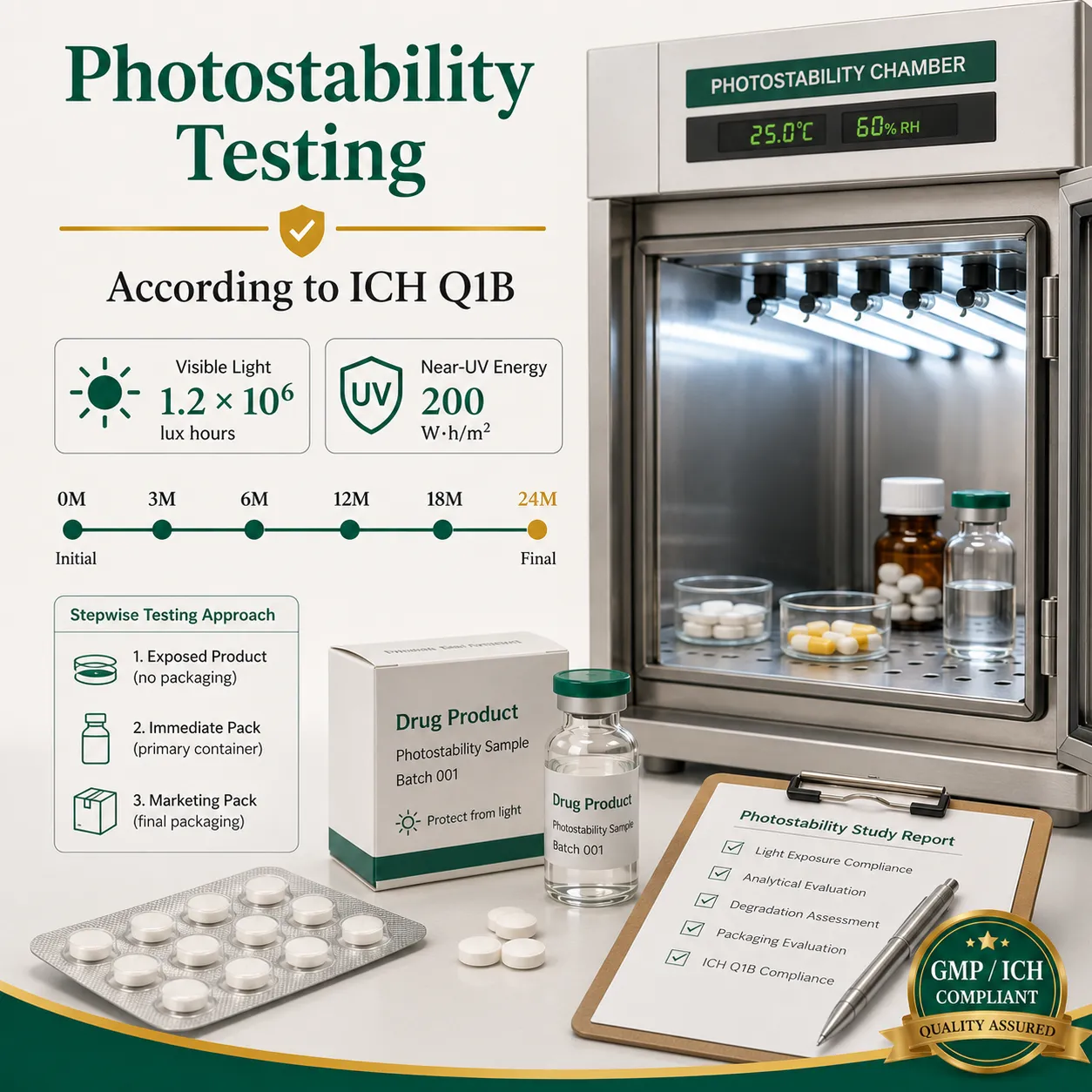
Photostability testing according to ICH Q1B evaluates whether exposure to visible and ultraviolet light causes unacceptable changes in a drug substance or drug product. The guideline requires exposure to at least 1.2 × 10⁶ lux hours of visible light and 200 W·h/m² of near-UV energy to assess product stability, packaging protection, and regulatory compliance.
Introduction
Light is a significant environmental factor that can affect pharmaceutical products throughout manufacturing, storage, distribution, and patient use. Exposure to visible and ultraviolet (UV) radiation may trigger chemical degradation, discoloration, potency loss, impurity formation, or changes in dissolution performance.
To ensure product quality and patient safety, regulatory authorities require manufacturers to assess the effects of light on new drug substances and drug products. The globally accepted framework for these evaluations is ICH Q1B: Photostability Testing of New Drug Substances and Products.
ICH Q1B establishes standardized testing conditions, exposure requirements, and evaluation criteria that help determine whether a product requires special packaging, labeling, or formulation modifications to protect it from light-induced degradation.
This guide explains the scientific principles, testing approach, regulatory expectations, practical implementation, and GMP considerations for photostability testing under ICH Q1B.
What Is Photostability Testing?
Photostability testing evaluates the susceptibility of a drug substance or drug product to degradation when exposed to light.
The objectives are to:
- Determine intrinsic photosensitivity
- Identify photodegradation pathways
- Assess packaging protection
- Support shelf-life assignments
- Establish storage recommendations
- Ensure patient safety
Why Photostability Testing Is Important
Light-induced degradation may cause:
| Potential Effect | Product Impact |
|---|---|
| Assay reduction | Loss of potency |
| Impurity formation | Increased safety risk |
| Color changes | Appearance defects |
| Dissolution changes | Reduced performance |
| API degradation | Reduced efficacy |
| Packaging interaction | Product instability |
Photostability studies help identify these risks before commercialization.
Overview of ICH Q1B
ICH Q1B provides harmonized requirements for evaluating the effects of light on pharmaceutical products.
Key Objectives
✓ Assess intrinsic photosensitivity
✓ Evaluate protective packaging
✓ Determine storage recommendations
✓ Support regulatory submissions
✓ Maintain product quality throughout shelf life
ICH Q1B Light Exposure Requirements
To demonstrate adequate photostability, samples must receive minimum specified light exposure.
Confirmatory Exposure Conditions
| Exposure Type | Minimum Requirement |
|---|---|
| Visible Light | ≥ 1.2 × 10⁶ lux hours |
| Near-UV Energy | ≥ 200 W·h/m² |
Both exposure requirements must be achieved during testing.
Understanding Lux Hours
Lux hours represent cumulative visible light exposure.
Example
| Illumination Level | Exposure Time |
|---|---|
| 20,000 lux | 60 hours |
| 10,000 lux | 120 hours |
| 5,000 lux | 240 hours |
Each scenario provides approximately 1.2 × 10⁶ lux hours.
Stepwise Testing Approach Under ICH Q1B
ICH Q1B recommends a sequential testing strategy.
Step 1: Test Product Outside Packaging
The product is removed from its container and directly exposed to light.
Examples
- Tablets in Petri dishes
- Capsules on trays
- Powder samples in open containers
Objective
Determine intrinsic photosensitivity of the formulation.
Step 2: Test Product in Immediate Container
If unacceptable changes occur during Step 1, testing continues using the immediate packaging.
Examples
| Product | Immediate Container |
|---|---|
| Tablets | Blister pack |
| Capsules | HDPE bottle |
| Injection | Glass vial |
| Suspension | Plastic bottle |
Objective
Evaluate protection provided by primary packaging.
Step 3: Test Product in Final Marketing Pack
If degradation still occurs, testing proceeds using the marketed package.
Examples
- Cartons
- Secondary packaging
- Opaque overwraps
- Light-protective pouches
Objective
Demonstrate that commercial packaging provides adequate protection.
Acceptable Light Sources Under ICH Q1B
The guideline allows two primary approaches.
Option 1: Xenon or Metal Halide Lamp
Characteristics
- Produces visible and UV light
- Simulates natural daylight
- Uses appropriate filters
Advantages
- Broad spectrum exposure
- Efficient testing
Option 2: Fluorescent Lamp Combination
Configuration
| Lamp Type | Purpose |
|---|---|
| Cool White Fluorescent | Visible light |
| Near-UV Fluorescent | UV exposure |
Near-UV lamps should emit predominantly between:
320–400 nm
Study Design Considerations
Sample Selection
Testing should include:
- Drug substance
- Drug product
- Representative production batches
Controls
Protected control samples should be included.
Purpose
To distinguish photodegradation from:
- Thermal degradation
- Humidity effects
- Storage-related changes
Sample Orientation
Factors affecting exposure:
- Distance from light source
- Sample thickness
- Product surface area
- Packaging transparency
Evaluation of Photostability Results
After exposure, samples are analyzed using validated methods.
Typical Parameters Evaluated
| Test | Purpose |
|---|---|
| Assay | Potency determination |
| Related Substances | Impurity assessment |
| Dissolution | Performance evaluation |
| Appearance | Color and physical changes |
| Water Content | Moisture assessment |
| Identification | API integrity |
What Constitutes a Significant Change?
ICH Q1B does not define universal acceptance criteria, but significant changes commonly include:
| Observation | Potential Concern |
|---|---|
| Assay loss >5% | Potency reduction |
| New impurity formation | Safety concern |
| Color change | Product appearance issue |
| Dissolution failure | Performance risk |
| Physical instability | Quality defect |
Acceptance criteria should align with approved product specifications.
Practical Example: Tablet Photostability Study
Product
Film-coated antihypertensive tablet
Initial Results
| Parameter | Initial |
|---|---|
| Assay | 100.0% |
| Total Impurities | 0.15% |
| Dissolution | 98% |
After ICH Q1B Exposure
| Parameter | Exposed Sample |
|---|---|
| Assay | 94.0% |
| Total Impurities | 1.2% |
| Dissolution | 92% |
Investigation
Observed:
- Significant assay reduction
- Increased impurities
- Visible discoloration
Root Cause
Photodegradation of API.
CAPA
- Introduced aluminum-aluminum blister packaging.
- Added light-protective carton.
Packaging Strategies for Light-Sensitive Products
When photodegradation occurs, packaging may provide protection.
Common Protective Packaging
| Packaging Type | Protection Level |
|---|---|
| Amber Glass Bottles | High |
| Opaque HDPE Containers | High |
| Alu-Alu Blisters | Excellent |
| PVC Blisters | Moderate |
| Clear Glass Containers | Limited |
GMP Considerations for Photostability Studies
Photostability testing must follow GMP principles.
Documentation Requirements
Maintain:
- Approved protocols
- Exposure records
- Calibration certificates
- Analytical data
- Trend reports
- Final conclusions
Data Integrity Requirements
Photostability studies should comply with ALCOA+ principles:
✓ Attributable
✓ Legible
✓ Contemporaneous
✓ Original
✓ Accurate
✓ Complete
✓ Consistent
✓ Enduring
✓ Available
Equipment Qualification
Light exposure systems should be:
- IQ qualified
- OQ qualified
- PQ qualified
- Calibrated periodically
Regulatory Expectations
ICH Q1B
Primary global guideline governing photostability studies.
FDA Expectations
Photostability data are typically included within:
- NDA submissions
- ANDA submissions
- Stability sections
FDA reviewers assess packaging adequacy and degradation risks.
EMA Expectations
EMA follows ICH Q1B requirements and expects scientific justification for packaging protection claims.
WHO and PIC/S Expectations
Both emphasize:
- Risk-based stability programs
- Validated methods
- Reliable documentation
- Packaging suitability
Common Inspection Findings
| Observation | Regulatory Concern |
|---|---|
| Inadequate exposure verification | Invalid study |
| Missing controls | Data reliability issues |
| Unqualified light source | Non-compliance |
| Poor documentation | GMP deficiency |
| Incomplete investigations | Weak quality system |
| Insufficient packaging justification | Regulatory questions |
Best Practices for ICH Q1B Compliance
Study Design
✓ Include protected controls
✓ Verify exposure levels
✓ Use validated analytical methods
Packaging Evaluation
✓ Assess primary packaging
✓ Evaluate secondary packaging
✓ Justify protection claims
Documentation
✓ Maintain complete records
✓ Document all deviations
✓ Retain raw data
Quality Systems
✓ Train personnel
✓ Perform internal audits
✓ Review trends regularly
FAQs
1. What is photostability testing according to ICH Q1B?
Photostability testing evaluates whether light exposure causes unacceptable changes in a drug substance or drug product.
2. What light exposure does ICH Q1B require?
At least 1.2 × 10⁶ lux hours of visible light and 200 W·h/m² of near-UV energy.
3. Why is photostability testing important?
It identifies light-induced degradation that may affect product quality, efficacy, and safety.
4. Which products require photostability testing?
New drug substances, drug products, and products submitted for regulatory approval.
5. What light sources are acceptable under ICH Q1B?
Xenon lamps, metal halide lamps, and combinations of cool white and near-UV fluorescent lamps.
6. What is considered a significant photostability change?
Assay loss, impurity increases, discoloration, dissolution changes, or physical instability.
7. Why are protected control samples used?
They help distinguish light-induced changes from other environmental effects.
8. Can packaging be used to prevent photodegradation?
Yes. Amber bottles, opaque containers, and aluminum blisters are commonly used.
9. Does ICH Q1B apply to both drug substances and drug products?
Yes. The guideline covers both APIs and finished pharmaceutical products.
10. What happens if a product fails photostability testing?
Manufacturers may need formulation changes, protective packaging, or additional stability studies.