


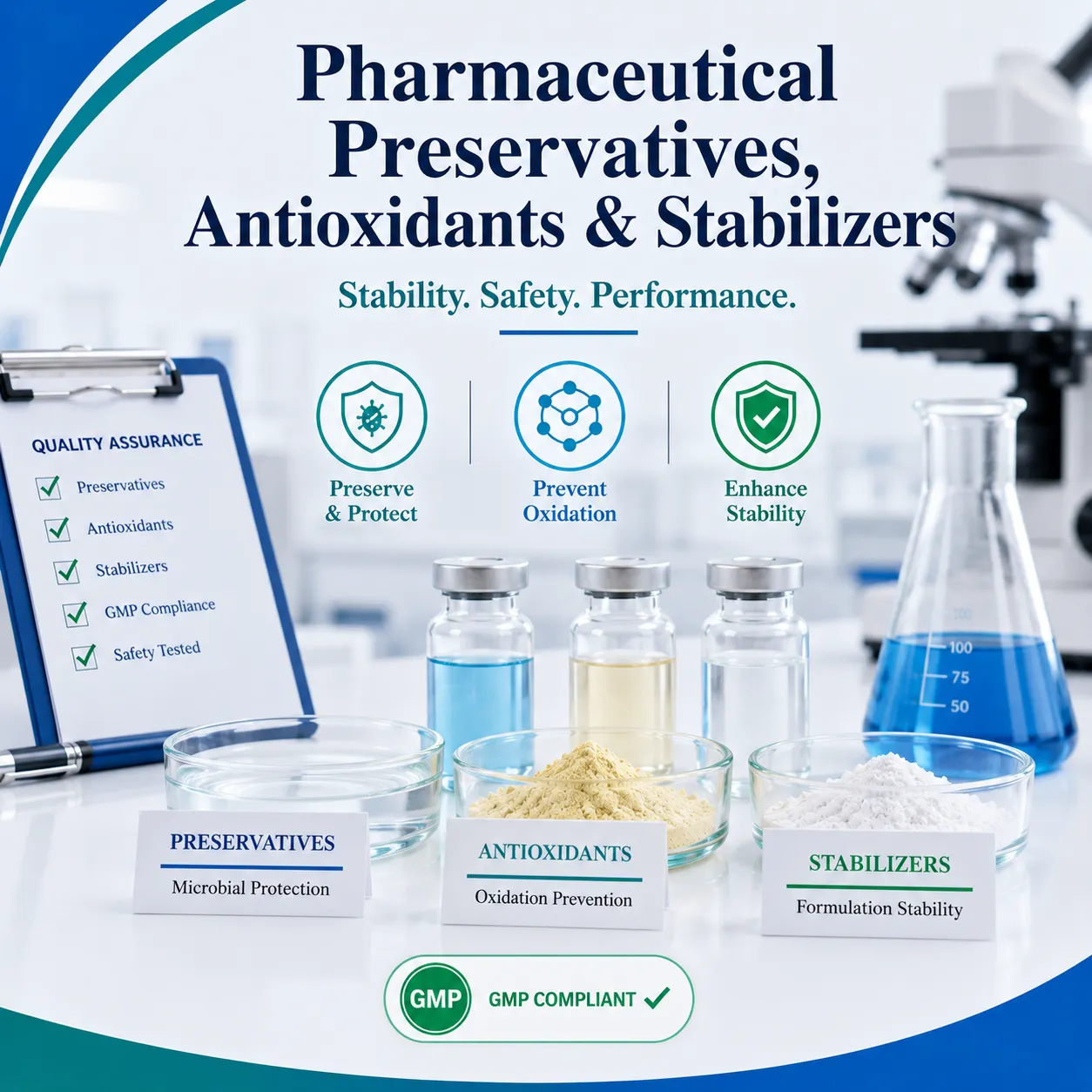

Learn Pharmaceutical Preservatives, Antioxidants & Stabilizers, including functions, selection criteria, GMP requirements, USP <51>, and formulation applications.
Definition
Preservatives, antioxidants, and stabilizers are pharmaceutical excipients added to drug products to protect against microbial contamination, oxidative degradation, and physical or chemical instability. They help maintain product quality, efficacy, safety, and shelf life throughout manufacturing, storage, and patient use.
Preservatives, Antioxidants, and Stabilizers Used in Pharmaceutical Products
Introduction
The stability of a pharmaceutical product is essential for ensuring patient safety, therapeutic effectiveness, and regulatory compliance. During storage and use, formulations can be exposed to microbial contamination, oxidation, hydrolysis, pH shifts, and environmental stressors that may compromise quality.
To overcome these challenges, formulators incorporate preservatives, antioxidants, and stabilizers into pharmaceutical products. These functional excipients protect formulations against microbial growth, chemical degradation, and physical instability, extending shelf life and ensuring consistent product performance.
Whether developing oral liquids, ophthalmic preparations, injectables, emulsions, creams, or inhalation products, selecting the appropriate stabilization system is a critical aspect of pharmaceutical formulation design.
Why Stability Matters in Pharmaceutical Products
A stable drug product should maintain:
- Identity
- Strength
- Purity
- Quality
- Safety
- Performance
Without adequate stabilization, formulations may experience:
- Microbial contamination
- Oxidation
- Discoloration
- Precipitation
- Loss of potency
- Off-odor formation
- Reduced shelf life
Understanding Pharmaceutical Preservatives
What Are Preservatives?
Preservatives are antimicrobial agents added to pharmaceutical formulations to inhibit or prevent microbial growth.
They are particularly important for:
- Oral liquids
- Creams
- Emulsions
- Suspensions
- Ophthalmic products
- Multi-dose injectables
- Nasal preparations
- Inhalation solutions
Preservatives help maintain product integrity throughout storage and repeated use.
Why Preservatives Are Required
Sterile Products
Even products sterilized during manufacturing may require preservatives to maintain sterility after opening.
Examples
- Ophthalmic solutions
- Multi-dose parenterals
- Nasal sprays
Non-Sterile Products
Many aqueous products provide ideal growth conditions for microorganisms.
High-Risk Dosage Forms
| Dosage Form | Microbial Risk |
|---|---|
| Syrups | High |
| Suspensions | High |
| Emulsions | High |
| Creams | Moderate to High |
| Gels | Moderate |
How Preservatives Work
Preservatives interfere with microbial survival through several mechanisms.
Mechanisms of Action
- Cell membrane disruption
- Cytoplasmic leakage
- Protein coagulation
- Enzyme inhibition
- Oxidation of cellular components
- Cell wall synthesis inhibition
These actions prevent microbial growth and proliferation.
Common Pharmaceutical Preservatives
| Preservative | Typical Applications |
|---|---|
| Benzalkonium Chloride | Ophthalmics, Nasal Products |
| Benzethonium Chloride | Topicals |
| Chlorobutanol | Ophthalmics |
| Methylparaben | Oral Liquids, Gels |
| Propylparaben | Creams, Emulsions |
| Phenylmercuric Nitrate | Ophthalmic Products |
| Thimerosal | Vaccines, Specialty Products |
| Sodium Benzoate | Oral Formulations |
| Sorbic Acid | Oral Liquids |
Key Factors in Preservative Selection
Selecting a preservative requires evaluation of multiple formulation variables.
Selection Criteria
pH Compatibility
The preservative should remain largely undissociated at the formulation pH.
Solubility
Adequate concentration must remain in the aqueous phase.
Compatibility
Must not interact with:
- APIs
- Excipients
- Containers
- Closures
Patient Safety
Should be:
- Non-toxic
- Non-irritating
- Non-sensitizing
Stability
Must remain effective throughout shelf life.
Preservative Effectiveness Testing (USP <51>)
Purpose
USP General Chapter <51> evaluates whether antimicrobial preservatives adequately protect pharmaceutical products.
Challenge Organisms
- Candida albicans
- Aspergillus niger
- Escherichia coli
- Pseudomonas aeruginosa
- Staphylococcus aureus
The test demonstrates preservative effectiveness throughout the intended shelf life.
Understanding Pharmaceutical Antioxidants
What Are Antioxidants?
Antioxidants are excipients added to formulations to prevent or slow oxidative degradation.
Oxidation can result in:
- Potency loss
- Color changes
- Odor development
- Precipitation
- Product instability
Causes of Oxidation
Oxidative degradation may be accelerated by:
- Oxygen exposure
- Light
- Heat
- Trace metals
- Peroxides
- pH changes
Common Pharmaceutical Antioxidants
| Antioxidant | Application |
|---|---|
| Ascorbic Acid | Oral Liquids, Emulsions |
| Ascorbyl Palmitate | Lipid Systems |
| Butylated Hydroxyanisole (BHA) | Ointments |
| Butylated Hydroxytoluene (BHT) | Oils and Fats |
| Propyl Gallate | Emulsions |
| Sodium Bisulfite | Injectable Products |
| Sodium Metabisulfite | Ophthalmics |
| Tocopherol (Vitamin E) | Oil-Based Products |
Best Practices for Oxidation Control
Formulation Strategies
Minimize Oxygen Exposure
- Avoid excessive mixing
- Reduce foaming
- Eliminate vortex formation
Reduce Headspace
Fill containers as completely as possible.
Nitrogen Purging
Replace oxygen with inert gases.
Early Antioxidant Addition
Antioxidants should be incorporated early during compounding.
Stabilizers in Pharmaceutical Products
What Are Stabilizers?
Stabilizers are excipients that maintain physical and chemical integrity throughout a product’s shelf life.
Functions
- Control pH
- Prevent precipitation
- Enhance solubility
- Protect APIs
- Improve compatibility
Role of pH in Stability
pH is among the most critical formulation variables.
Why pH Matters
pH influences:
- Solubility
- Stability
- Absorption
- Drug activity
- Patient comfort
Effects of Incorrect pH
| Problem | Consequence |
|---|---|
| Low Solubility | Precipitation |
| Instability | Degradation |
| Irritation | Poor Patient Compliance |
| Reduced Activity | Lower Efficacy |
Buffer Systems as Stabilizers
Buffers help maintain optimal pH throughout shelf life.
Common Buffers
- Citrate Buffer
- Phosphate Buffer
- Acetate Buffer
- Borate Buffer
Buffers resist pH changes during storage and use.
Chelating Agents: Supporting Stability
Chelating agents enhance antioxidant effectiveness by binding trace metals that catalyze oxidation.
Common Chelators
| Chelating Agent | Application |
|---|---|
| EDTA (Disodium Edetate) | Ophthalmics |
| Citric Acid | Oral Formulations |
| Sodium Citrate | Buffers |
Dosage Form-Specific Considerations
Emulsions
Challenges:
- Preservative partitioning into oil phase
- Oxidation of oils
Recommended preservatives:
- Methylparaben
- Propylparaben
Recommended antioxidants:
- BHT
- BHA
- Tocopherol
Ophthalmic Products
Requirements:
- Minimal irritation
- Broad antimicrobial activity
- High compatibility
Common preservatives:
- Benzalkonium Chloride
- Chlorobutanol
- Phenylmercuric Nitrate
Common antioxidants:
- Sodium Metabisulfite
- EDTA
Oral Inhalation Products
Considerations:
- Sterility
- Patient tolerance
- Foam control
Only the minimum effective preservative concentration should be used.
Parenteral Products
Multi-dose vials require antimicrobial preservation.
Common Preservatives
- Benzyl Alcohol
- Phenol
- Parabens
Compatibility with:
- APIs
- Containers
- Closures
must be verified.
Ointments and Creams
Common Antioxidants
- BHT
- Propyl Gallate
- Tocopherol
These prevent rancidity of fatty bases.
How to Select Preservatives, Antioxidants, and Stabilizers
Step 1: Evaluate Product Characteristics
Assess:
- Dosage form
- Route of administration
- Water activity
- pH
Step 2: Identify Degradation Risks
Determine susceptibility to:
- Microbial growth
- Oxidation
- Hydrolysis
- pH drift
Step 3: Assess Excipient Compatibility
Review compatibility with:
- API
- Other excipients
- Packaging components
Step 4: Perform Stability Studies
Conduct:
- Accelerated stability testing
- Long-term stability studies
- Preservative effectiveness testing
Step 5: Validate Safety and Performance
Confirm efficacy throughout shelf life.
Practical Example
Multi-Dose Ophthalmic Solution
Challenges
- Sterility maintenance
- Oxidation prevention
- pH control
Selected System
| Function | Excipient |
|---|---|
| Preservative | Benzalkonium Chloride |
| Antioxidant | Sodium Metabisulfite |
| Chelator | EDTA |
| Buffer | Borate Buffer |
Benefits
- Microbial protection
- Oxidative stability
- Controlled pH
- Enhanced shelf life
GMP and Regulatory Insights
Regulatory Expectations
Authorities expect:
- Scientifically justified preservative selection
- Stability-indicating studies
- USP <51> compliance
- Risk assessments
- Shelf-life validation
GMP Considerations
Manufacturers should ensure:
- Raw material qualification
- Preservative effectiveness testing
- Container-closure compatibility
- Change control
- Stability monitoring
ICH Guidelines
Relevant guidance includes:
- ICH Q1A Stability Testing
- ICH Q8 Pharmaceutical Development
- ICH Q9 Quality Risk Management
- ICH Q10 Pharmaceutical Quality Systems
FAQs
1. What are pharmaceutical preservatives?
Preservatives are antimicrobial agents added to formulations to prevent or minimize microbial contamination.
2. Why are preservatives important in ophthalmic products?
They maintain sterility and prevent microbial growth during storage and repeated use.
3. What is USP <51>?
USP <51> is the Preservative Effectiveness Test used to evaluate antimicrobial preservative performance.
4. What are pharmaceutical antioxidants?
Antioxidants are excipients that prevent or slow oxidation of drugs and formulations.
5. Which antioxidants are commonly used in pharmaceuticals?
Ascorbic acid, BHT, BHA, propyl gallate, sodium metabisulfite, and tocopherol.
6. What is the role of EDTA in formulations?
EDTA acts as a chelating agent that binds trace metals and enhances antioxidant effectiveness.
7. Why is pH important for stability?
pH affects solubility, degradation rates, drug activity, absorption, and patient comfort.
8. Which dosage forms commonly require preservatives?
Oral liquids, creams, emulsions, ophthalmics, inhalation solutions, and multi-dose injectables.
9. How are preservatives selected?
Selection depends on pH, compatibility, solubility, safety, efficacy, and dosage form requirements.
10. Can preservatives interact with excipients?
Yes. Preservatives may bind to excipients, surfactants, or packaging materials, reducing effectiveness.