


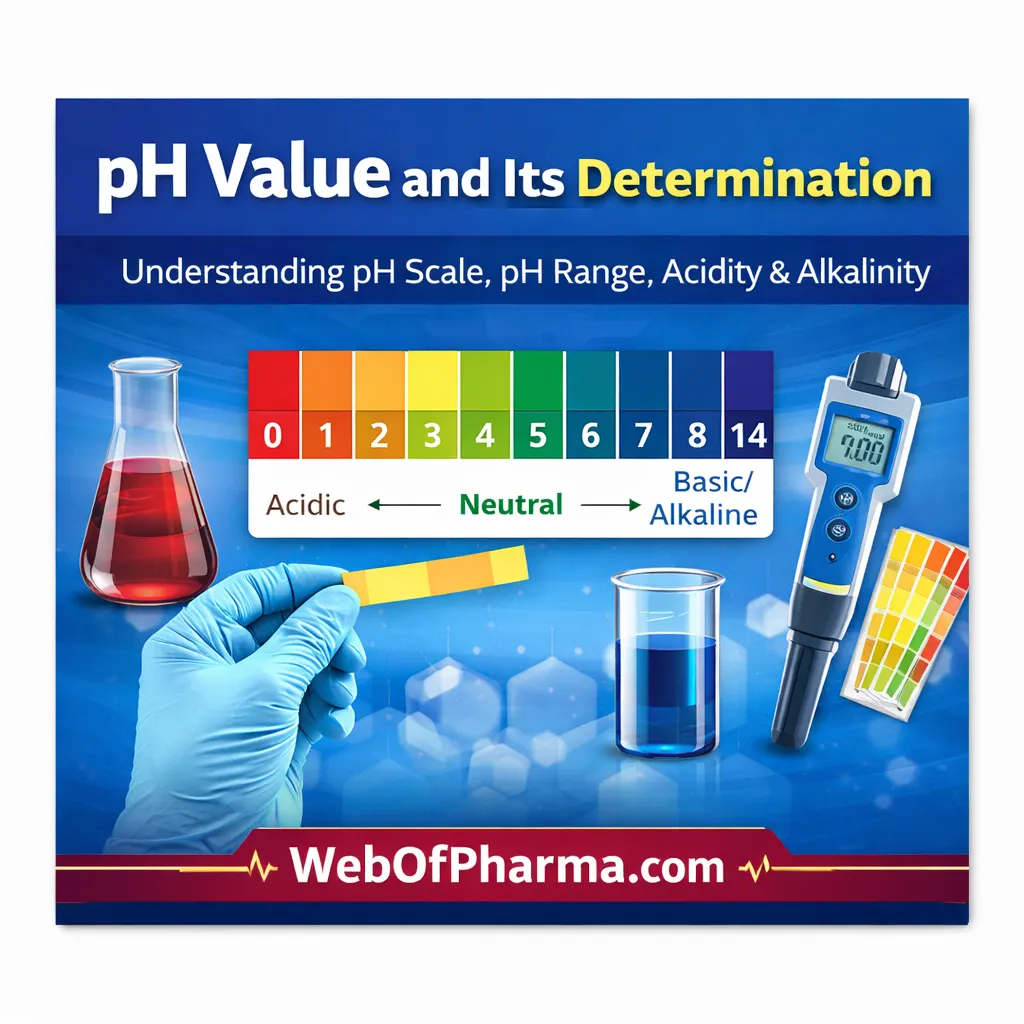

Learn about pH value and its determination between 0 and 14 that shows the alkalinity and acidity of the solution. Understand the pH scale, pH range of solutions, and practical applications in science and pharmaceuticals.
Curiosity is one of the most important traits of a science student. If you remember your chemistry classes, you’ve likely come across the concept of the pH scale and how it measures acidity and alkalinity.
We are often taught that the pH value and its determination between 0 and 14 that shows the alkalinity and acidity of the solution is a standard scientific principle. But have you ever wondered why this range exists—and whether it is always limited to these values?
Let’s explore the concept in a simple and practical way.
What is pH Value?
The pH value of a solution is defined as the negative logarithm (base 10) of the concentration of hydrogen (hydronium) ions present in that solution.
In simpler terms, the pH scale and pH range of solutions help us understand whether a substance is:
- Acidic (pH < 7)
- Neutral (pH = 7)
- Basic/Alkaline (pH > 7)
This measurement plays a critical role in chemistry, biology, environmental science, and especially in the pharmaceutical industry.
Understanding the pH Scale and pH Range of Solutions
The commonly known pH scale ranges from 0 to 14, where:
- 0–6: Acidic solutions
- 7: Neutral solution
- 8–14: Basic (alkaline) solutions
This range is based on typical aqueous solutions under standard conditions, where hydrogen ion concentration varies within predictable limits.
However, it’s important to note that the pH value and its determination between 0 and 14 that shows the alkalinity and acidity of the solution is not an absolute limitation. In highly concentrated or non-aqueous systems, pH values can go below 0 or above 14.
Why is pH Usually Measured Between 0 and 14?
In most laboratory and pharmaceutical applications, solutions are not highly concentrated. Typically, concentrations do not exceed 1M (molar).
- A hydrogen ion concentration of 1M results in pH ≈ 0
- A hydroxide ion concentration of 1M results in pH ≈ 14
This is why the pH scale and pH range of solutions are generally presented between 0 and 14.
However, in extreme chemical environments:
- Strong acids can have pH < 0
- Strong bases can have pH > 14
Factors Affecting pH Value Determination
While calculating pH might seem straightforward, several factors influence accurate results:
1. Ion Activity vs Concentration
Technically, pH depends on hydrogen ion activity, not just concentration. However, concentration is commonly used for practical calculations.
2. Temperature
Temperature significantly impacts pH:
- Changes dissociation of water
- Alters equilibrium constants
- Affects electrode response in pH meters
For example, pure water has a pH of 7 at 25°C, but this value changes with temperature.
3. Nature of the Solution
Highly concentrated or non-aqueous solutions may not follow the standard pH scale and pH range of solutions.
Methods for pH Value Determination
The pH value and its determination between 0 and 14 that shows the alkalinity and acidity of the solution can be measured using different techniques:
1. pH Meter
- Most accurate method
- Measures voltage difference between electrodes
- Provides precise numerical values
2. pH Indicator Paper
- Changes color based on pH
- Gives approximate values
3. pH Strips
- Easy and quick method
- Color comparison with standard chart
Importance of pH in Pharmaceuticals
In the pharmaceutical industry, pH plays a vital role in:
- Drug formulation and stability
- Dissolution and absorption of drugs
- Quality control testing
- Water quality and effluent treatment
Even slight variations in pH can impact drug effectiveness and patient safety.
A practical example is human blood. A small deviation from normal pH levels can indicate serious health issues, as it reflects changes in physiological balance.
Conclusion
The concept of pH value and its determination between 0 and 14 that shows the alkalinity and acidity of the solution is fundamental in science. While the pH scale and pH range of solutions are typically presented between 0 and 14, real-world chemistry can extend beyond these limits under special conditions.
Understanding pH not only strengthens your scientific knowledge but also helps in practical applications, especially in pharmaceuticals, where precision is critical.
Frequently Asked Questions (FAQs)
1. What is the full form of pH?
pH stands for “Potential of Hydrogen.”
2. What does the pH value indicate?
It indicates whether a solution is acidic, neutral, or basic based on hydrogen ion concentration.
3. What is the pH scale and pH range of solutions?
The pH scale ranges from 0 to 14, showing acidity (below 7), neutrality (7), and alkalinity (above 7).
4. How is pH value determined?
It is determined using a pH meter, pH paper, or indicator strips.
5. Why is pH usually between 0 and 14?
Because most aqueous solutions fall within this range under standard conditions.
6. Can pH values go below 0 or above 14?
Yes, in highly concentrated or non-aqueous solutions.
7. What does a pH below 7 mean?
It indicates an acidic solution. Lower values mean stronger acidity.
8. What does a pH above 7 mean?
It indicates a basic (alkaline) solution. Higher values mean stronger alkalinity.
9. What does a neutral pH mean?
A pH of 7 indicates neutrality, where acidity and alkalinity are balanced.
10. Why is pH important in pharmaceuticals?
pH affects drug stability, solubility, absorption, and overall product quality.