


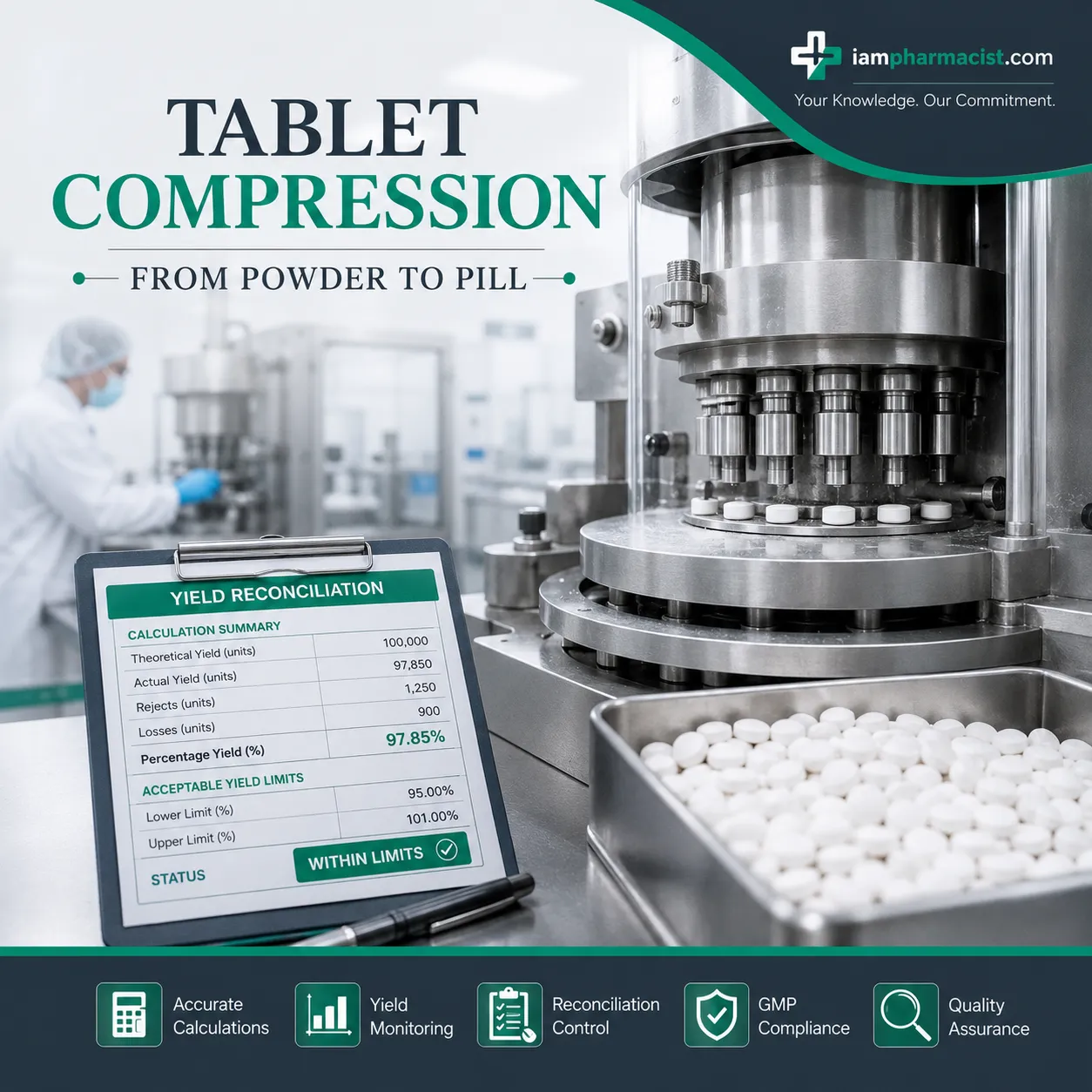

Learn pharmaceutical yield reconciliation calculations, manufacturing loss analysis, acceptable yield limits, and GMP-compliant batch reconciliation procedures.
Definition
Manufacturing loss and yield reconciliation in pharmaceutical production is the GMP process of comparing theoretical quantities against actual quantities produced, consumed, rejected, sampled, and lost to ensure complete material accountability, process efficiency, and product quality compliance.
Pharmaceutical manufacturing involves multiple processing stages, including dispensing, granulation, blending, compression, coating, filling, and packaging. At every stage, small material losses naturally occur due to equipment hold-up, sampling, dust generation, spillage, and processing operations.
To maintain Good Manufacturing Practice (GMP) compliance, manufacturers must perform yield calculations and material reconciliation to ensure that every gram of raw material and every finished unit is accounted for.
Yield reconciliation serves as a critical quality system that helps detect:
- Material mix-ups
- Process inefficiencies
- Excessive manufacturing losses
- Packaging discrepancies
- Potential contamination events
- Documentation errors
This guide explains pharmaceutical yield calculations, manufacturing loss formulas, acceptable yield limits, reconciliation procedures, and GMP expectations.
Why Yield Reconciliation Is Important in Pharmaceutical Manufacturing
Yield reconciliation is more than a mathematical exercise—it is a regulatory requirement designed to maintain product quality and traceability.
Key Objectives
- Verify material accountability
- Measure process efficiency
- Detect abnormal losses
- Prevent product mix-ups
- Ensure batch record accuracy
- Support product release decisions
Regulatory agencies including FDA, EU GMP, WHO GMP, and PIC/S require documented reconciliation throughout manufacturing and packaging operations.
Pharmaceutical Yield & Reconciliation Calculator
Yield Calculation
Manufacturing Loss Calculation
Final Material Reconciliation
Packaging Reconciliation
Results
| Parameter | Result |
|---|---|
| Percentage Yield (%) | – |
| Yield Status | – |
| Manufacturing Line Loss (kg) | – |
| Manufacturing Loss (%) | – |
| Material Accounted For (kg) | – |
| Material Difference (kg) | – |
| Batch Reconciliation Status | – |
| Packaging Reconciliation Status | – |
Understanding Theoretical Yield vs Actual Yield
Theoretical Yield
Theoretical yield represents the quantity expected if the process operates perfectly with no losses.
Example
Batch formula:
100 kg
Expected output:
100 kg
Theoretical Yield = 100 kg
Actual Yield
Actual yield is the quantity physically obtained after manufacturing.
Example
Actual output:
97.8 kg
Actual Yield = 97.8 kg
Percentage Yield Calculation
Percentage yield measures manufacturing efficiency.
Formula
Percentage Yield (%)=(Theoretical QuantityActual Quantity Produced)×100
Example
Theoretical Yield:
100 kg
Actual Yield:
97.8 kgYield=(10097.8)×100 =97.8%
Result
| Parameter | Value |
|---|---|
| Theoretical Yield | 100 kg |
| Actual Yield | 97.8 kg |
| Percentage Yield | 97.8% |
Manufacturing Line Loss Calculation
Manufacturing loss represents material that is not recoverable due to processing operations.
Common sources include:
- Equipment hold-up
- Dust generation
- Product transfer losses
- Sampling
- Filter retention
- Spillage
Formula
Line Loss=Quantity Before Processing−Quantity After Processing
Example
Material before blending:
100 kg
Material after blending:
98.5 kg100−98.5=1.5 kg
Line Loss = 1.5 kg
Manufacturing Loss Percentage
Formula
Loss %=(Input QuantityLine Loss)×100
Example
1001.5×100=1.5%
Acceptable Yield Limits in Pharmaceutical Manufacturing
Yield limits are generally defined within the Master Batch Record (MBR), process validation reports, or approved SOPs.
Common Industry Standards
| Manufacturing Stage | Acceptable Yield |
|---|---|
| Granulation | 95.0–102.0% |
| Blending | 95.0–102.0% |
| Compression | 95.0–101.0% |
| Encapsulation | 95.0–101.0% |
| Coating | 95.0–101.0% |
| Filling Operations | 95.0–101.0% |
| Packaging | 98.0–101.0% |
API Loss Acceptance
For high-value active pharmaceutical ingredients:
| Material Type | Typical Loss Limit |
|---|---|
| API | ≤ 0.5% |
| Excipients | Site-specific |
| Packaging Components | Per approved reconciliation limits |
Exceeding these limits generally triggers a deviation investigation.
Yield Reconciliation Process
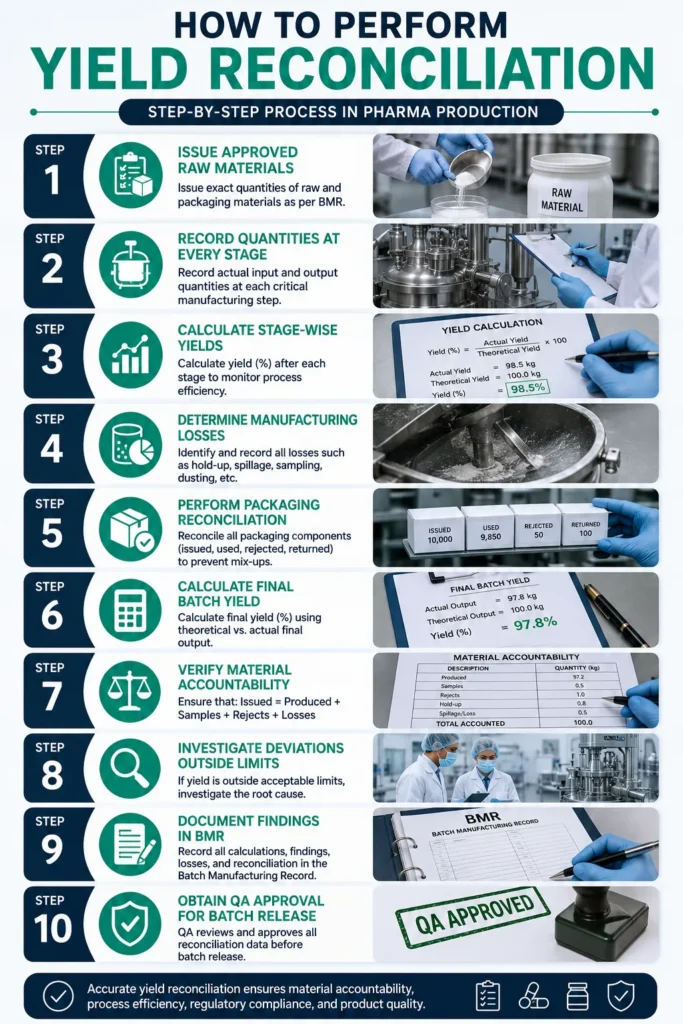
Step 1: Material Issuance
Stores and dispensing personnel issue approved quantities according to the Batch Manufacturing Record (BMR).
Verify
- Material code
- Batch number
- Quantity issued
- Expiry status
Step 2: Record In-Process Yields
Production records actual quantities after each stage.
Examples
- Wet granulation yield
- Dried granule yield
- Blend yield
- Compression yield
- Coating yield
Step 3: Calculate Stage-Wise Yield
Example
| Process Stage | Input (kg) | Output (kg) | Yield (%) |
|---|---|---|---|
| Granulation | 100 | 98.8 | 98.8 |
| Blending | 98.8 | 98.3 | 99.5 |
| Compression | 98.3 | 97.5 | 99.2 |
Step 4: Packaging Reconciliation
Packaging reconciliation is one of the most critical GMP controls.
Reconcile
- Printed cartons
- Labels
- Inserts
- Foils
- Bottles
- Caps
- Finished packs
Packaging Reconciliation Formula
Issued=Used+Returned+Rejected
Example
| Component | Quantity |
|---|---|
| Labels Issued | 10,000 |
| Used | 9,850 |
| Rejected | 50 |
| Returned | 100 |
| Total | 10,000 |
Step 5: Final Batch Reconciliation
At batch completion:
Formula
Material Accountability=Produced+Rejected+Samples+Losses
must equalTotal Issued
Practical Yield Reconciliation Example
Tablet Batch
Raw Material Issued
100 kg
Manufacturing Results
| Description | Quantity (kg) |
|---|---|
| Finished Product | 97.2 |
| Process Samples | 0.5 |
| Rejects | 1.0 |
| Equipment Hold-Up | 0.8 |
| Spillage | 0.5 |
| Total Accounted | 100.0 |
Reconciliation
97.2+0.5+1.0+0.8+0.5=100.0
Result:
✅ Fully reconciled batch
Investigation of Yield Deviations
Yields outside approved limits require immediate investigation.
Low Yield Causes
- Excessive dust generation
- Equipment malfunction
- Product sticking
- Incorrect process parameters
- Unrecorded spillage
High Yield Causes
- Weighing errors
- Incorrect calculations
- Moisture gain
- Double counting
- Documentation mistakes
GMP Actions for Out-of-Limit Yield
If yield falls outside approved limits:
Required Actions
- Quarantine batch.
- Notify QA.
- Open deviation record.
- Perform root cause investigation.
- Assess product quality impact.
- Implement corrective actions.
- Obtain QA approval before release.
Regulatory Expectations
FDA Expectations
21 CFR Part 211 requires:
- Accurate production records
- Yield calculations
- Investigation of discrepancies
EU GMP Requirements
Manufacturers must:
- Record yields at critical stages
- Investigate unexpected deviations
- Reconcile printed packaging materials
WHO GMP Expectations
Batch documentation must demonstrate complete accountability of:
- Raw materials
- Intermediate products
- Bulk products
- Packaging materials
Best Practices for Yield Reconciliation
Maintain Stage-Wise Yield Monitoring
Track yields after every major process step.
Establish Historical Trends
Use statistical data to identify abnormal losses.
Validate Equipment Losses
Determine hold-up quantities during process validation.
Strengthen Documentation Controls
Ensure accurate recording within BMR and packaging records.
Implement Independent Verification
QA review minimizes reconciliation errors.
Common Reconciliation Errors to Avoid
| Error | Potential Impact |
|---|---|
| Missing loss entries | Incomplete accountability |
| Incorrect yield formula | False compliance |
| Unrecorded samples | Reconciliation mismatch |
| Packaging count errors | Product mix-up risk |
| No investigation of deviations | GMP observations |
SEO FAQs
1. What is yield reconciliation in pharmaceutical manufacturing?
Yield reconciliation is the process of comparing theoretical quantities with actual quantities produced, rejected, sampled, and lost during manufacturing.
2. Why is yield reconciliation important?
It ensures material accountability, process control, GMP compliance, and detection of unusual losses.
3. How is percentage yield calculated?
Percentage yield equals actual yield divided by theoretical yield multiplied by 100.
4. What is manufacturing line loss?
Line loss is the quantity of material lost due to equipment hold-up, sampling, transfer losses, or spillage.
5. What are acceptable pharmaceutical yield limits?
Most manufacturing stages operate within 95–102%, while packaging typically ranges from 98–101%.
6. Why are packaging materials reconciled?
To prevent label mix-ups, product misidentification, and counterfeit risks.
7. What happens if yield exceeds 100%?
An investigation is required to determine causes such as weighing errors, moisture gain, or documentation mistakes.
8. What GMP documents contain yield data?
Batch Manufacturing Records (BMRs), Batch Packaging Records (BPRs), and reconciliation logs.
9. Who reviews reconciliation calculations?
Production personnel perform calculations, while QA independently reviews and approves them.
10. What should be done when reconciliation fails?
The batch should be quarantined and investigated through the deviation management system.