


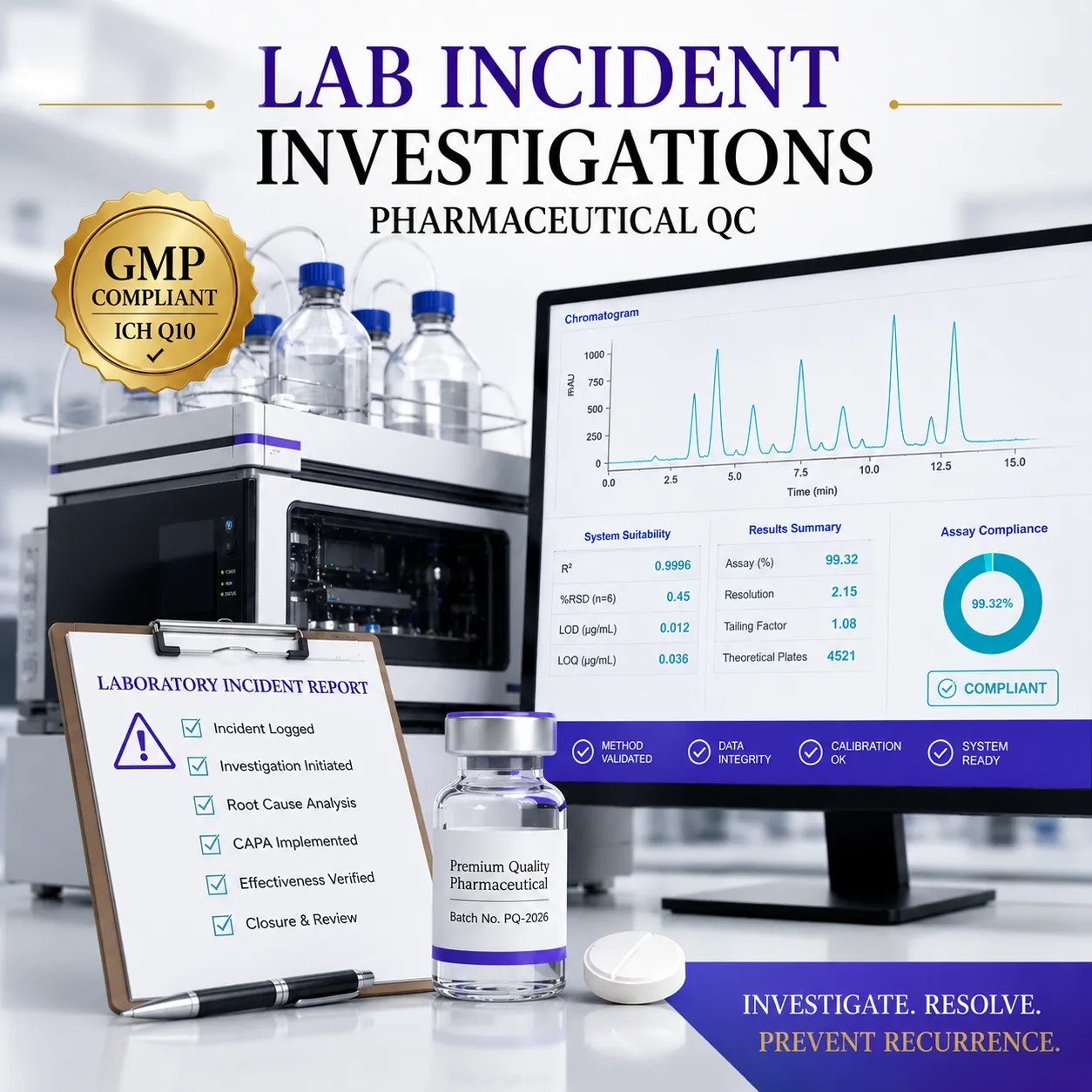

Learn how to investigate laboratory incidents in pharmaceutical QC, implement CAPA, ensure data integrity, and maintain GMP compliance.
Definition
A laboratory incident investigation in pharmaceutical quality control (QC) is a documented process used to identify, assess, investigate, and resolve unplanned events occurring during laboratory activities that may affect product quality, data integrity, safety, or regulatory compliance. Effective investigations determine root causes, implement corrective and preventive actions (CAPA), and ensure compliance with GMP, GLP, FDA, and ICH requirements.
Introduction
Pharmaceutical Quality Control laboratories generate the scientific data that supports product release decisions, stability studies, regulatory submissions, and ongoing product quality monitoring. Because of this critical role, any laboratory error, procedural deviation, equipment malfunction, or documentation discrepancy must be investigated thoroughly.
A laboratory incident refers to any unplanned or unintended event occurring during analytical activities that may impact data integrity, product quality, patient safety, or regulatory compliance. While some incidents may appear minor, recurring laboratory errors often indicate deeper systemic weaknesses involving procedures, training, equipment, or quality oversight.
A robust laboratory incident investigation system helps organizations identify root causes, prevent recurrence, strengthen compliance, and maintain confidence in analytical results.
What Is a Laboratory Incident?
A laboratory incident is any unexpected event occurring during testing, sample preparation, documentation, or instrument operation that may affect the reliability of analytical data.
Common Sources of Laboratory Incidents
| Category | Examples |
|---|---|
| Human Error | Incorrect weighment, dilution errors, transcription mistakes |
| Equipment Issues | HPLC failure, GC leakage, power interruption |
| Method Deviations | Incorrect STP followed, missed procedural steps |
| Documentation Errors | Missing entries, incorrect calculations |
| Sample Handling Issues | Improper storage, contamination |
| Data Integrity Events | Unrecorded changes, unauthorized modifications |
| Environmental Factors | Utility failures, temperature excursions |
Objectives of Laboratory Incident Investigations
A structured investigation process aims to:
- Protect product quality
- Ensure patient safety
- Maintain data integrity
- Identify root causes
- Implement corrective actions
- Prevent recurrence
- Support GMP and GLP compliance
- Improve laboratory performance
Laboratory Incident Numbering System
Many pharmaceutical organizations use a unique numbering system to maintain traceability.
Example Format
QC/LI/YY-XXX
Breakdown
| Element | Description |
|---|---|
| QC | Quality Control Department |
| LI | Laboratory Incident |
| YY | Year |
| XXX | Sequential Number |
Example
QC/LI/25-001
Represents the first laboratory incident reported in the QC department during 2025.
Common Laboratory Incidents in Pharmaceutical QC
Documentation-Related Incidents
- Missing entries in logbooks
- Incomplete worksheets
- Incorrect calculations
- Missing signatures
- Wrong batch information
Analytical Procedure Deviations
- Incorrect STP used
- Special notes not followed
- Incorrect sample storage conditions
- Failure to equilibrate chromatographic column
- Incorrect sonication conditions
Sample Preparation Errors
| Incident | Potential Impact |
|---|---|
| Incorrect standard used | Invalid results |
| Wrong reagent used | Analytical bias |
| Incorrect mobile phase | Retention time changes |
| Wrong volumetric flask | Calculation errors |
| Incorrect filtration | Sample contamination |
Instrument-Related Incidents
HPLC/GC Examples
- Vial not positioned properly
- Wrong sequence entered
- Leakage at column inlet
- Retention time shifting
- High system pressure
- Solvent delivery interruption
- Instrument power failure
Dissolution Testing Incidents
- Incorrect shaft height
- Wrong apparatus selected
- Incorrect dissolution medium
- Sampling outside specified time
- Missing correction volume adjustment
Incident Reporting Procedure
Step 1: Immediate Identification
Upon discovering an incident, the analyst should:
- Stop affected activities if necessary
- Preserve all relevant records
- Inform the supervisor immediately
Documentation Required
- Raw data
- Worksheets
- Chromatograms
- Spectra
- Weight slips
- Instrument logs
Step 2: Record the Incident
The analyst completes an Incident Report Form and records:
- Date and time
- Description of event
- Test involved
- Instrument used
- Potential impact assessment
Best Practice
Document facts only and avoid assumptions.
Step 3: Incident Logbook Entry
All incidents should be entered into a centralized Laboratory Incident Logbook.
Benefits
- Trending analysis
- Compliance tracking
- Audit readiness
- Recurrence monitoring
Investigation Process
Roles and Responsibilities
| Role | Responsibility |
|---|---|
| Analyst | Report incident |
| Supervisor | Initial assessment |
| Reviewer | Technical evaluation |
| GLP In-Charge | Investigation oversight |
| Quality Unit | Final review and approval |
Investigation Checklist
The reviewer and GLP In-Charge should evaluate:
Personnel Factors
- Training records
- Competency status
- Workload assessment
Method Factors
- Correct STP followed
- Method suitability
- Calculation verification
Equipment Factors
- Calibration status
- Maintenance records
- Audit trail review
Material Factors
- Reagents
- Standards
- Columns
- Glassware
Environmental Factors
- Temperature
- Humidity
- Utility performance
Root Cause Analysis
A proper investigation focuses on identifying the true root cause rather than assigning blame.
Common Root Cause Tools
| Tool | Purpose |
|---|---|
| 5 Whys | Drill down to root cause |
| Fishbone Diagram | Categorize contributing factors |
| Fault Tree Analysis | Analyze event pathways |
| Risk Assessment | Determine impact severity |
Example Root Cause Investigation
Incident
Incorrect mobile phase composition prepared for HPLC analysis.
Immediate Cause
Analyst selected wrong preparation worksheet.
Root Cause
Two nearly identical worksheet versions existed simultaneously.
Corrective Action
Remove obsolete worksheet.
Preventive Action
Implement electronic document control system.
Classification of Laboratory Incidents
Organizations often classify incidents into two categories.
Ordinary Events
Minor incidents with limited impact.
Examples
- Instrument aborted during analysis
- Bracketing standard failure
- Temporary power interruption
- Sequence entry error identified before injection
Significant Events
Events potentially affecting product quality or data reliability.
Examples
| Significant Event | Risk Level |
|---|---|
| OOS Result | High |
| OOT Result | High |
| STP Revision Required | High |
| Specification Revision | High |
| Data Integrity Concern | Critical |
| Invalid Analytical Method | Critical |
Corrective and Preventive Actions (CAPA)
After identifying the root cause, CAPAs must be implemented.
Corrective Actions
Address immediate issues.
Examples:
- Retrain analyst
- Repair equipment
- Correct documentation
- Repeat analysis
Preventive Actions
Prevent recurrence.
Examples:
- SOP revision
- Additional training
- Enhanced review process
- Automated controls
Handling Invalidated Data
When an incident compromises data validity:
Required Actions
- Mark affected records as “INVALIDATED”
- Record justification
- Archive with incident report
- Maintain traceability
Documents to Invalidate
- Chromatograms
- Worksheets
- Spectra
- Weight slips
- Instrument printouts
Practical Examples of Laboratory Incidents
Example 1: Incorrect Weighment
Incident
Analyst accidentally weighs 120 mg instead of 100 mg.
Investigation
Balance functioning correctly.
Root Cause
Calculation worksheet not reviewed.
CAPA
Independent verification step added.
Example 2: Missing Logbook Entry
Incident
HPLC usage entry omitted.
Investigation
No evidence of malicious intent.
Root Cause
Training gap.
CAPA
Refresher training and periodic audits.
Example 3: HPLC Retention Time Shift
Incident
Unexpected retention time change.
Investigation
Column temperature not stabilized.
Root Cause
Equilibration procedure not followed.
CAPA
STP revised to emphasize equilibration requirements.
Technology and Digital Incident Management
Modern QC laboratories increasingly use:
- Electronic Incident Reporting Systems
- Laboratory Information Management Systems (LIMS)
- Electronic Quality Management Systems (eQMS)
- Automated CAPA Tracking
- Audit Trail Monitoring Tools
Benefits
| Benefit | Outcome |
|---|---|
| Faster reporting | Improved response time |
| Better traceability | Stronger compliance |
| Trending analysis | Proactive risk management |
| Electronic workflows | Improved efficiency |
GMP and Regulatory Expectations
Relevant Regulations
FDA
- 21 CFR 211.160
- 21 CFR 211.192
- 21 CFR 211.194
EU GMP
- Chapter 6 Quality Control
- Chapter 4 Documentation
ICH Guidelines
- ICH Q9(R1) Quality Risk Management
- ICH Q10 Pharmaceutical Quality System
WHO GMP
- Laboratory investigation requirements
- Data integrity controls
Best Practices for Effective Laboratory Incident Management
✔ Encourage immediate reporting
✔ Promote a no-blame quality culture
✔ Investigate root causes thoroughly
✔ Trend recurring incidents
✔ Implement effective CAPA
✔ Strengthen analyst training
✔ Utilize electronic systems where possible
✔ Review incident metrics during management review
✔ Integrate investigations into continuous improvement programs
✔ Ensure Quality Unit oversight
Conclusion
Laboratory incident investigations are a fundamental component of pharmaceutical quality systems. Whether involving analytical errors, instrument failures, documentation discrepancies, or procedural deviations, every incident provides an opportunity to strengthen laboratory controls and improve compliance.
An effective investigation program not only protects product quality and patient safety but also demonstrates a company’s commitment to GMP, data integrity, and continuous improvement. Organizations that establish robust reporting, root cause analysis, CAPA management, and trending systems are better equipped to prevent recurrence and maintain regulatory confidence.
FAQs
1. What is a laboratory incident in pharmaceutical QC?
A laboratory incident is any unplanned event during analytical activities that may affect product quality, safety, data integrity, or regulatory compliance.
2. How should laboratory incidents be reported?
Incidents should be documented immediately in an incident report form and recorded in a controlled incident logbook.
3. Who investigates laboratory incidents?
Typically, the reviewer, supervisor, GLP In-Charge, and Quality Unit participate in the investigation process.
4. What is the purpose of laboratory incident investigations?
To identify root causes, assess impact, implement CAPA, and prevent recurrence.
5. What is the difference between ordinary and significant incidents?
Ordinary incidents have limited impact, while significant incidents may affect product quality, data integrity, or patient safety.
6. What are common laboratory incidents?
Equipment failures, incorrect weighments, documentation errors, method deviations, and sample preparation mistakes.
7. Why is root cause analysis important?
It identifies underlying causes rather than symptoms, enabling effective preventive actions.
8. What happens to invalidated analytical data?
It must be clearly marked as invalidated, justified, archived, and retained for traceability.
9. How can laboratories reduce recurring incidents?
Through training, procedural improvements, CAPA implementation, and incident trending.
10. What regulations govern laboratory investigations?
FDA 21 CFR Part 211, EU GMP Chapters 4 and 6, ICH Q9, ICH Q10, and WHO GMP guidelines.