


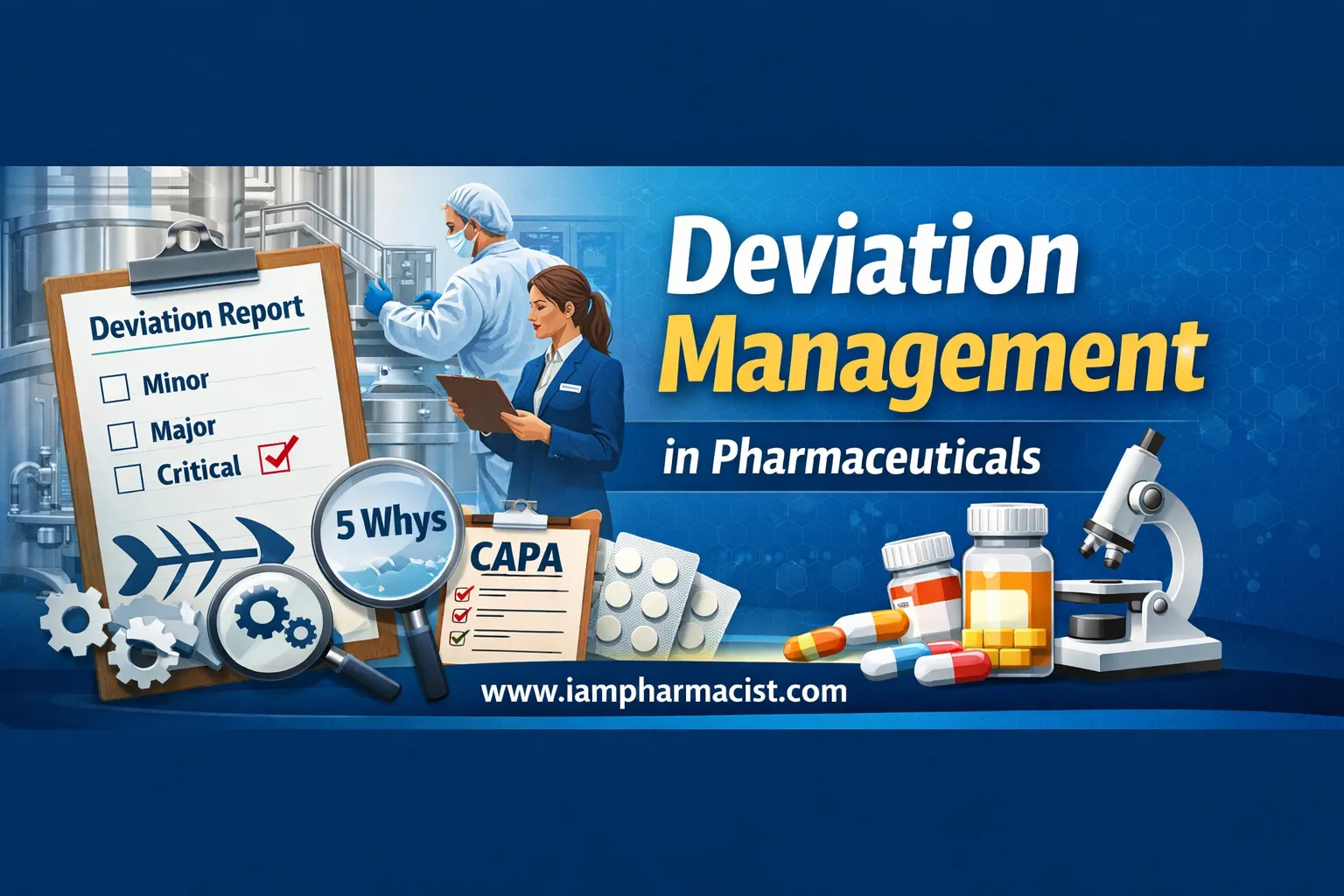

Learn the complete process of Deviation Management in Pharmaceuticals including SOP procedures, types of deviations, root cause investigation, CAPA implementation, and compliance with GMP standards.
Deviation Management in Pharmaceuticals: Complete SOP Guide
Deviation Management in Pharmaceuticals is a critical component of current Good Manufacturing Practices (cGMP) that ensures product quality, regulatory compliance, and patient safety. Any deviation from approved procedures, specifications, or standard operating procedures must be documented, investigated, and resolved through corrective and preventive actions.
This guide explains the standard operating procedure (SOP) for handling deviations within pharmaceutical manufacturing, quality control, and warehousing environments.
1. Purpose
The purpose of Deviation Management in Pharmaceuticals is to establish a systematic approach for identifying, documenting, and resolving deviations from approved procedures.
The objectives include:
1.1 Reporting and Analysis
To ensure proper reporting and analysis of any deviation from established SOPs, analytical procedures, or specifications.
1.2 Corrective and Preventive Actions
To implement corrective and preventive actions (CAPA) that minimize the risk of recurrence and maintain compliance with GMP standards.
2. Scope
This procedure applies to all departments involved in pharmaceutical product quality, including:
- Warehousing
- Manufacturing
- Quality Control (QC)
- Quality Assurance (QA)
These departments play a critical role in ensuring the safety, quality, and consistency of pharmaceutical products.
3. Responsibilities
Effective Deviation Management in Pharmaceuticals requires clear responsibilities across departments.
3.1 Deviation Identification
Any employee who observes a deviation is responsible for initiating a Deviation Report. This may include personnel from:
- Warehouse
- Production
- Quality Control
- Quality Assurance
- Maintenance
- Other relevant departments
3.2 Departmental Notification
The Section In-Charge or Head of Department (HOD) must ensure that the Quality Assurance (QA) department is notified immediately.
3.3 Quality Control Responsibilities
For deviations occurring during testing or calibration procedures, the QC Manager or Senior QC Analyst must generate the Deviation Report promptly.
3.4 Quality Assurance Oversight
The QA Manager is responsible for:
- Stopping work if necessary
- Withholding test reports
- Investigating the deviation
- Approving work resumption
- Ensuring CAPA implementation
- Final closure of the deviation report
3.5 QA Monitoring
QA Officers conduct routine assurance rounds to verify that deviations are reported whenever they occur.
4. Materials and Equipment
Any material, equipment, or system involved in the deviation must be documented and evaluated during the investigation process.
5. Procedure
5.1 Definitions
Understanding deviation types is essential for effective Deviation Management in Pharmaceuticals.
5.1.1 Minor Deviation
A Minor Deviation occurs when the event does not affect product quality, critical process parameters, or critical equipment.
Examples include:
- Failure to follow the FEFO (First Expired First Out) principle in raw material handling
- Use of a balance slightly out of tolerance when determining gross weight
- Temporary pressure differential outside limits in a Class D washing area
- Inadequately trained staff performing warehouse cleaning
- Process temperature briefly outside specification
- Equipment malfunction that does not affect product quality
5.1.2 Major Deviation
A Major Deviation affects product quality attributes or critical process parameters but is unlikely to cause harm to patients or the environment.
Examples include:
- Using an unapproved reference standard for API testing
- Inadequately trained personnel conducting sterility testing
- Production starting without proper line clearance
- Misbehavior during critical aseptic processes
- Operational parameters outside range for non-critical parameters
- Untrained personnel segregating approved and rejected raw materials
5.1.3 Critical Deviation
A Critical Deviation directly impacts product quality and poses a high risk to patient safety.
Examples include:
- Use of expired or rejected API
- Incorrect raw material or quantity used in manufacturing
- Product mislabeling
Such deviations require immediate investigation and corrective action.
5.1.4 Deviation
A Deviation is defined as any non-compliance with approved GMP standards, specifications, or standard operating procedures.
5.1.5 Planned Deviation
A Planned Deviation occurs when a controlled decision is made to perform a process differently than defined in the SOP due to unforeseen circumstances.
Examples include:
- Reprocessing or reworking of a batch
Planned deviations are typically one-time events and must be fully documented and justified.
5.1.6 Unplanned Deviation
An Unplanned Deviation occurs due to unexpected events that cause a process to deviate from the established SOP.
These deviations require investigation and risk assessment.
5.2 Deviation Reporting and Handling System
A structured reporting system ensures traceability and compliance in Deviation Management in Pharmaceuticals.
5.2.1 Deviation Reporting
The person who observes the deviation must immediately complete a Deviation Report Form, including key details about the incident, and submit it to the QA department.
If changes to formulation, packaging, analytical methods, or specifications are required, the deviation report must be linked to a Product Change Request Form.
5.2.2 Deviation Numbering System
The QA department assigns a unique number and records the deviation in the Deviation Log Book.
Example format:
DEV/YY/SR#
Example: DEV/15/001
5.2.3 Handling Planned Deviations
For planned deviations:
- The concerned department provides the root cause and immediate action
- QA Manager approves actions such as:
- Segregation
- Sorting
- Holding
- Reworking
- Retesting
- QA ensures these actions are implemented promptly
Minor deviations may be closed after immediate corrective action without a detailed investigation.
Root Cause Investigation and Risk Assessment
Major and critical deviations require a detailed investigation.
Investigation Methods
The QA Manager assigns an investigation team to determine the root cause using structured tools such as:
1. 5 Whys Analysis
This method involves repeatedly asking “Why?” to identify the underlying cause of a deviation.
2. Ishikawa Fishbone Diagram
This cause-and-effect diagram analyzes contributing factors such as:
- Materials
- Personnel
- Equipment
- Methods
- Environment
- Controls
The most probable cause is tested and confirmed before corrective action is implemented.
Corrective and Preventive Actions (CAPA)
After identifying the root cause, appropriate Corrective and Preventive Actions (CAPA) must be implemented.
These include:
- Defining required actions
- Assigning responsible personnel
- Establishing completion timelines
- Providing documentation proving completion
CAPA effectiveness must also be verified.
Deviation Closure and Follow-Up
Once all corrective and preventive actions are completed:
- QA closes the deviation report
- The deviation logbook is updated
- A follow-up review is conducted within one week to verify effectiveness
Deviation reports related to manufacturing or testing batches are retained in the deviation record file.
Annual Trend Analysis
Quality Assurance performs yearly trend analysis of all deviations to identify recurring issues.
The analysis includes:
- Statistical evaluation
- Graphical representation (bar charts)
- Identification of systemic problems
The final report is submitted to the Executive Director for review and approval.
If a deviation remains open for more than one year, the QA Manager must evaluate the delay. If justified, the existing report may be closed and a new deviation report initiated.
Conclusion
Deviation Management in Pharmaceuticals plays a vital role in maintaining product quality, regulatory compliance, and patient safety. By implementing a structured SOP that includes proper documentation, root cause investigation, and CAPA implementation, pharmaceutical organizations can reduce operational risks and continuously improve their quality systems.
A well-managed deviation system also supports regulatory inspections and strengthens overall pharmaceutical quality management systems (QMS).
Frequently Asked Questions (FAQs)
1. What is Deviation Management in Pharmaceuticals?
Deviation Management in Pharmaceuticals is a structured process used to identify, document, investigate, and correct deviations from approved procedures, specifications, or GMP requirements.
2. What are the types of deviations in pharmaceuticals?
Deviations are typically classified into three types: Minor, Major, and Critical, depending on their impact on product quality and patient safety.
3. What is the difference between planned and unplanned deviation?
A planned deviation is a controlled and documented change from the SOP due to a specific situation, while an unplanned deviation occurs unexpectedly during operations.
4. What tools are used for deviation root cause analysis?
Common tools include 5 Whys analysis, Ishikawa Fishbone diagrams, and Quality Risk Management (QRM) techniques.
5. Why is CAPA important in deviation management?
CAPA ensures that the root cause of a deviation is addressed and preventive measures are implemented to avoid recurrence, improving overall quality and compliance.