


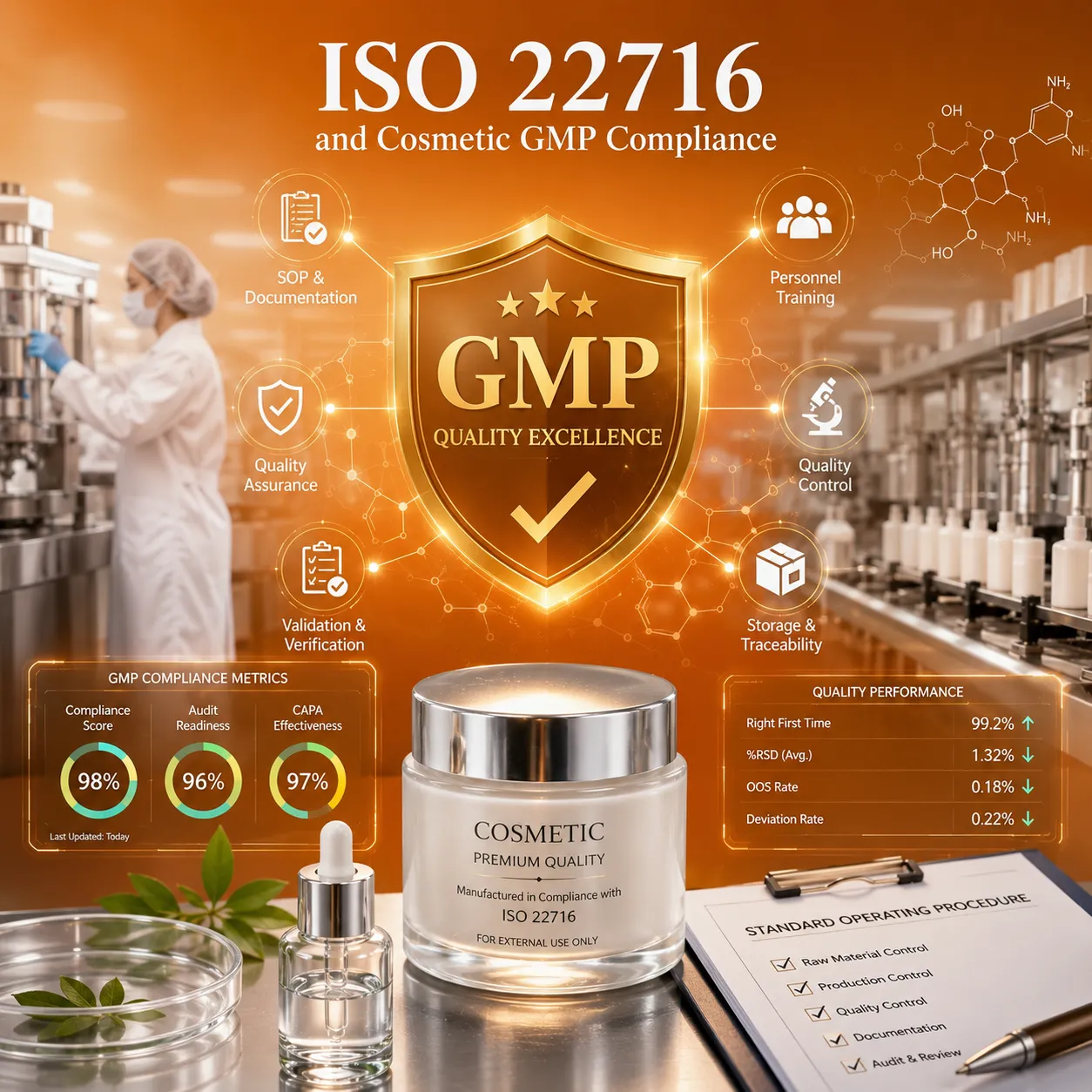

Learn ISO 22716 and Cosmetic GMP Compliance requirements, certification steps, regulatory insights, and best practices for global cosmetic manufacturing.
What is ISO 22716?
ISO 22716 is the internationally recognized Good Manufacturing Practice (GMP) standard for cosmetic products. It provides guidelines for personnel, facilities, equipment, raw materials, production, quality control, storage, and documentation to ensure cosmetic product safety, quality, and regulatory compliance. It is widely used to meet global regulatory requirements, including EU Regulation 1223/2009.
Introduction
As global cosmetic markets become increasingly regulated, manufacturers face growing pressure to demonstrate product safety, consistency, and quality. One of the most widely accepted frameworks for achieving these objectives is ISO 22716, the international standard for Good Manufacturing Practices (GMP) in the cosmetics industry.
Whether you manufacture skincare products, personal care items, fragrances, or beauty products, ISO 22716 provides a structured approach to controlling manufacturing processes, minimizing contamination risks, and ensuring compliance with international regulations.
For organizations exporting products to the European Union and other regulated markets, compliance with ISO 22716 is often essential for market access and regulatory acceptance.
This guide explains the requirements, implementation process, compliance benefits, and practical GMP considerations for cosmetic manufacturers.
What Is ISO 22716?
ISO 22716:2007 provides comprehensive GMP guidelines specifically designed for cosmetic products. Unlike pharmaceutical GMP regulations, which focus on medicinal products, ISO 22716 addresses the unique manufacturing and quality requirements of cosmetic products.
The standard establishes a framework for:
- Quality management
- Personnel hygiene and training
- Facility design
- Equipment qualification and maintenance
- Raw material control
- Production operations
- Quality control testing
- Documentation systems
- Product storage and shipment
- Complaint handling and recalls
Its primary goal is to ensure that cosmetic products are consistently manufactured and controlled according to predefined quality standards.
Why ISO 22716 Matters
Key Business Benefits
| Benefit | Impact |
|---|---|
| Regulatory Compliance | Supports compliance with global cosmetic regulations |
| Product Safety | Reduces contamination and quality risks |
| Consumer Confidence | Demonstrates commitment to quality |
| Global Market Access | Facilitates exports to regulated markets |
| Operational Efficiency | Standardizes manufacturing processes |
| Supplier Management | Improves traceability and material control |
| Audit Readiness | Simplifies regulatory and customer audits |
Regulatory Importance of ISO 22716
European Union Requirements
Under EU Regulation (EC) No. 1223/2009, cosmetic manufacturers must apply GMP principles.
ISO 22716 is recognized as the harmonized standard demonstrating GMP compliance and must be referenced within the product’s:
Product Information File (PIF)
The PIF contains:
- Product description
- Cosmetic Product Safety Report (CPSR)
- Manufacturing method
- GMP evidence
- Product claims substantiation
- Animal testing declarations
Failure to demonstrate GMP compliance can result in:
- Product recalls
- Regulatory actions
- Import restrictions
- Market access limitations
Scope of ISO 22716
Included Activities
| Covered by ISO 22716 | Description |
|---|---|
| Personnel | Training, hygiene, competency |
| Premises | Facility cleanliness and design |
| Equipment | Maintenance and calibration |
| Raw Materials | Receiving, testing, storage |
| Production | Controlled manufacturing processes |
| Quality Control | Product testing and release |
| Documentation | SOPs, records, procedures |
| Storage & Shipment | Product protection and traceability |
| Complaints & Recalls | Investigation and corrective actions |
Excluded Activities
| Not Covered | Reason |
|---|---|
| Research & Development | Outside manufacturing scope |
| Product Distribution After Manufacturer Release | Managed by separate supply chain controls |
Core Requirements of ISO 22716
1. Personnel Management
Employees directly influence product quality and safety.
Requirements
- GMP training programs
- Defined responsibilities
- Personal hygiene procedures
- Health monitoring where applicable
- Competency assessments
Example
A skincare manufacturer conducts annual GMP refresher training and documents employee competency evaluations before authorizing production tasks.
2. Premises and Facilities
Facilities must be designed to minimize contamination risks.
Requirements
- Controlled workflow
- Segregated storage areas
- Cleaning and sanitation procedures
- Pest control programs
- Environmental monitoring
Example
A cosmetic cream manufacturer separates raw material storage from finished goods warehouses to prevent mix-ups.
3. Equipment Control
Manufacturing equipment must consistently perform as intended.
Requirements
- Maintenance schedules
- Cleaning validation
- Calibration records
- Equipment identification
- Breakdown management procedures
Example
Mixing vessels undergo scheduled preventive maintenance and calibration every six months.
4. Raw Material Management
Raw materials directly affect product safety and efficacy.
Requirements
- Approved supplier program
- Incoming material inspections
- Traceability systems
- Quarantine procedures
- Storage controls
Example
Each batch of botanical extracts receives a unique lot number and undergoes identity verification before use.
5. Production Operations
Manufacturing processes must be controlled and documented.
Requirements
- Approved manufacturing instructions
- Batch records
- Process controls
- Deviation management
- Change control procedures
Example
A shampoo manufacturer records processing temperatures and mixing times for every batch.
6. Quality Control
Products must meet predefined specifications before release.
Requirements
- Sampling plans
- Testing procedures
- Product specifications
- Stability evaluations
- Release authorization
Example
Finished facial serums are tested for pH, viscosity, microbial limits, and appearance before market release.
7. Documentation and Recordkeeping
Documentation serves as evidence of GMP compliance.
Essential Documents
| Document Type | Purpose |
|---|---|
| SOPs | Standardized operations |
| Batch Manufacturing Records | Production traceability |
| Training Records | Personnel qualification |
| Audit Reports | Compliance verification |
| CAPA Records | Continuous improvement |
| Calibration Logs | Equipment reliability |
Step-by-Step Guide to ISO 22716 Compliance
Step 1: Conduct a GMP Gap Assessment
Evaluate current operations against ISO 22716 requirements.
Review Areas
- Facility design
- Documentation
- Personnel training
- Production controls
- Quality systems
Step 2: Develop GMP Documentation
Create:
- SOPs
- Work instructions
- Quality manuals
- Forms and templates
- Training materials
Step 3: Train Employees
Ensure staff understand:
- GMP principles
- Hygiene requirements
- Documentation practices
- Deviation reporting
Step 4: Implement Operational Controls
Establish:
- Material management procedures
- Equipment maintenance programs
- Cleaning schedules
- Environmental controls
Step 5: Perform Internal Audits
Assess compliance through periodic audits.
Audit findings should be classified as:
- Critical
- Major
- Minor
- Opportunities for improvement
Step 6: Address Non-Conformities
Implement CAPA programs to eliminate root causes and prevent recurrence.
Step 7: Undergo Third-Party Assessment
An accredited certification body or audit organization reviews compliance and issues a certificate of conformity.
Common providers include:
- SGS
- Bureau Veritas
- TÜV Rheinland
- Control Union
- Intertek
Practical Example: ISO 22716 Implementation
Scenario
A cosmetic company producing moisturizers plans to enter the EU market.
Challenges
- Incomplete SOPs
- Limited traceability
- No formal internal audit process
Actions Taken
| Action | Outcome |
|---|---|
| Developed GMP documentation | Improved process consistency |
| Introduced batch tracking | Full ingredient traceability |
| Conducted staff training | Reduced procedural deviations |
| Established internal audits | Better compliance oversight |
Result
The organization successfully passed an external ISO 22716 audit and gained access to EU distribution channels.
Common ISO 22716 Compliance Challenges
| Challenge | Solution |
|---|---|
| Poor documentation | Implement document control systems |
| Inadequate training | Establish recurring GMP programs |
| Supplier quality issues | Strengthen supplier qualification |
| Weak traceability | Deploy batch tracking systems |
| Audit findings | Implement robust CAPA procedures |
| Cross-contamination risks | Improve facility segregation |
ISO 22716 vs Pharmaceutical GMP
| Aspect | ISO 22716 | Pharmaceutical GMP |
|---|---|---|
| Industry | Cosmetics | Pharmaceuticals |
| Regulatory Oversight | Cosmetic authorities | Health authorities |
| Validation Requirements | Risk-based | Extensive validation |
| Product Risk Level | Lower | Higher |
| Focus | Product quality and safety | Product safety, efficacy, and quality |
| Documentation | Comprehensive | Highly extensive |
Expert Insights: Future of Cosmetic GMP Compliance
The cosmetics industry is increasingly adopting digital quality management systems (eQMS), automated traceability solutions, and risk-based GMP frameworks. Regulatory authorities are also placing greater emphasis on:
- Data integrity
- Supply chain transparency
- Sustainability documentation
- Product safety evidence
- Continuous quality improvement
Organizations implementing ISO 22716 today are better positioned to meet future regulatory expectations and consumer demands.
Conclusion
ISO 22716 serves as the global benchmark for cosmetic Good Manufacturing Practices, providing manufacturers with a practical framework for ensuring product safety, quality, and regulatory compliance. By implementing structured controls for personnel, facilities, materials, production, and documentation, organizations can reduce risks, improve operational efficiency, and gain access to international markets.
For companies targeting Europe and other highly regulated regions, ISO 22716 compliance is more than a quality initiative—it is a strategic business requirement that supports consumer trust, brand reputation, and long-term growth.
FAQs
1. What is ISO 22716?
ISO 22716 is the international GMP guideline for cosmetic manufacturing that ensures product quality, safety, and regulatory compliance.
2. Is ISO 22716 mandatory?
In many markets, particularly the EU, GMP compliance is mandatory, and ISO 22716 is the recognized standard for demonstrating compliance.
3. What industries use ISO 22716?
Cosmetic manufacturers, contract manufacturers, private-label producers, and ingredient suppliers use ISO 22716.
4. Does ISO 22716 cover research and development?
No. ISO 22716 excludes research and development activities from its scope.
5. How long does ISO 22716 implementation take?
Most organizations require between 3 and 12 months depending on facility size and existing quality systems.
6. What is the difference between ISO 22716 and ISO 9001?
ISO 22716 focuses specifically on cosmetic GMP, while ISO 9001 addresses general quality management systems.
7. Is ISO 22716 certification issued by ISO?
No. Independent accredited certification bodies conduct compliance audits and issue certificates of conformity.
8. What documents are required for ISO 22716?
SOPs, batch records, training records, audit reports, CAPA records, specifications, and quality manuals are commonly required.
9. How often should internal audits be conducted?
At least annually, though many organizations perform quarterly or semi-annual GMP audits.
10. Can small cosmetic companies implement ISO 22716?
Yes. ISO 22716 is scalable and can be adapted to small, medium, and large cosmetic manufacturing operations.