


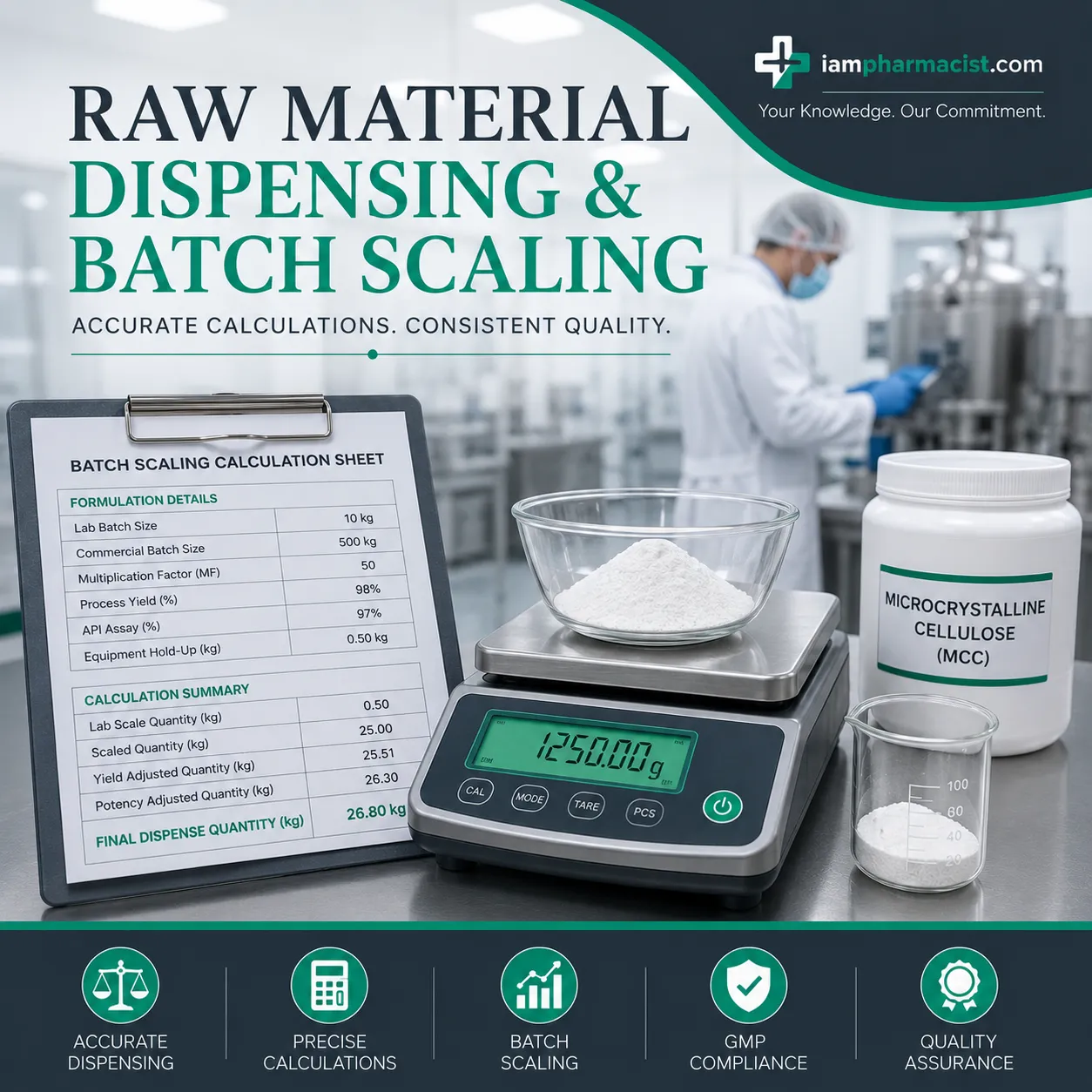

Learn raw material dispensing and batch scaling calculations, formula conversion from lab scale to commercial production, potency adjustments, and GMP controls.
Definition
Raw material dispensing and batch scaling calculations are pharmaceutical manufacturing processes used to convert laboratory formulations into commercial production batches by applying scale-up factors, potency adjustments, yield corrections, and equipment overages while ensuring GMP compliance and product quality.
Scaling a pharmaceutical formulation from laboratory development to commercial manufacturing is one of the most critical stages in product commercialization. A successful scale-up ensures that the final commercial batch maintains the same quality, potency, stability, and performance demonstrated during development.
Raw material dispensing and batch scaling involve more than simply multiplying ingredient quantities. Manufacturers must account for:
- Batch multiplication factors
- Process yields
- Active ingredient potency
- Equipment hold-up volumes
- Manufacturing losses
- Dispensing accuracy
This guide explains pharmaceutical batch scaling calculations, formula conversion methods, dispensing adjustments, and GMP requirements with practical examples.
Why Batch Scaling Is Important
Incorrect scale-up calculations can lead to:
- Potency failures
- Yield losses
- Batch rejections
- Validation failures
- Regulatory observations
Accurate scaling helps ensure:
✅ Consistent product quality
✅ Reproducible manufacturing performance
✅ Efficient material utilization
✅ GMP compliance
Understanding Raw Material Dispensing
Raw material dispensing is the controlled weighing and issuance of ingredients according to an approved formula and Batch Manufacturing Record (BMR).
Typical materials include:
| Material Type | Examples |
|---|---|
| Active Ingredients | APIs |
| Fillers | Lactose, MCC |
| Binders | PVP |
| Disintegrants | Croscarmellose |
| Lubricants | Magnesium Stearate |
| Preservatives | Methyl Paraben |
| Solvents | Purified Water |
Dispensing accuracy directly affects product quality and batch uniformity.
Raw Material Dispensing & Batch Scaling Calculator
Convert laboratory formulations into commercial-scale manufacturing quantities with yield, potency, and hold-up adjustments.
Batch Scaling Inputs
Results
| Parameter | Result |
|---|---|
| Batch Multiplication Factor (MF) | – |
| Scaled Quantity (kg) | – |
| Yield Adjusted Quantity (kg) | – |
| Potency Corrected Quantity (kg) | – |
| Equipment Hold-Up / Overage (kg) | – |
| Final Dispense Quantity (kg) | – |
Calculation Formulas Used
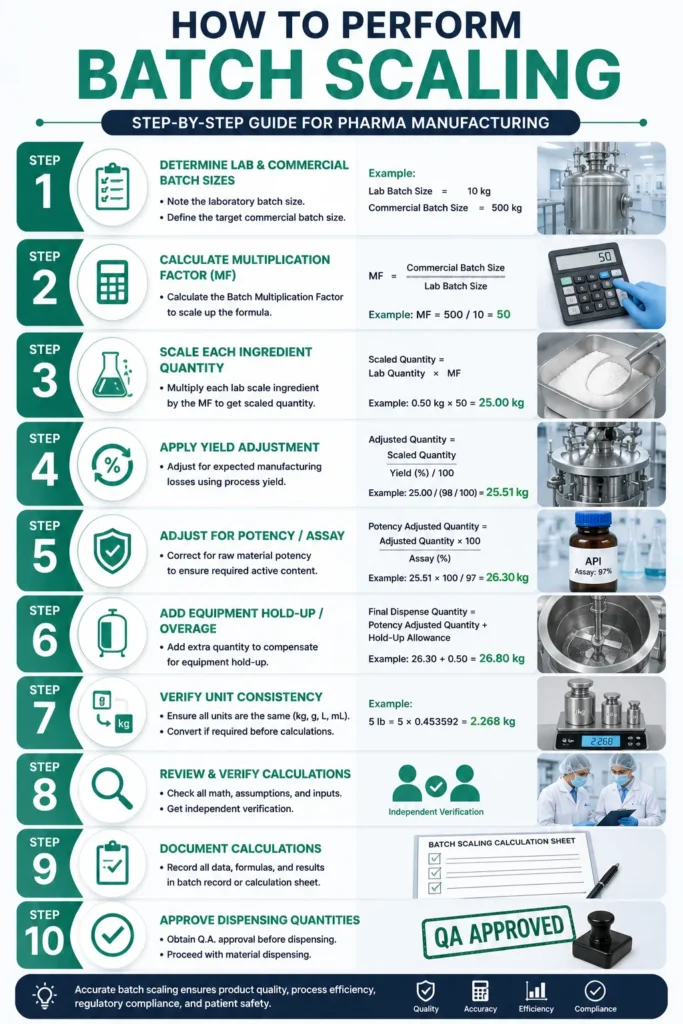
Multiplication Factor (MF) = Commercial Batch Size ÷ Lab Batch Size
Scaled Quantity = Lab Ingredient Quantity × MF
Yield Adjusted Quantity = Scaled Quantity ÷ (Yield % ÷ 100)
Potency Corrected Quantity = Yield Adjusted Quantity × 100 ÷ Potency %
Final Dispense Quantity = Potency Corrected Quantity + Hold-Up Allowance
Core Batch Scaling Calculation
The first step is determining the Batch Multiplication Factor (MF).
Formula
Multiplication Factor (MF)=Lab Batch SizeCommercial Batch Size
Example
Laboratory Batch:
10 kg
Commercial Batch:
500 kgMF=10500=50
Result
Multiplication Factor = 50
Formula Conversion from Lab Scale to Commercial Scale
Once the multiplication factor is known, each ingredient is multiplied accordingly.
Formula
Scaled Quantity=Lab Quantity×MF
Example Formula
Laboratory Batch (10 kg)
| Ingredient | Quantity (kg) |
|---|---|
| API | 0.50 |
| Lactose | 6.50 |
| MCC | 2.50 |
| Magnesium Stearate | 0.50 |
Commercial Batch (500 kg)
MF = 50
| Ingredient | Lab Qty (kg) | Scaled Qty (kg) |
|---|---|---|
| API | 0.50 | 25 |
| Lactose | 6.50 | 325 |
| MCC | 2.50 | 125 |
| Magnesium Stearate | 0.50 | 25 |
Yield Loss Adjustment
Commercial processes experience unavoidable losses due to:
- Blending
- Granulation
- Filtration
- Transfer operations
- Packaging
To compensate, raw material quantities must be adjusted.
Formula
Adjusted Dispense Quantity=Yield FractionScaled Quantity
Example
Scaled API Requirement:
25 kg
Expected Process Yield:
98%0.9825=25.51 kg
Result
API to Dispense = 25.51 kg
Potency Correction Calculation
Many APIs and natural extracts are supplied below 100% assay.
Manufacturers must correct the dispensing quantity.
Formula
Actual Dispensed Amount=Assay%Scaled Quantity×100
Example
Required API:
25 kg
Material Assay:
97%9725×100=25.77 kg
Result
Dispense:
25.77 kg
to obtain 25 kg active content.
Equipment Hold-Up Adjustment
Commercial manufacturing equipment retains material within:
- Tanks
- Pipelines
- Filters
- Transfer hoses
- Filling machines
These retained quantities are called hold-up losses.
Formula
Dispense Quantity=Required Quantity+Hold-Up Allowance
Example
Required API:
25.77 kg
Expected Hold-Up:
0.50 kg25.77+0.50=26.27 kg
Final Dispense Quantity
26.27 kg
Complete Scale-Up Calculation Example
Product
Tablet Formulation
Lab Batch Size
10 kg
Commercial Batch Size
500 kg
API Assay
97%
Process Yield
98%
Hold-Up Loss
0.50 kg
Step 1: Calculate MF
500/10=50
Step 2: Scale API
0.50×50=25 kg
Step 3: Adjust for Yield
25/0.98=25.51 kg
Step 4: Adjust for Assay
25.51×100/97=26.30 kg
Step 5: Add Hold-Up
26.30+0.50=26.80 kg
Final API Dispensing Quantity
26.80 kg
Unit Conversion Considerations
Before scaling, all units should be standardized.
| Unit | Convert To |
|---|---|
| Pounds (lb) | Kilograms |
| Ounces (oz) | Grams |
| Liters (L) | Milliliters |
| Milligrams (mg) | Grams |
Example
5 lb API5×0.453592=2.268 kg
Convert before applying scale-up calculations.
GMP Requirements for Raw Material Dispensing
Dispensing Area Controls
Pharmaceutical dispensing areas should have:
- Controlled access
- Line clearance procedures
- Environmental monitoring
- Material identification systems
Documentation Requirements
All dispensing records should include:
- Material name
- Batch number
- Quantity dispensed
- Balance identification
- Operator signature
- QA verification
Weighing Equipment Qualification
Balances must be:
- Calibrated
- Qualified
- Within weighing range
- Suitable for intended accuracy
Safety Considerations During Dispensing
Powder Handling
Large-scale powder dispensing requires:
- Dust extraction systems
- Respiratory protection
- Explosion prevention controls
Liquid Dispensing
Corrosive or hazardous liquids require:
- Closed transfer systems
- Chemical-resistant PPE
- Spill containment measures
Common Scale-Up Errors
| Error | Impact |
|---|---|
| Incorrect multiplication factor | Wrong batch size |
| Ignoring potency | Potency failure |
| No yield adjustment | Insufficient product |
| Unit conversion mistakes | Major formulation deviations |
| Ignoring hold-up losses | Packaging shortages |
Regulatory Expectations
FDA
21 CFR Part 211 requires accurate dispensing and documented manufacturing controls.
EU GMP
Requires verified calculations, reconciliation, and traceable dispensing records.
WHO GMP
Mandates documented material issuance and accountability throughout manufacturing.
FAQs
1. What is batch scaling in pharmaceutical manufacturing?
Batch scaling is the process of converting a laboratory formulation into a larger commercial manufacturing batch.
2. How is the multiplication factor calculated?
The multiplication factor equals commercial batch size divided by laboratory batch size.
3. Why are yield corrections necessary?
They compensate for expected manufacturing losses and ensure target output is achieved.
4. What is potency correction?
Potency correction adjusts raw material quantities when assay values are below 100%.
5. What is equipment hold-up?
Material retained in equipment such as tanks, pipelines, filters, and transfer lines.
6. Why is dispensing accuracy important?
It directly affects product potency, content uniformity, and regulatory compliance.
7. Should all ingredients be scaled equally?
Initially yes, but further adjustments may be required for yield, potency, and process considerations.
8. What GMP document contains dispensing quantities?
The Batch Manufacturing Record (BMR).
9. How are unit conversion errors prevented?
By standardizing all measurements before scaling calculations.
10. Who verifies dispensing calculations?
Production personnel perform calculations, and QA or a second reviewer independently verifies them.