


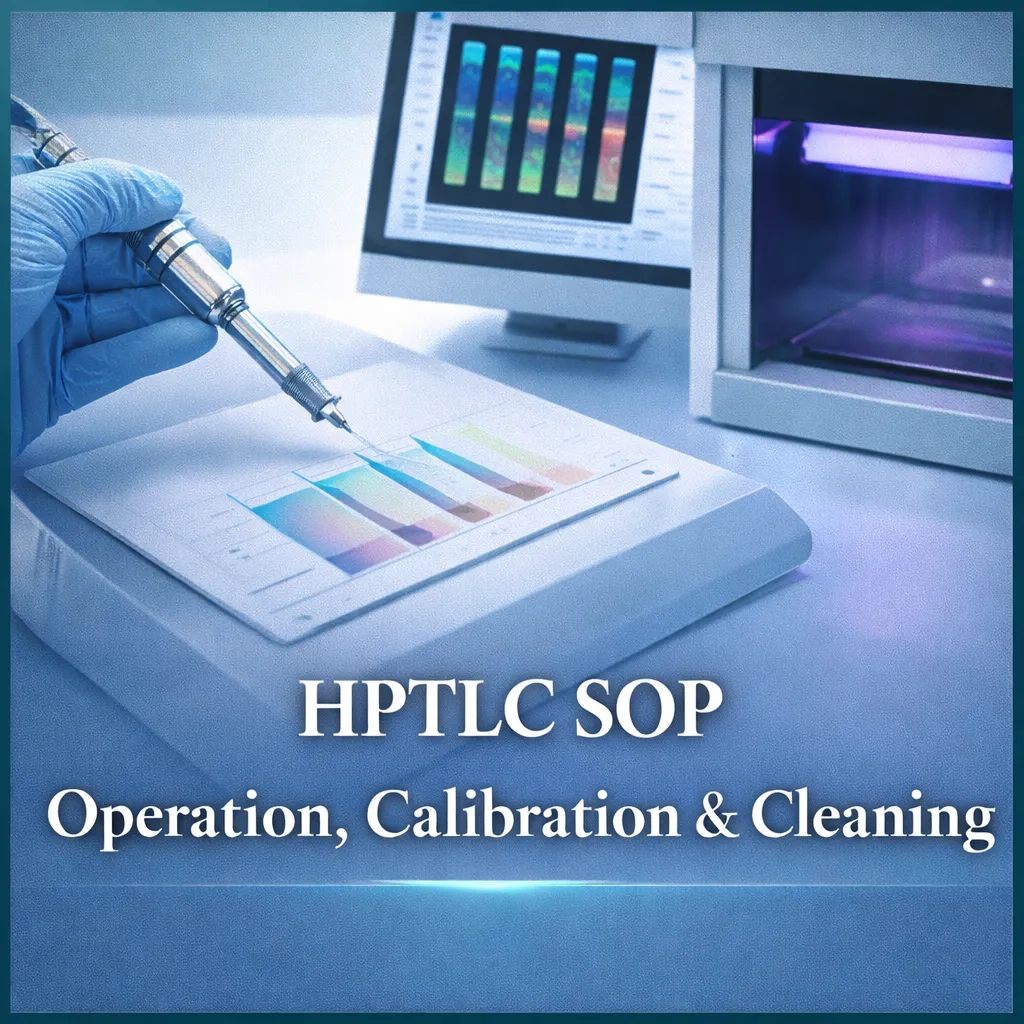

Learn High-Performance Thin Layer Chromatography (HPTLC) SOP for operation, calibration, and cleaning in API QC labs to ensure accurate chromatography results and compliance.
Introduction
High-Performance Thin Layer Chromatography (HPTLC) is a widely used analytical technique in pharmaceutical quality control laboratories, especially for API analysis. Accurate chromatographic results depend on proper operation, regular calibration, and meticulous cleaning of the system.
This SOP provides a comprehensive guide for operating, calibrating, and cleaning the HPTLC system to ensure precision, reproducibility, and regulatory compliance.
1.0 Objective
To define a standardized procedure for the operation, calibration, and cleaning of the HPTLC system.
2.0 Scope
This SOP applies to the HPTLC system installed in the API Quality Control laboratory.
3.0 Responsibility
- Doing: Technical Assistant / Executive
- Checking: Executive / Manager
4.0 Accountability
- Head of the Department
5.0 Step-by-Step SOP for HPTLC
5.1 Operation of HPTLC System
5.1.1 Pre-Operation Checks
- Ensure system cleanliness (chamber, syringe, scanner)
- Verify calibration status
- Check availability of solvents and TLC plates
5.1.2 Sample Application
- Load sample into syringe
- Apply sample using applicator (linomat)
5.1.3 Plate Development
- Prepare mobile phase
- Place TLC plate in chamber
- Allow proper development
5.1.4 Detection & Scanning
- Dry developed plate
- Analyze using scanner and UV cabinet
- Record chromatographic data
5.1.5 Completion
- Remove used plates
- Save and document results
5.2 Calibration of HPTLC System
5.2.1 Applicator Calibration
- Verify volume delivery accuracy
5.2.2 Scanner Calibration
- Check wavelength accuracy using standards
5.2.3 System Suitability
- Run standard samples
- Compare expected vs actual results
5.2.4 Documentation
- Record calibration results in logbook
5.3 Cleaning Procedure
5.3.1 Syringe Cleaning
- Clean with respective solvent
- Rinse with distilled water
- Sonicate (if required) for 10 minutes
5.3.2 Chamber Cleaning
- Wash with raw water
- Rinse with purified water
- Final rinse with methanol
- Wipe with tissue paper
- Dry using dryer
5.3.3 Equipment Cleaning
- Clean outer surfaces (linomat, scanner, UV cabinet)
- Use dry cotton cloth
- Remove stains using isopropanol
- Dry with tissue paper
5.3.4 Plate Removal
- Remove used TLC plates from UV cabinet
5.3.5 Storage
- Store chamber with lid in designated area
5.3.6 Documentation
- Record cleaning activity in log card
6.0 Abbreviations
- TLC: Thin Layer Chromatography
- UV: Ultraviolet
- API: Active Pharmaceutical Ingredient
Safety Precautions
- Handle solvents (methanol, IPA) carefully
- Use PPE (gloves, goggles, lab coat)
- Avoid UV exposure
- Ensure proper ventilation
- Dispose of TLC plates properly
Common Mistakes to Avoid
- Incomplete syringe cleaning
- Contaminated chamber
- Skipping calibration checks
- Improper solvent preparation
- Not removing used plates
Best Practices
- Clean system after every use
- Use fresh solvents
- Maintain calibration logs
- Validate system regularly
- Train personnel on SOP compliance
FAQs (Frequently Asked Questions)
1. What is HPTLC used for?
It is used for separation and analysis of compounds in QC labs.
2. Why is cleaning important in HPTLC?
To prevent contamination and ensure accurate results.
3. What solvent is used for final cleaning?
Methanol is commonly used.
4. Why is syringe cleaning critical?
To avoid cross-contamination between samples.
5. What is UV cabinet used for?
For visualization of TLC plates.
6. How often should calibration be done?
As per SOP schedule.
7. What happens if chamber is not clean?
It affects chromatographic separation.
8. Who is responsible for operation?
Technical staff performs; Manager verifies.
9. Is documentation necessary?
Yes, for compliance and traceability.
10. What PPE is required?
Gloves, goggles, and lab coat.