


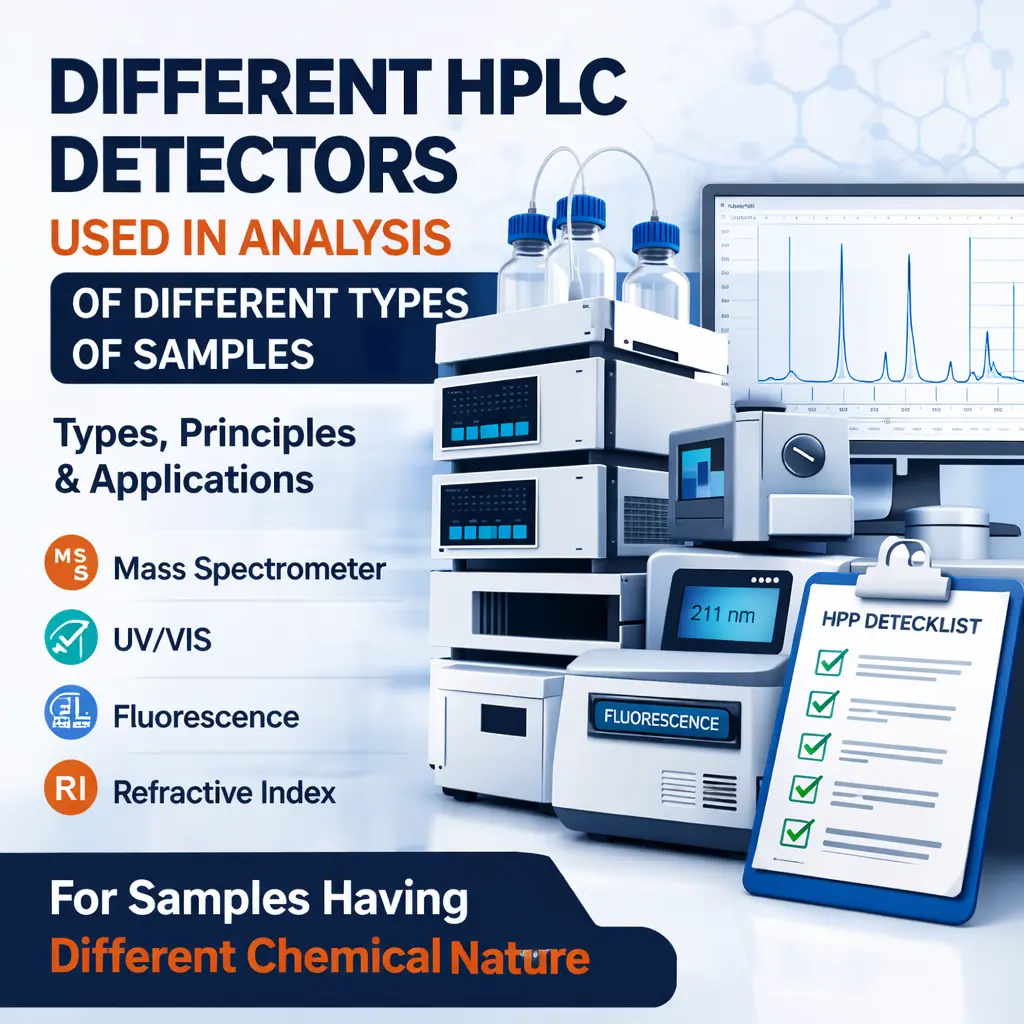

Learn about Different HPLC detectors used in analysis of different types of samples having different chemical nature. Understand UV, PDA, fluorescence, RI, conductivity, and mass spectrometry detectors, their working principles, advantages, and applications in pharmaceutical and chemical analysis.
Introduction to HPLC Detectors
High-Performance Liquid Chromatography (HPLC) is one of the most widely used analytical techniques in pharmaceutical, chemical, environmental, and food testing laboratories. A critical component of the HPLC system is the detector, which identifies and quantifies compounds separated by the chromatographic column.
Different HPLC detectors used in analysis of different types of samples having different chemical nature play a vital role in ensuring accurate detection, sensitivity, and reliability of analytical results. The choice of detector depends on the chemical properties of the analyte, required sensitivity, and method requirements.
HPLC detectors are designed to detect solutes present in the mobile phase as they elute from the column. They provide information about:
- Identity of compounds
- Concentration of analytes
- Purity of samples
- Presence of impurities
What is an HPLC Detector?
An HPLC detector is an instrument component that measures physical or chemical changes in the mobile phase caused by analytes as they pass through the detector cell.
Detectors are capable of:
- Detecting eluting compounds
- Measuring analyte concentration
- Monitoring separation efficiency
- Ensuring analytical accuracy
Key Features of an Ideal HPLC Detector
An effective HPLC detector must meet specific performance requirements to ensure reliable analytical results.
Important Characteristics
- Specific or universal response to compounds
- High sensitivity toward analyte
- Minimal response to mobile phase
- Low detector noise
- Linear response to concentration
- Low cell volume
- Minimal contribution to peak broadening
- Stability against temperature and flow rate variations
These characteristics ensure accurate detection across different chemical natures of samples, including polar, non-polar, ionic, and high molecular weight compounds.
Classification of HPLC Detectors
HPLC detectors are generally classified into two major categories:
1. Specific (Selective) Detectors
2. Bulk Property (Universal) Detectors
This classification helps analysts select different HPLC detectors used in analysis of different types of samples having different chemical nature based on analytical requirements.
A) Specific (Selective) HPLC Detectors
Specific detectors respond to particular chemical properties of analytes, such as UV absorption, fluorescence, or mass-to-charge ratio.
1. Mass Spectrometric (MS) HPLC Detector
Principle
Mass spectrometry detectors operate by ionizing molecules and separating them based on their mass-to-charge ratio (m/z).
Key Features
- Extremely high sensitivity
- High selectivity
- Accurate molecular identification
- Structural information
Applications
- Impurity profiling
- Pharmacokinetic studies
- Drug metabolism analysis
- Trace-level detection
Advantages
- Very low detection limits
- Highly specific identification
- Suitable for complex samples
2. UV/Visible (UV/VIS) HPLC Detector
Principle
UV/VIS detectors measure the absorption of ultraviolet or visible light by analytes.
Types
- Fixed wavelength detector
- Variable wavelength detector
- Diode array detector
Applications
- Pharmaceutical drug analysis
- Assay determination
- Stability studies
- Dissolution testing
Why It Is Popular
The UV detector is the most commonly used detector in pharmaceutical laboratories due to its reliability and ease of operation.
3. Photo Diode Array (PDA) HPLC Detector
Principle
PDA detectors use multiple photodiodes to simultaneously measure absorbance at different wavelengths.
Key Features
- Multi-wavelength detection
- Peak purity analysis
- Spectral identification
- Rapid analysis
Applications
- Method development
- Impurity analysis
- Stability studies
4. Fluorescence HPLC Detector
Principle
Fluorescence detectors measure light emitted by fluorescent compounds after excitation.
Key Features
- Very high sensitivity
- High selectivity
- Low detection limits
Applications
- Vitamin analysis
- Environmental pollutants
- Biological samples
- Trace impurity detection
Sensitivity
Fluorescence detectors are often 10–1000 times more sensitive than UV detectors.
B) Bulk Property (Universal) HPLC Detectors
Bulk property detectors measure changes in physical properties of the mobile phase rather than specific analyte characteristics.
1. Conductivity HPLC Detector
Principle
Conductivity detectors measure electrical conductivity of the mobile phase.
Key Features
- High sensitivity for ionic compounds
- Reproducible results
- Universal detection
Applications
- Ion analysis
- Water quality testing
- Electrolyte determination
- Environmental monitoring
2. Refractive Index (RI) HPLC Detector
Principle
RI detectors measure changes in refractive index between the mobile phase and analyte.
Key Features
- Universal detection capability
- Suitable for non-UV absorbing compounds
Applications
- Sugar analysis
- Polymer analysis
- Lipid analysis
- Alcohol determination
Limitation
Highly sensitive to temperature fluctuations.
3. Electrochemical HPLC Detector
Principle
Electrochemical detectors measure electrical signals generated by oxidation or reduction reactions.
Key Features
- High sensitivity
- Selective detection
- Suitable for redox-active compounds
Applications
- Pharmaceutical analysis
- Neurotransmitter detection
- Drug metabolism studies
4. Light Scattering HPLC Detector
Principle
Light scattering detectors measure scattered light from analyte particles in the mobile phase.
Types
- Low-angle laser light scattering detector
- Multi-angle laser light scattering detector
Applications
- Protein analysis
- Polymer characterization
- High molecular weight compounds
Other Important HPLC Detectors
Additional specialized detectors include:
- Evaporative Light Scattering Detector (ELSD)
- Infrared (IR) Detector
- Aerosol-Based Detector
- Chiral Detector
- Pulsed Amperometric Detector
These detectors further expand the capability of Different HPLC detectors used in analysis of different types of samples having different chemical nature, especially in advanced pharmaceutical and research laboratories.
How to Select the Right HPLC Detector
Choosing the correct detector depends on several analytical factors.
Selection Criteria
- Chemical nature of analyte
- Required sensitivity
- Detection limit
- Sample complexity
- Regulatory requirements
- Cost and maintenance
- Compatibility with mobile phase
Common Applications of HPLC Detectors in Pharmaceutical Industry
HPLC detectors are widely used in pharmaceutical quality control and research laboratories.
Typical Uses
- Assay determination
- Impurity analysis
- Stability testing
- Dissolution testing
- Cleaning validation
- Residual solvent analysis
- Bioanalysis
- Environmental monitoring
Summary
HPLC detectors are essential components in chromatographic systems, enabling accurate detection and quantification of analytes. Understanding Different HPLC detectors used in analysis of different types of samples having different chemical nature helps analysts select the appropriate detector for reliable and reproducible results.
Selecting the right detector improves analytical accuracy, enhances method performance, and ensures compliance with regulatory requirements in pharmaceutical laboratories.
Frequently Asked Questions (FAQs)
1. What is the function of an HPLC detector?
An HPLC detector identifies and measures compounds as they elute from the chromatographic column.
2. Which is the most commonly used HPLC detector?
The UV/Visible detector is the most widely used due to its reliability, simplicity, and cost-effectiveness.
3. What is the most sensitive HPLC detector?
Mass spectrometry and fluorescence detectors are among the most sensitive HPLC detectors.
4. What type of detector is used for non-UV absorbing compounds?
Refractive Index (RI) or Evaporative Light Scattering Detectors are commonly used.
5. Which detector is used for ionic compounds?
Conductivity detectors are typically used for ionic substances.
6. Why is temperature control important in RI detectors?
Because refractive index measurements are highly sensitive to temperature changes.
7. What is the advantage of PDA detectors over UV detectors?
PDA detectors can monitor multiple wavelengths simultaneously and perform peak purity analysis.
8. Which HPLC detector is best for trace-level detection?
Fluorescence and mass spectrometry detectors are best for detecting very low concentrations.
9. Can one HPLC method use multiple detectors?
Yes, advanced systems can use multiple detectors simultaneously for better analysis.
10. How do you choose the correct HPLC detector?
The selection depends on the chemical nature of the analyte, required sensitivity, and analytical method requirements.