


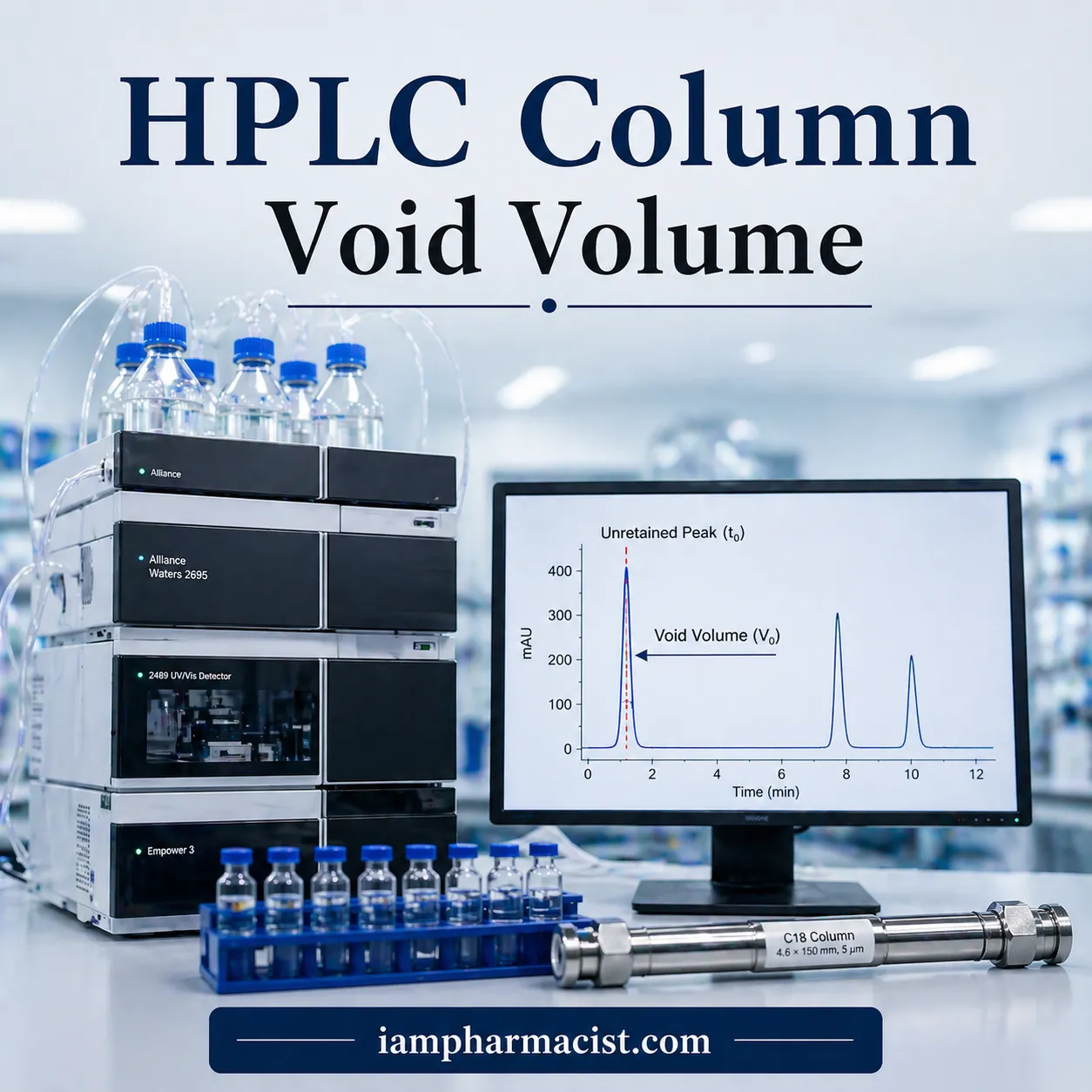

Learn HPLC column void volume, its formula, calculation, importance in chromatography, and how it affects resolution and retention time.
Definition
HPLC column void volume (V₀ or Vₘ) is the volume of mobile phase within the column that is not occupied by stationary phase and represents the minimum volume required for an unretained compound to elute.
Introduction
In High-Performance Liquid Chromatography (HPLC), understanding system volumes is essential for accurate analysis. Among these, void volume plays a critical role in determining retention time, resolution, and overall system performance.
Void volume represents the portion of the column accessible to the mobile phase. It directly influences how quickly compounds travel through the column and is fundamental for interpreting chromatographic data.https://www.thermofisher.com/pk/en/home/industrial/chromatography/chromatography-learning-center/chromatography-consumables-resources/chromatography-troubleshooting-guides/chromatography-troubleshooting-guides-gas-chromatography.html
A clear understanding of void volume helps analysts optimize methods, improve separation efficiency, and ensure reliable results.
Why Void Volume is Important
- Determines column dead time (t₀)
- Helps calculate retention factor (k’)
- Influences resolution and separation efficiency
- Supports method development and validation
Types of Volumes in HPLC
| Volume Type | Description | Role |
|---|---|---|
| Void Volume (V₀) | Mobile phase volume in column | Determines dead time |
| Column Volume | Total volume of column | Overall capacity |
| Retention Volume | Volume at which analyte elutes | Identifies compounds |
| Elution Volume | Volume needed for elution | Used in calculations |
| Bed Volume | Volume of packed stationary phase | Affects separation |
Understanding HPLC Column Void Volume
What is Void Volume?
Void volume is the space between stationary phase particles filled with mobile phase. It exists only when the column is packed.
It represents the minimum solvent volume required before any analyte can be detected.
Void Volume vs Dead Time
- Void volume (V₀): Measured in mL
- Dead time (t₀): Time taken for unretained compound to elute
Both are directly related and essential for chromatographic calculations.
Formula for Void Volume
Method 1: Using Flow Rate and Dead Time
Vm=F×t0
Where:
- Vₘ = Void volume
- F = Flow rate (mL/min)
- t₀ = Dead time (min)
Method 2: Using Column Dimensions
Vm=y×π×(2i.d)2×L
Where:
- y ≈ 0.7 (void fraction)
- i.d = Internal diameter
- L = Column length
How to Determine Void Volume
Step 1: Select an Unretained Compound
- Choose a compound with minimal interaction
- Example: Uracil
Step 2: Inject the Sample
- Run chromatogram under standard conditions
Step 3: Measure Dead Time (t₀)
- Identify first peak (unretained)
Step 4: Record Flow Rate
- Note system flow rate (mL/min)
Step 5: Calculate Void Volume
- Apply formula: Vₘ = F × t₀
Step 6: Validate Results
- Repeat for consistency
- Compare with theoretical values
Factors Affecting Void Volume
- Column dimensions (length, diameter)
- Particle size of stationary phase
- Packing density
- Flow rate variations
FAQs
1. What is void volume in HPLC?
It is the volume of mobile phase inside the column not occupied by stationary phase.
2. What is dead time in HPLC?
Time taken for an unretained compound to elute.
3. How is void volume calculated?
Using flow rate and dead time (Vₘ = F × t₀).
4. Why is void volume important?
It helps determine retention factor and resolution.
5. What is the symbol for void volume?
V₀ or Vₘ.
6. What compound is used to measure void volume?
Unretained compounds like uracil.
7. Does column size affect void volume?
Yes, length and diameter directly influence it.
8. What is the difference between void and retention volume?
Void volume is minimum solvent volume; retention volume includes analyte interaction.
9. Can void volume be zero?
No, it exists only in packed columns.
10. How does void volume affect resolution?
Incorrect values can lead to poor separation and inaccurate results.
{ “@context”: “https://schema.org”, “@type”: “Article”, “headline”: “HPLC Column Void Volume Explained Clearly”, “description”: “Learn void volume in HPLC, formulas, calculations, and importance in chromatography.”, “author”: { “@type”: “Person”, “name”: “SEO Technical Writer” }, “datePublished”: “2026-04-25” } { “@context”: “https://schema.org”, “@type”: “FAQPage”, “mainEntity”: [ { “@type”: “Question”, “name”: “What is void volume in HPLC?”, “acceptedAnswer”: { “@type”: “Answer”, “text”: “It is the mobile phase volume inside the column not occupied by stationary phase.” } } ] } { “@context”: “https://schema.org”, “@type”: “HowTo”, “name”: “How to Calculate HPLC Void Volume”, “step”: [ {“@type”: “HowToStep”,”name”: “Select unretained compound”}, {“@type”: “HowToStep”,”name”: “Measure dead time”}, {“@type”: “HowToStep”,”name”: “Record flow rate”}, {“@type”: “HowToStep”,”name”: “Calculate volume”} ] }