


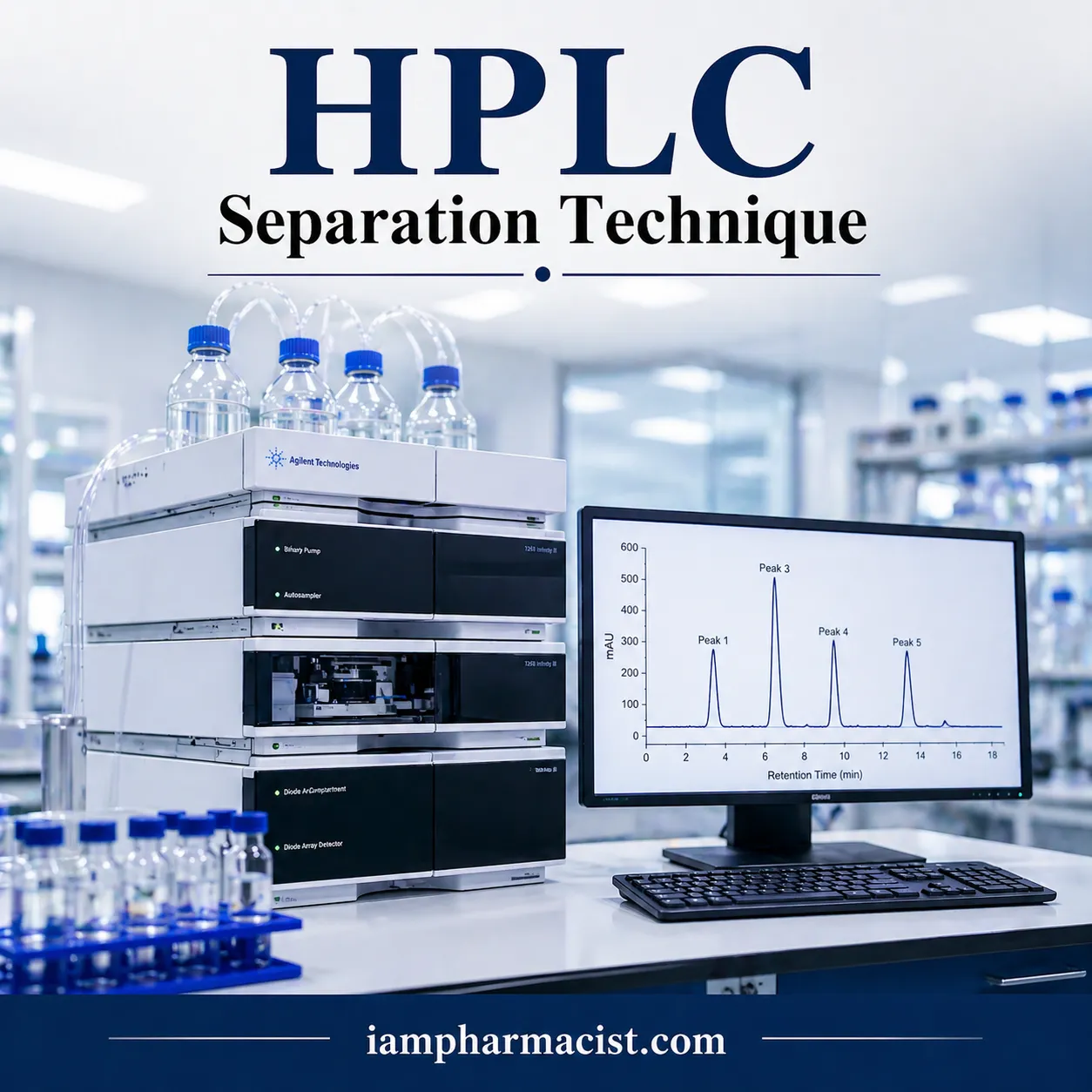

Learn the separation technique of HPLC, its working principle, mechanism, and applications in pharmaceutical, environmental, and research analysis.
Definition
The separation technique of HPLC is based on differential interactions between sample components, the stationary phase, and the mobile phase, resulting in distinct retention times for each compound.
Introduction
High Performance Liquid Chromatography (HPLC) is a powerful analytical technique widely used in pharmaceuticals, research, and environmental testing. Its core strength lies in its ability to separate complex mixtures into individual components with high precision.https://iampharmacist.com/types-of-hplc-columns/
The separation process occurs inside the column, where compounds interact differently with the stationary phase and mobile phase. These interactions cause each compound to travel at a different speed, leading to effective separation.
From drug analysis to biological sample testing, HPLC remains a cornerstone technique for accurate identification and quantification of compounds.https://www.sciencedirect.com/science/article/abs/pii/S0026265X19323628
Where HPLC Separation is Used
- Pharmaceutical manufacturing
- Clinical diagnostics (e.g., vitamin analysis)
- Environmental testing (toxins, pesticides)
- Biochemical and microbiology researchhttps://www.thermofisher.com/pk/en/home/industrial/chromatography/chromatography-learning-center/chromatography-consumables-resources/chromatography-troubleshooting-guides/chromatography-troubleshooting-guides-gas-chromatography.html
HPLC Separation Mechanism (Overview Table)
| Factor | Role in Separation | Effect on Compounds |
|---|---|---|
| Stationary Phase | Solid adsorbent (silica-based) | Controls retention |
| Mobile Phase | Liquid solvent (water + organic) | Drives movement |
| Polarity | Key separation parameter | Determines interaction strength |
| Flow Rate | Controls speed of analysis | Affects resolution |
| Column Type | Defines separation mode | Impacts efficiency |
How Separation Works in HPLC
1. Injection of Sample
The sample mixture is introduced into the system through an injector.
2. Mobile Phase Flow
A high-pressure pump pushes the mobile phase (water + methanol/acetonitrile) through the column.
3. Interaction with Stationary Phase
- The column contains silica particles with functional groups (e.g., C18)
- Compounds interact differently based on polarity
4. Differential Migration
- Polar compounds move faster (less interaction)
- Non-polar compounds move slower (strong interaction)
5. Elution of Compounds
Separated compounds exit the column at different times (retention times).
6. Detection
A detector records peaks corresponding to each compound.
HPLC Separation Process
Step 1: Prepare the Sample
- Filter and dissolve in suitable solvent
Step 2: Select Mobile Phase
- Choose appropriate solvent system
- Common: water + methanol/acetonitrile
Step 3: Choose Column Type
- C18 for reverse phase
- Silica for normal phase
Step 4: Inject Sample
- Introduce precise volume into system
Step 5: Run the System
- Maintain proper flow rate and pressure
Step 6: Monitor Separation
- Observe chromatogram peaks
Step 7: Analyze Results
- Identify compounds by retention time
- Quantify using peak area
Role of Polarity in HPLC Separation
Polarity is the key factor influencing separation:
- Polar compounds → Weak interaction → Faster elution
- Non-polar compounds → Strong interaction → Slower elution
Example:
- Water (polar) mixes with ethanol
- Oil (non-polar) does not mix with water
This principle is directly applied in reverse-phase HPLC systems.
Gradient Elution in HPLC
- Mobile phase composition changes over time
- Organic solvent concentration increases
- Helps elute strongly retained compounds
FAQs
1. What is the separation technique of HPLC?
It is based on differences in interaction between compounds and stationary/mobile phases.
2. What factors affect HPLC separation?
Polarity, flow rate, column type, and mobile phase composition.
3. What is retention time in HPLC?
The time taken by a compound to elute from the column.
4. Why is polarity important in HPLC?
It determines how strongly compounds interact with the column.
5. What is mobile phase in HPLC?
A solvent that carries the sample through the column.
6. What is stationary phase?
A solid material inside the column responsible for separation.
7. What is gradient elution?
Changing solvent composition during analysis to improve separation.
8. Where is HPLC used?
Pharma, environmental testing, clinical labs, and research.
9. What is reverse phase HPLC?
A method using non-polar stationary phase and polar mobile phase.
10. How are compounds identified in HPLC?
By comparing retention times and peak areas.
{ “@context”: “https://schema.org”, “@type”: “Article”, “headline”: “Separation Technique of HPLC Explained”, “description”: “Complete guide to HPLC separation technique, mechanism, and applications.”, “author”: { “@type”: “Person”, “name”: “SEO Technical Writer” }, “datePublished”: “2026-04-25” } { “@context”: “https://schema.org”, “@type”: “FAQPage”, “mainEntity”: [ { “@type”: “Question”, “name”: “What is HPLC separation technique?”, “acceptedAnswer”: { “@type”: “Answer”, “text”: “It separates compounds based on their interaction with stationary and mobile phases.” } } ] } { “@context”: “https://schema.org”, “@type”: “HowTo”, “name”: “How HPLC Separation Works”, “step”: [ {“@type”: “HowToStep”,”name”: “Prepare sample”}, {“@type”: “HowToStep”,”name”: “Select mobile phase”}, {“@type”: “HowToStep”,”name”: “Inject sample”}, {“@type”: “HowToStep”,”name”: “Analyze peaks”} ] }