




Learn SOP for handling reference and working standards in pharma QC, including procurement, storage, usage, and documentation for compliance.
Definition
A Reference and Working Standards SOP is a documented procedure used in pharmaceutical quality control to ensure proper procurement, storage, preparation, usage, and documentation of analytical standards for accurate and reliable test results.
| Section | Purpose | Key Activities |
|---|---|---|
| Procurement | Ensure authentic standards | IP/USP/BP sourcing |
| Preparation | Develop working standards | Comparative analysis |
| Storage | Maintain integrity | Temperature & humidity control |
| Usage | Ensure traceability | Logbooks & vial control |
| Documentation | Compliance and audit readiness | Records & retention |
Step-by-Step SOP
- Procure reference standards from approved sources
- Record procurement details
- Store under recommended conditions
- Prepare working standards via comparative analysis
- Label and document each vial
- Use within defined validity
- Maintain usage and issuance logs
- Archive records for compliance
Introduction
In pharmaceutical Quality Control laboratories, reference and working standards are the backbone of analytical accuracy. Any deviation in their handling can directly impact product quality, regulatory compliance, and patient safety.
A well-defined SOP for handling reference and working standards ensures:
- Data integrity
- Traceability
- Consistency in analytical results
This guide provides a comprehensive, audit-ready SOP aligned with GMP and regulatory expectations.
1.0 OBJECTIVE
To lay down a procedure for handling of reference and working standards.
2.0 SCOPE
Applicable for handling of reference and working standards used in pharmaceutical analysis.
3.0 RESPONSIBILITY
Officer / Executive – Quality Control
4.0 ACCOUNTABILITY
Manager – Quality Control
5.0 PROCEDURE
5.1 Procurement of Reference Standards and Impurities
- Reference standards shall be procured from:
- IP (Indian Pharmacopoeia)
- USP (United States Pharmacopeia)https://www.usp.org/reference-standards
- BP (British Pharmacopoeia)
- Approved in-house standards
- Maintain procurement records including:
- Batch/Lot number
- Potency
- Quantity received
- Certificate of Analysis (CoA)
5.2 Storage of Reference Standards
- Store under recommended conditions (as per CoA)
- Maintain controlled:
- Temperature
- Humidity
- Ensure:
- Light protection if required
- Segregation from working standards
5.3 Usage and Record Maintenance
- Maintain usage logs for:
- Quantity used
- Balance quantity
- Analyst signature
- Ensure full traceability
5.4 Preparation of Working Standards
- Working standards shall be prepared using reference standards
- Developed using purest form of raw material
Analytical Development
- Perform three independent analyses using:
- HPLC
- UV
- Auto titrator
- Calculate average value for routine use
5.5 Validity and Usage of Working Standards
- Validity:
- Maximum 1 year
- 6 months for less stable products
- Preparation:
- 12 vials per year
5.6 Labeling of Working Standards
Each vial must include:
- Working Standard
- Product Name (e.g., XYZ)
- W.S No. (WS/XX/001)
- Assay (%)
- LOD/Water (%)
- Vial Number
- Effective Date
- Use Before Date
- Issue Date
5.7 Storage of Working Standards
- Store under:
- Refrigerated conditions (2°C–8°C)
- Maintain:
- Humidity < 60%
- Cool, dark conditions
5.8 Handling of Opened Vials
- Use within 30 days of opening
- Store in desiccator at room temperature
- Discard after 30 days
- Open new vial and record
5.9 Documentation and Record Control
- Use approved logbooks/registers
- Maintain:
- Annual issuance
- Proper documentation control
- Retain records for 5 years
5.10 Archival and Compliance
- QA Manager ensures:
- Record reconciliation
- Archival control
- Authorized disposal
6.0 ABBREVIATIONS
- SOP – Standard Operating Procedure
- LOD – Loss on Drying
- W.S – Working Standard
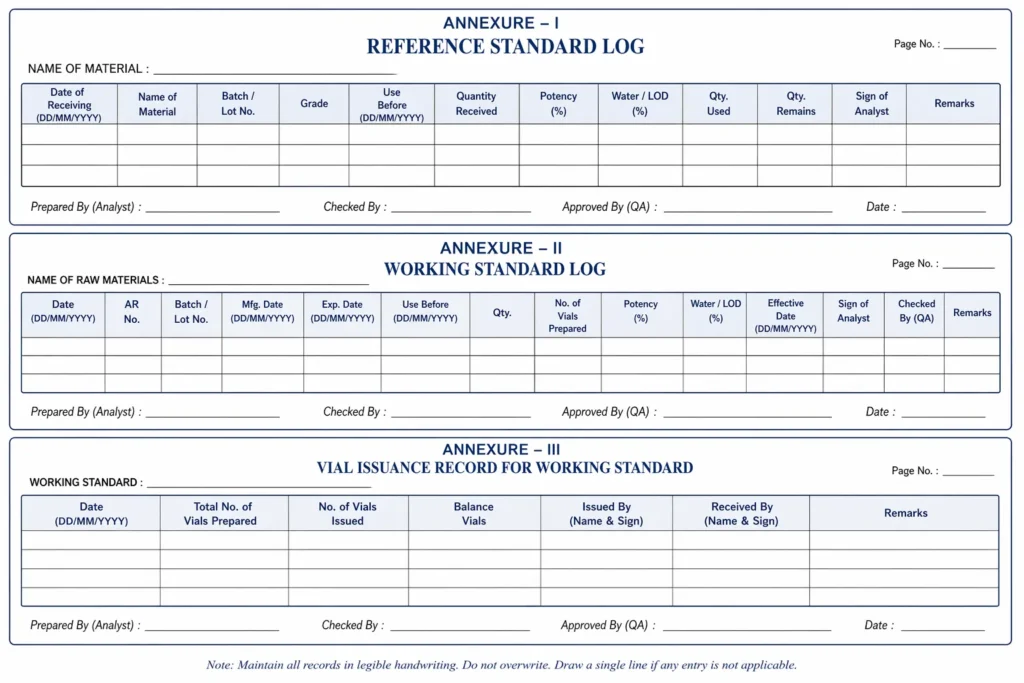
Annexures
Annexure I: Reference Standard Log
- Date received
- Material name
- Batch/Lot No.
- Potency
- Quantity used/remains
- Analyst signature
Annexure II: Working Standard Log
- Raw material details
- Batch/lot
- Potency
- Number of vials
- Effective date
Annexure III: Vial Issuance Record
- Total vials prepared
- Issued vs balance
- Issued/received by
- Remarks
FAQs
1. What is a reference standard?
A highly pure compound used as a benchmark in analysis.
2. What is a working standard?
A secondary standard derived from reference standard for routine use.
3. Why are working standards prepared?
To reduce cost and ensure availability for routine testing.
4. How long can working standards be used?
Typically up to 1 year or less for unstable materials.
5. Why store standards in refrigeration?
To maintain stability and prevent degradation.
6. What is LOD in standards?
Loss on drying indicating moisture content.
7. How many vials are prepared?
Usually 12 vials for one year usage.
8. What happens after 30 days of vial opening?
The vial must be discarded.
9. Why maintain logbooks?
For traceability and regulatory compliance.
10. What standards are acceptable sources?
IP, USP, BP, or approved in-house standards.
{ “@context”: “https://schema.org”, “@type”: “Article”, “headline”: “Reference & Working Standards SOP for Pharma QC”, “description”: “SOP for handling reference and working standards in pharmaceutical analysis.”, “author”: { “@type”: “Organization”, “name”: “Pharma QC Experts” }, “datePublished”: “2026-04-21” } { “@context”: “https://schema.org”, “@type”: “FAQPage”, “mainEntity”: [ { “@type”: “Question”, “name”: “What is a working standard?”, “acceptedAnswer”: { “@type”: “Answer”, “text”: “A working standard is derived from a reference standard for routine analysis.” } } ] } { “@context”: “https://schema.org”, “@type”: “HowTo”, “name”: “How to Handle Working Standards”, “step”: [ {“@type”: “HowToStep”, “text”: “Procure reference standard”}, {“@type”: “HowToStep”, “text”: “Prepare working standard”}, {“@type”: “HowToStep”, “text”: “Store under controlled conditions”} ] }