


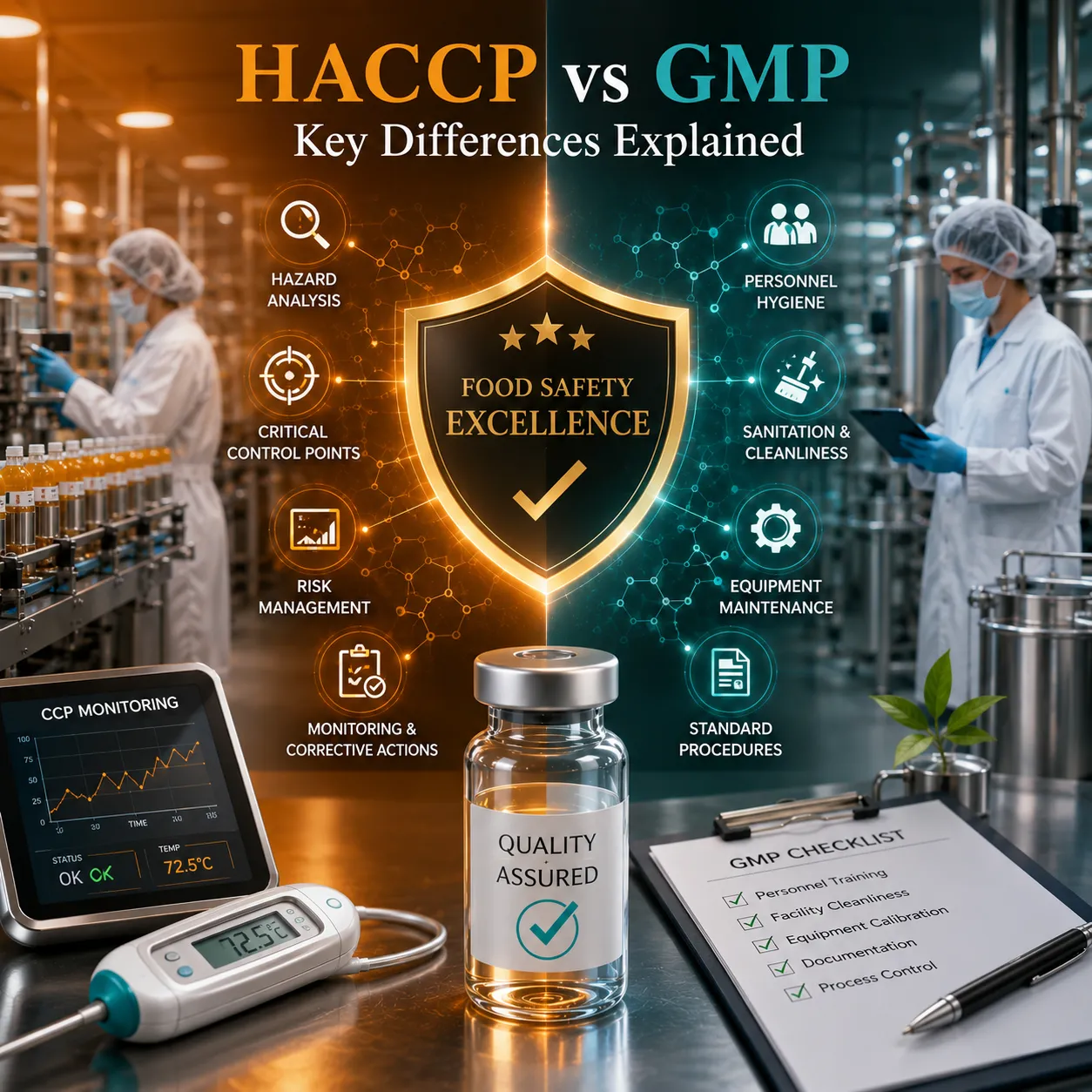

Learn the differences between HACCP vs GMP, how they work together, regulatory requirements, implementation steps, and food safety compliance.
What Is the Difference Between HACCP and GMP?
Good Manufacturing Practices (GMP) establish the foundational conditions needed to produce safe products through proper hygiene, sanitation, facility design, personnel practices, and equipment maintenance. HACCP (Hazard Analysis and Critical Control Points) is a risk-based system that identifies, evaluates, and controls specific food safety hazards at critical points within a manufacturing process. GMP serves as the foundation, while HACCP builds upon it to manage product-specific risks.
Introduction
Food safety and quality management rely on multiple systems working together to prevent contamination, ensure regulatory compliance, and protect consumers. Among the most important frameworks are Good Manufacturing Practices (GMP) and Hazard Analysis and Critical Control Points (HACCP).
Although these terms are often used interchangeably, they serve different functions within a food safety management system. GMP creates the operational foundation for safe manufacturing, while HACCP provides a structured methodology for identifying and controlling specific hazards.
For quality managers, food safety professionals, regulatory affairs specialists, and manufacturing leaders, understanding the distinction between HACCP and GMP is critical for achieving compliance and maintaining product integrity.
What Is GMP?
Good Manufacturing Practices (GMP) are a set of operational and environmental requirements designed to ensure products are consistently manufactured under controlled conditions.
GMP focuses on preventing contamination and quality issues through standardized processes and facility-wide controls.
Core GMP Elements
- Personnel hygiene
- Facility sanitation
- Equipment maintenance
- Pest control
- Raw material handling
- Documentation systems
- Process controls
- Training programs
- Storage and distribution controls
GMP Objective
To establish a clean, controlled, and compliant manufacturing environment.
What Is HACCP?
Hazard Analysis and Critical Control Points (HACCP) is a preventive food safety system that identifies and controls hazards throughout the production process.
Unlike GMP, HACCP focuses on product-specific risks and critical process steps.
HACCP Objective
To identify, evaluate, and control biological, chemical, and physical hazards before they impact product safety.
HACCP vs GMP: Key Differences
| Feature | GMP | HACCP |
|---|---|---|
| Primary Focus | Manufacturing environment and operational controls | Product-specific hazard control |
| Approach | Preventive and facility-wide | Risk-based and process-specific |
| Scope | Entire facility and operations | Specific production processes |
| Hazard Control | General prevention | Targeted hazard management |
| Regulatory Role | Foundation system | Advanced food safety system |
| Documentation | SOPs, logs, training records | HACCP plan, CCP records |
| Monitoring | General compliance checks | Continuous CCP monitoring |
| Corrective Actions | Process deviations | Critical limit failures |
How GMP and HACCP Work Together
A common misconception is that HACCP can replace GMP. In reality, HACCP cannot function effectively without strong GMP programs.
House Building Analogy
| Component | Food Safety Equivalent |
|---|---|
| Foundation | GMP |
| Security System | HACCP |
| House Structure | Quality Management System |
| Ongoing Maintenance | Audits and Continuous Improvement |
GMP creates a safe manufacturing environment, while HACCP targets specific hazards within that environment.
GMP as a Prerequisite Program (PRP)
Before implementing HACCP, organizations must establish prerequisite programs.
Common GMP-Based PRPs
| Program | Purpose |
|---|---|
| Personnel Hygiene | Prevent contamination |
| Sanitation Program | Maintain cleanliness |
| Pest Control | Eliminate infestation risks |
| Supplier Approval | Ensure material quality |
| Equipment Maintenance | Prevent equipment failures |
| Traceability | Enable recalls and investigations |
| Training | Improve employee competency |
Without effective prerequisite programs, HACCP plans become difficult to implement and sustain.
The Seven Principles of HACCP
Principle 1: Conduct Hazard Analysis
Identify:
- Biological hazards
- Chemical hazards
- Physical hazards
Example
A dairy processor identifies microbial contamination risks during milk pasteurization.
Principle 2: Determine Critical Control Points (CCPs)
Identify process steps where hazards can be prevented or eliminated.
Example
Pasteurization temperature becomes a CCP.
Principle 3: Establish Critical Limits
Define acceptable limits.
Example
Milk must reach a specified temperature for a minimum holding time.
Principle 4: Establish Monitoring Procedures
Continuously monitor CCPs.
Example
Automated temperature monitoring systems.
Principle 5: Establish Corrective Actions
Define actions when critical limits are exceeded.
Example
Reject or reprocess affected batches.
Principle 6: Establish Verification Procedures
Verify system effectiveness.
Example
Calibration and internal audits.
Principle 7: Maintain Records
Document all HACCP activities.
Example
CCP logs and verification reports.
Practical Example: GMP vs HACCP in Action
Scenario: Ready-to-Eat Salad Production
GMP Controls
| GMP Activity | Purpose |
|---|---|
| Employee handwashing | Prevent contamination |
| Equipment cleaning | Maintain sanitation |
| Pest control | Eliminate infestation |
| Facility maintenance | Prevent environmental hazards |
HACCP Controls
| HACCP Activity | Purpose |
|---|---|
| CCP at wash step | Reduce microbial hazards |
| Chlorine concentration monitoring | Maintain safety limits |
| Corrective actions | Address deviations |
| Verification testing | Confirm effectiveness |
Result
GMP provides the overall hygienic environment, while HACCP manages the highest-risk process steps.
Regulatory Requirements for HACCP and GMP
United States
GMP
Governed under:
- FDA Current Good Manufacturing Practices (CGMP)
- 21 CFR Part 117 (Food)
HACCP
Required for:
- Seafood (21 CFR Part 123)
- Juice products (21 CFR Part 120)
- Certain preventive control programs under FSMA
International Standards
HACCP principles are recognized by:
- Codex Alimentarius
- ISO 22000
- FSSC 22000
- BRCGS
- SQF
Most global food safety schemes require both GMP and HACCP implementation.
Step-by-Step Guide: Implementing GMP and HACCP Together
Step 1: Establish GMP Programs
Implement:
- Hygiene procedures
- Cleaning programs
- Pest control
- Maintenance systems
Step 2: Conduct Hazard Analysis
Review all production steps and identify potential hazards.
Step 3: Determine Critical Control Points
Identify where hazards can be controlled.
Step 4: Define Critical Limits
Establish measurable safety parameters.
Step 5: Implement Monitoring Systems
Monitor CCPs consistently.
Step 6: Create Corrective Action Procedures
Define responses to deviations.
Step 7: Verify and Audit
Perform:
- Internal audits
- Validation studies
- Verification reviews
Step 8: Maintain Documentation
Keep records for inspections and compliance audits.
Common Mistakes Organizations Make
| Mistake | Consequence |
|---|---|
| Weak GMP Programs | HACCP failures |
| Poor Documentation | Regulatory findings |
| Inadequate Training | Increased contamination risks |
| Incorrect CCP Identification | Uncontrolled hazards |
| Lack of Verification | Reduced HACCP effectiveness |
| Poor Recordkeeping | Audit deficiencies |
Conclusion
GMP and HACCP are complementary—not competing—food safety systems. GMP establishes the foundational controls necessary for safe manufacturing, while HACCP focuses on identifying and managing specific hazards within production processes.
Organizations that successfully integrate both systems achieve stronger regulatory compliance, improved product quality, enhanced consumer protection, and greater operational efficiency. In today’s increasingly regulated food industry, implementing both GMP and HACCP is essential for long-term success.
FAQs
1. What is the main difference between HACCP and GMP?
GMP establishes general manufacturing controls, while HACCP identifies and manages specific food safety hazards at critical control points.
2. Is HACCP required before GMP?
No. GMP must be implemented first because it serves as the foundation for HACCP.
3. Can HACCP replace GMP?
No. HACCP relies on strong GMP programs to function effectively.
4. Which comes first, GMP or HACCP?
GMP is implemented first as a prerequisite program before HACCP development.
5. What are Critical Control Points (CCPs)?
CCPs are process steps where hazards can be prevented, eliminated, or reduced to acceptable levels.
6. Is HACCP mandatory in the food industry?
Many food sectors, including seafood and juice manufacturing, are legally required to implement HACCP.
7. What types of hazards does HACCP address?
Biological, chemical, and physical hazards.
8. What records are required for HACCP?
Hazard analyses, CCP monitoring records, verification records, corrective action reports, and validation documents.
9. How often should HACCP plans be reviewed?
At least annually or whenever significant process changes occur.
10. Are GMP and HACCP recognized internationally?
Yes. Both frameworks are globally recognized and incorporated into standards such as ISO 22000, FSSC 22000, BRCGS, and SQF.