


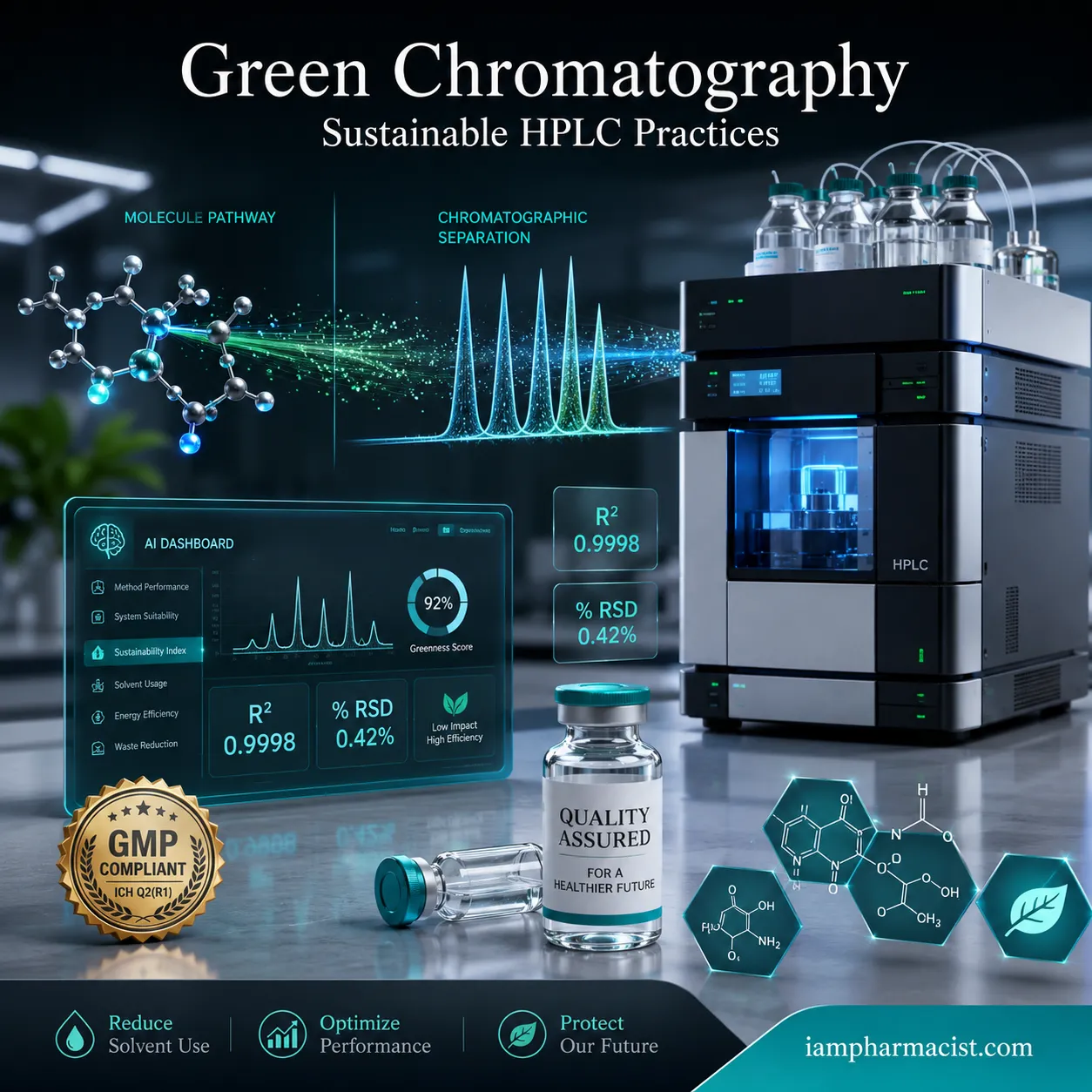

Learn sustainable HPLC practices (Green Chromatography), green solvents, miniaturized chromatography, GMP compliance, and eco-friendly analytical strategies for modern labs.
Definition
Green chromatography is the application of Green Analytical Chemistry principles to chromatographic methods, especially HPLC, to reduce solvent consumption, hazardous waste, energy usage, and environmental impact while maintaining analytical performance, regulatory compliance, and data quality. The approach includes eco-friendly solvents, miniaturized systems, sustainable sample preparation, and greenness assessment tools.
Introduction
Sustainability is rapidly becoming a strategic priority across pharmaceutical, biotechnology, food, and contract testing laboratories. Traditional HPLC methods provide excellent analytical performance but often rely on large volumes of organic solvents, generate hazardous waste, and consume significant energy.
As laboratories pursue GMP compliance, ESG objectives, and operational efficiency, green chromatography has emerged as a practical solution. Modern sustainable HPLC practices help laboratories reduce environmental impact without compromising method robustness, accuracy, or regulatory acceptance.
Recent developments in green analytical chemistry have accelerated the adoption of eco-friendly solvents, miniaturized chromatography systems, energy-efficient instrumentation, and greener sample preparation workflows. These innovations are reshaping how laboratories approach method development and lifecycle management.
What Is Green Analytical Chemistry (GAC)?
Green Analytical Chemistry (GAC) focuses on minimizing the environmental footprint of analytical procedures while maintaining scientific reliability.
Its core objectives include:
- Reducing hazardous chemical usage
- Minimizing waste generation
- Improving energy efficiency
- Reducing sample and reagent consumption
- Supporting automation and real-time monitoring
- Measuring sustainability through greenness metrics
The principles of GAC now serve as the foundation for sustainable HPLC development.
Why Green Chromatography Matters in Pharmaceutical Laboratories
| Challenge in Conventional HPLC | Green Chromatography Solution |
|---|---|
| High acetonitrile consumption | Ethanol-based mobile phases |
| Large solvent waste volumes | Micro-HPLC and UHPLC |
| Energy-intensive operations | Efficient pumps and low-flow systems |
| Hazardous sample preparation | Solvent-minimized extraction |
| ESG reporting pressures | Greenness assessment metrics |
| Rising disposal costs | Waste reduction strategies |
Key Benefits
- Lower operating costs
- Reduced hazardous waste disposal
- Improved laboratory safety
- Enhanced sustainability reporting
- Support for ESG initiatives
- Better alignment with GMP quality systems
Core Sustainable HPLC Practices
1. Use Green Solvents
Traditional HPLC relies heavily on methanol and acetonitrile. Sustainable methods increasingly replace these solvents with environmentally preferable alternatives.
Common Green Solvents
| Solvent | Sustainability Advantage |
|---|---|
| Ethanol | Renewable, low toxicity |
| Water | Minimal environmental impact |
| Ethyl Lactate | Biodegradable |
| Limonene | Bio-based alternative |
| Supercritical CO₂ | Reduced organic solvent use |
| NADES | Biodegradable and tunable |
Research demonstrates that ethanol-water mobile phases can provide excellent chromatographic performance while substantially reducing environmental impact.
2. Implement Micro-HPLC and Miniaturization
Miniaturization represents one of the most effective sustainability strategies in chromatography.
Advantages
- Up to 95% lower solvent consumption
- Reduced sample requirements
- Higher sensitivity
- Lower waste generation
- Improved operational efficiency
Micro-HPLC, capillary LC, and nano-HPLC systems achieve significant reductions in solvent usage while maintaining excellent analytical performance.
Example
A conventional method using 1.0 mL/min flow can often be redesigned to operate at 0.1–0.2 mL/min, dramatically reducing annual solvent consumption.
3. Adopt Sustainable Sample Preparation
Sample preparation often contributes the largest environmental burden within an analytical workflow.
Green Extraction Technologies
| Technique | Sustainability Benefit |
|---|---|
| SPME | Solvent-free extraction |
| FPSE | Reduced solvent requirements |
| μ-SPE | Lower reagent consumption |
| QuEChERS | Minimal waste generation |
| UAE | Faster extraction |
| MAE | Reduced energy demand |
Green sample preparation improves sustainability while maintaining analytical recovery and precision.
4. Measure Method Greenness
Modern laboratories should quantify sustainability using validated metrics.
Popular Greenness Assessment Tools
| Tool | Purpose |
|---|---|
| AGREE | Evaluates all 12 GAC principles |
| GAPI | Visual environmental assessment |
| Analytical Eco-Scale | Penalty-point system |
| BAGI | Practical applicability assessment |
These tools help compare methods and identify opportunities for continuous improvement.
Step-by-Step Guide to Implement Green HPLC
Step 1: Audit Current Methods
Evaluate:
- Solvent usage
- Energy consumption
- Waste generation
- Sample preparation requirements
Step 2: Identify High-Impact Areas
Focus on:
- Acetonitrile-heavy methods
- High-throughput assays
- Waste-intensive procedures
Step 3: Evaluate Alternative Solvents
Test:
- Ethanol-water systems
- Ethyl lactate blends
- NADES-based extraction systems
Step 4: Optimize Chromatographic Conditions
Consider:
- Shorter columns
- Smaller particle sizes
- Reduced flow rates
- UHPLC conversion
Step 5: Apply Greenness Metrics
Measure sustainability improvements using:
- AGREE
- GAPI
- Eco-Scale
Step 6: Validate Under GMP
Ensure compliance with:
- ICH guidelines
- Data integrity requirements
- Method lifecycle management
Step 7: Monitor and Improve
Track:
- Solvent consumption
- Energy usage
- Waste generation
- Cost savings
Practical Pharmaceutical Examples
Example 1: Assay Method Optimization
Before
- Mobile phase: Acetonitrile/Water (60:40)
- Flow rate: 1.0 mL/min
After
- Mobile phase: Ethanol/Water (50:50)
- Flow rate: 0.4 mL/min
Results
- Reduced solvent toxicity
- Lower disposal costs
- Comparable system suitability
Example 2: Stability-Indicating Method
Traditional Approach
- 30-minute runtime
- High solvent consumption
Green Approach
- UHPLC implementation
- 8-minute runtime
Outcome
- Reduced energy use
- Increased throughput
- Lower environmental footprint
GMP and Regulatory Considerations
Green methods must remain compliant with regulatory expectations.
Relevant Standards
GMP Requirements
- Method validation
- Data integrity
- Change control
- Risk assessment
Environmental Standards
- ISO 14001 Environmental Management Systems
- ESG reporting frameworks
- Corporate sustainability programs
Food & Pharmaceutical Quality Systems
- ISO 22000
- HACCP-based controls
- GFSI-recognized standards
Green analytical practices align closely with ISO 14001 objectives through reduced waste, lower energy consumption, and safer solvent selection.
Challenges of Green Chromatography
| Challenge | Potential Solution |
|---|---|
| Higher initial investment | Long-term cost savings |
| Method redevelopment | QbD-based optimization |
| Staff training needs | Competency programs |
| Equipment limitations | Phased implementation |
| Regulatory concerns | Robust validation strategy |
Despite these challenges, adoption continues to accelerate as sustainability becomes a laboratory performance metric.
Future Trends in Sustainable HPLC
Emerging innovations include:
- AI-assisted method development
- Smart chromatography systems
- Digital sustainability monitoring
- Life cycle assessment integration
- Automated green solvent selection
- Advanced NADES applications
- Portable microfluidic chromatography
These developments are expected to further improve analytical efficiency while reducing environmental impact.
FAQs
1. What is green chromatography?
Green chromatography applies sustainability principles to chromatographic methods by reducing solvent use, waste generation, and energy consumption.
2. What are green solvents in HPLC?
Common green solvents include ethanol, water, ethyl lactate, limonene, NADES, and supercritical CO₂.
3. Is green HPLC GMP compliant?
Yes. Green HPLC methods can be fully GMP compliant when properly validated and controlled.
4. How does micro-HPLC improve sustainability?
It reduces solvent consumption, sample volume requirements, and waste generation.
5. What is the AGREE metric?
AGREE is a greenness assessment tool that evaluates analytical methods against the 12 principles of Green Analytical Chemistry.
6. Can ethanol replace acetonitrile in HPLC?
In many applications, ethanol-water mobile phases can successfully replace acetonitrile-based systems.
7. What are the benefits of green chromatography?
Reduced costs, lower waste disposal expenses, improved safety, and stronger ESG performance.
8. Which industries use green HPLC?
Pharmaceutical, biotechnology, food, environmental, and academic laboratories.
9. What is the biggest challenge in adopting green HPLC?
Method redevelopment and initial investment in optimized instrumentation.
10. What is the future of sustainable chromatography?
AI-driven optimization, smart laboratories, microfluidic systems, and advanced green solvents.