


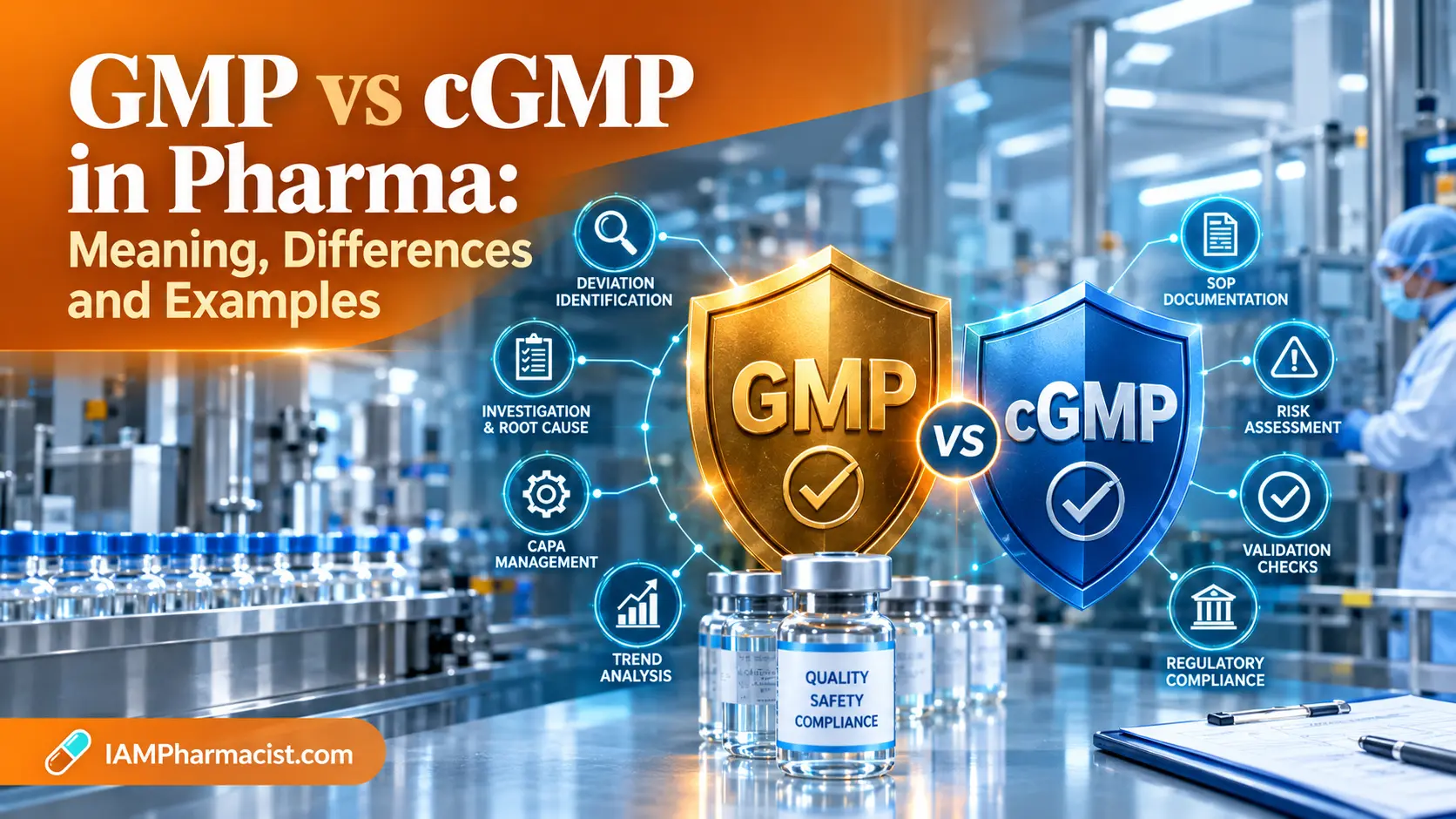

GMP vs cGMP describe controls that help medicines meet consistent quality standards. Applicable rules depend on the regulator and product. The “c” does not signal a separate or higher quality tier.
Key takeaways
- GMP means Good Manufacturing Practice; cGMP means current Good Manufacturing Practice.
- U.S. drug cGMP is primarily in 21 CFR Parts 210 and 211; EU medicinal-product GMP guidance is in EudraLex Volume 4.
- There is no single global GMP certificate that replaces each market’s legal requirements.
What is GMP in pharmaceutical manufacturing?
Good Manufacturing Practice (GMP) controls how medicines are made, tested, stored and released. It covers people, premises, equipment, materials, procedures and records that affect quality. Manufacturers must follow the rules and authorizations for their products and markets.
GMP aims to prevent contamination, mix-ups, incorrect strength and unreliable results. A tablet should contain its approved ingredients and strength; a sterile injectable needs controls against microbial contamination. FDA describes drug cGMP as minimum requirements for methods, facilities and controls that support product safety, ingredients and strength (FDA cGMP overview).
What does “current” mean in cGMP?
In U.S. FDA terminology, cGMP means current Good Manufacturing Practice. “Current” reminds manufacturers to review whether systems and controls remain suitable as science, technology and risks change. It does not mean buying the newest equipment regardless of need; controls should be scientifically sound and fit the process, as explained in the FDA cGMP overview.
U.S. drug cGMP is primarily in 21 CFR Parts 210 and 211: Part 210 provides general provisions and Part 211 covers finished pharmaceuticals. Part 212 addresses PET drugs; Part 314 concerns new drug applications; Part 600 contains general biologics provisions. These are not interchangeable cGMP rulebooks. EU medicinal-product GMP guidance is in EudraLex Volume 4.
GMP vs cGMP: key differences
| Point | GMP | cGMP |
|---|---|---|
| Meaning | General term for regulated manufacturing practices. | U.S. FDA term emphasizing current practices. |
| Common reference | EU GMP guidance, including EudraLex Volume 4. | U.S. drug rules, especially 21 CFR Parts 210 and 211. |
| Quality level | Not inherently a lower standard. | Not a separate “premium” tier. |
| Practical expectation | Meet current requirements in each applicable jurisdiction. | Maintain suitable, up-to-date controls under U.S. rules. |
Compare the actual rules, product scope and market—not just the acronym. Global manufacturers may need to map their quality systems to several frameworks.
Practical GMP examples
- Dispensing: confirm material identity, status, quantity and lot traceability before weighing.
- Production: follow an approved batch record and document process checks when they occur.
- Laboratory: use suitable instruments, approved methods, trained analysts and controlled records.
- Packaging: reconcile labels and packaging components to reduce product or strength mix-ups.
- Quality oversight: investigate deviations, assess product impact and verify corrective actions.
If tablet weights trend unexpectedly, staff should document the event, assess affected units, investigate the cause and decide whether controls need revision.
How to maintain GMP compliance
Identify rules for each product, site and market. Assess premises, equipment, suppliers, procedures, training and records. Keep procedures current, qualify equipment where required, validate processes when appropriate, and ensure staff are trained. Records should show what happened and when.
Complete, accurate and traceable data support quality decisions. Companies may use paper controls or an electronic quality management system (eQMS); software alone does not establish compliance. Review deviations, complaints and audit trends, and manage changes before they create new risks.
For U.S. medical devices, the framework is separate from drug Parts 210 and 211. FDA’s Quality Management System Regulation (QMSR) under 21 CFR Part 820 took effect on February 2, 2026, incorporating ISO 13485:2016 by reference.
Is GMP certification required?
No single worldwide GMP certificate authorizes a company to manufacture every medicine. Requirements vary and may include registration, manufacturing or import authorizations, product approvals and inspections. FDA evaluates facilities and processes during oversight and reports inspection classifications. Third-party certificates can support a program but do not replace legal duties or regulatory decisions.
Frequently asked questions
Is cGMP stricter than GMP?
Not by definition. “Current” is explicit in U.S. terminology, but the requirements that apply depend on the regulator, product and market.
Does “current” mean the newest technology?
No. It means maintaining suitable, up-to-date controls. Technology choices should fit the product, process and applicable requirements.
Which U.S. rules cover pharmaceutical cGMP?
For drugs, the core regulations are generally 21 CFR Parts 210 and 211. Part 212 covers PET drugs; other products may have additional requirements.
Is an eQMS required?
No. An eQMS can help manage documents, training, deviations and audits, but compliance depends on meeting the requirements with controlled, suitable systems.
In summary: GMP and cGMP share the goal of controlled, consistent manufacturing that protects product quality and patients. Identify the rules for each product and market, maintain suitable controls, and keep reliable evidence that they work.