


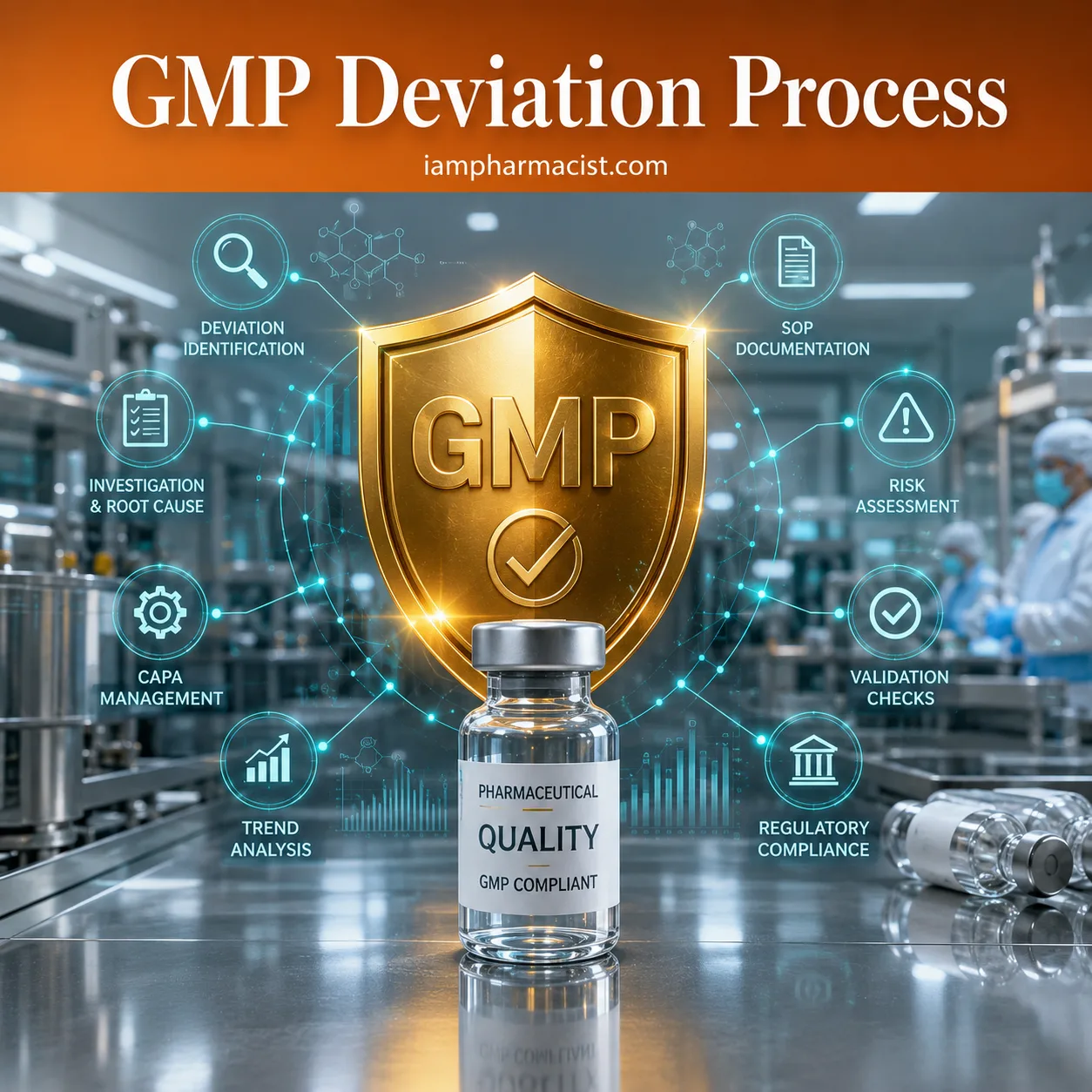

Learn the GMP deviation management process, including reporting, risk assessment, root cause analysis, CAPA, closure, trending, and audit readiness.
What Is a GMP Deviation?
A GMP deviation is an unplanned departure from an approved procedure, instruction, specification, process, or established condition.
Deviations may occur during manufacturing, packaging, testing, cleaning, storage, validation, calibration, or other GMP activities.
A good deviation system does more than document problems. It identifies why they happened, what may be affected, and how recurrence will be prevented.
GMP Deviation Management Process
| Step | Key Activity |
|---|---|
| 1 | Detect and report deviation |
| 2 | Take immediate containment action |
| 3 | Document the event |
| 4 | Assess risk and product impact |
| 5 | Investigate and determine root cause |
| 6 | Implement CAPA if required |
| 7 | Review, close, verify effectiveness and trend |
1. Detect and Report the Deviation
Report deviations as soon as they are discovered.
Record:
- Product and batch
- Date and time
- Equipment/system involved
- What happened
- Who discovered it
- Immediate action taken
Avoid vague descriptions such as “problem with filling line.”
A clear initial description makes later investigation much easier.
2. Take Immediate Containment Action
Protect the product and process before starting the full investigation.
Actions may include:
- Stop production
- Hold the batch
- Quarantine material
- Segregate affected product
- Preserve electronic data
- Notify QA
Example
If tablet hardness falls outside limits, stop compression, segregate tablets produced since the last acceptable check, notify QA, and document machine settings.
3. Assess Risk and Product Impact
Evaluate whether the deviation could affect:
- Patient safety
- Product quality
- Strength or purity
- Sterility
- Data integrity
- Other batches
- Released products
- Regulatory compliance
Companies commonly classify deviations as minor, major, or critical according to internally defined risk criteria.
4. Investigate the Deviation
A thorough investigation should review relevant evidence such as:
- Batch records
- Equipment logs
- Laboratory data
- Audit trails
- Maintenance history
- Calibration records
- Training records
- Previous similar deviations
The investigation should also determine whether other batches, products, equipment, or systems may be affected.
5. Determine the Root Cause
Root cause explains why the deviation happened, not only who made the mistake.
Useful tools include:
- 5 Whys
- Fishbone diagram
- Fault Tree Analysis
- Process mapping
- FMEA
Weak Root Cause
Operator error
Better Root Cause
The SOP was unclear, verification was missing, and operator qualification did not assess practical competency.
“Human error” should not automatically end the investigation.
6. Implement CAPA
CAPA should address the confirmed root cause.
| Action | Example |
| Correction | Replace damaged component |
| Corrective Action | Modify maintenance frequency |
| Preventive Action | Review similar equipment site-wide |
Not every minor deviation requires formal CAPA. The level of investigation and action should be proportionate to risk.
7. Close and Verify Effectiveness
Before closure, QA should confirm that the deviation contains:
- Clear investigation
- Product-impact assessment
- Root cause
- CAPA justification
- Batch disposition
- Required approvals
- Effectiveness plan
A CAPA is not effective merely because it was completed.
Better Effectiveness Check
No recurrence in the next 30 applicable batch records over the defined monitoring period.
Effectiveness criteria should be measurable and capable of failing.
Deviation Trending
Deviation trending helps identify problems that individual investigations may miss.
Trend by:
- Product
- Department
- Equipment
- Root cause
- Supplier
- Shift
- Process step
- Recurrence
- Ageing
- CAPA effectiveness
Twelve similar “minor” deviations on the same machine may indicate a significant equipment or qualification problem.
Common GMP Deviation Failures
| Failure | Compliance Risk |
| Vague deviation description | Poor investigation |
| “Human error” only | Root cause not established |
| Automatic retraining | Cause remains unresolved |
| No scope expansion | Other batches may be missed |
| Repeated extensions | Weak investigation control |
| No trending | Recurrence remains hidden |
| No CAPA effectiveness check | Recurrence risk unknown |
| Retrospective recording | Data-integrity concern |
GMP Regulatory Insights
FDA
21 CFR 211.100(b) requires deviations from written procedures to be recorded and justified.
21 CFR 211.192 requires unexplained discrepancies and specification failures to be thoroughly investigated, including potentially associated batches and products.
EU GMP
EU GMP requires significant deviations to be recorded, investigated to determine root cause, followed by appropriate CAPA and effectiveness monitoring.
ICH Q10
ICH Q10 requires a structured CAPA system and states that investigation effort, formality, and documentation should be proportionate to risk.
Deviation vs CAPA vs Change Control
| System | Purpose |
| Deviation | Investigate an unexpected event |
| CAPA | Correct causes and prevent recurrence |
| Change Control | Manage planned changes before implementation |
If an event is known and approved in advance, it should normally be assessed through change control rather than treated as an unplanned deviation.
GMP Deviation Audit Checklist
- Deviations reported promptly
- Risk classification justified
- Product impact assessed
- Investigation scope adequate
- Root cause scientifically supported
- Similar events reviewed
- CAPA addresses root cause
- Effectiveness verified
- Overdue deviations monitored
- Trends reviewed by management
Frequently Asked Questions
1. What is a deviation in GMP?
An unplanned departure from an approved procedure, specification, process, instruction, or established condition.
2. What are the main deviation-management steps?
Detection, containment, documentation, risk assessment, investigation, root-cause analysis, CAPA, closure, effectiveness verification, and trending.
3. Does every deviation require CAPA?
No. CAPA should be proportionate to the significance, recurrence, and risk of the deviation.
4. Is human error an acceptable root cause?
Not by itself in most cases. The investigation should assess procedure, training, equipment, workload, and system factors.
5. How long should a deviation remain open?
Regulations do not define one universal 30-day deadline. Companies should follow their approved internal timelines and justify extensions.
6. What is a major deviation?
A company-defined classification generally used for events with meaningful potential impact on product quality, process control, or compliance.
7. What is the difference between deviation and change control?
A deviation is unexpected. Change control evaluates and approves an intended change before implementation.
8. Why is deviation trending important?
It detects recurring and systemic problems that individual investigations may miss.
9. What do inspectors review in deviation records?
Risk assessment, investigation scope, root cause, CAPA, recurrence, overdue cases, effectiveness, and Quality Unit oversight.
10. What makes a strong deviation investigation?
Clear facts, appropriate scope, scientific root-cause analysis, risk-based actions, effective CAPA, and measurable effectiveness verification.
Conclusion
The GMP deviation management process is a key measure of Pharmaceutical Quality System effectiveness.
A strong deviation system should answer five questions:
What happened? Why did it happen? What else may be affected? What action was taken? How do we know it will not happen again?
When deviation investigations consistently answer these questions with evidence, the system supports both regulatory compliance and continuous pharmaceutical quality improvement.