


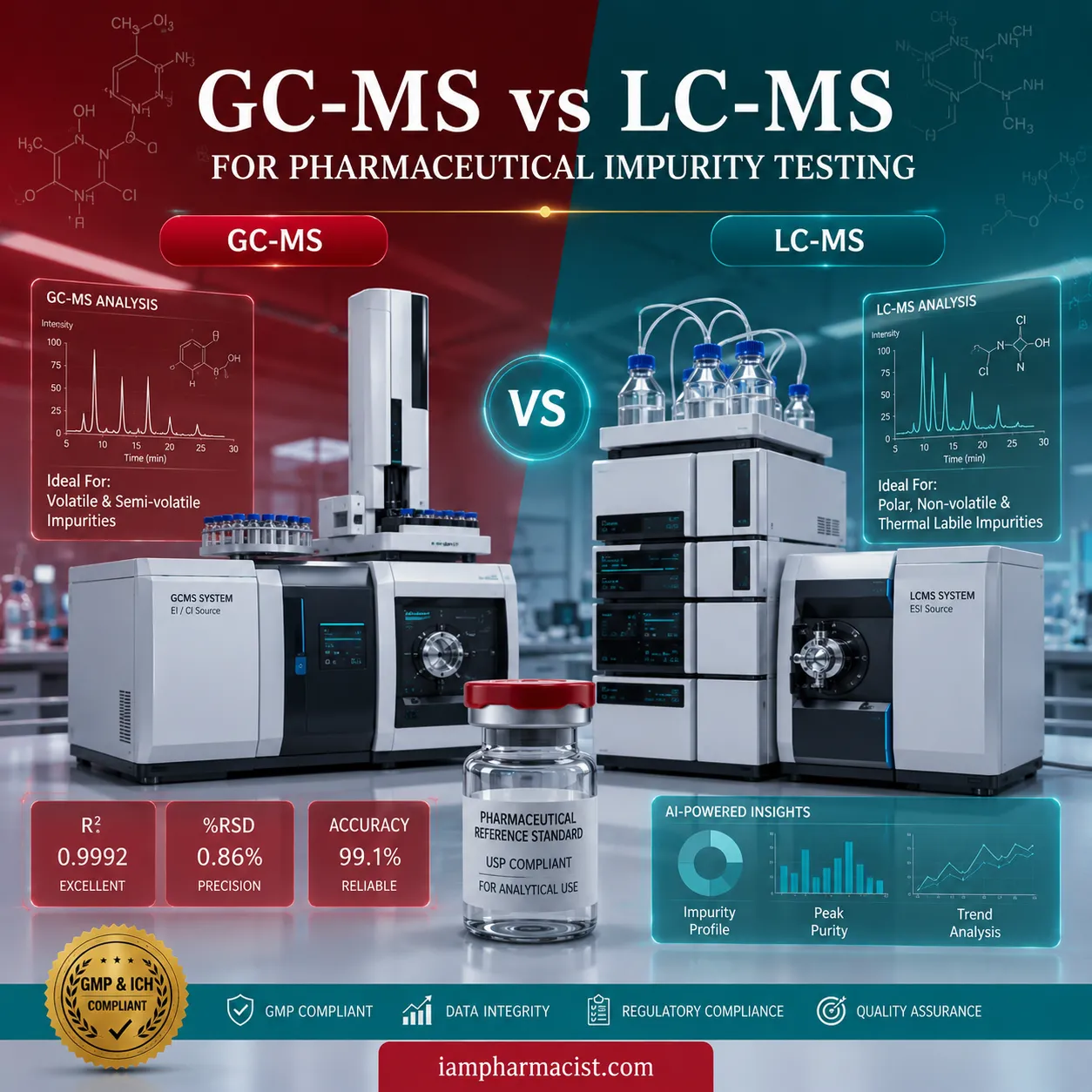

Compare GC-MS vs LC-MS for pharmaceutical impurity testing. Learn applications, regulatory requirements, advantages, limitations, and method selection.
GC-MS and LC-MS are complementary analytical techniques used for pharmaceutical impurity testing. GC-MS is ideal for volatile and thermally stable impurities such as residual solvents, while LC-MS is preferred for polar, non-volatile, heat-sensitive, and high-molecular-weight impurities including degradation products, nitrosamines, and peptide-related impurities. Selection depends on analyte volatility, polarity, molecular weight, and regulatory requirements under ICH Q3A, ICH Q3C, and ICH M7 guidelines.
Pharmaceutical impurity testing plays a critical role in ensuring drug safety, efficacy, and regulatory compliance. As regulatory expectations continue to evolve, analytical laboratories increasingly rely on advanced mass spectrometry techniques to identify, quantify, and characterize impurities at trace levels.
Among the most powerful tools available today are Gas Chromatography-Mass Spectrometry (GC-MS) and Liquid Chromatography-Mass Spectrometry (LC-MS). While both combine chromatographic separation with mass-based detection, they serve different analytical purposes.
Understanding when to use GC-MS versus LC-MS is essential for pharmaceutical scientists, quality control laboratories, method development teams, and regulatory professionals.
Understanding Pharmaceutical Impurity Testing
Impurities in pharmaceutical products may arise from:
- Manufacturing processes
- Starting materials
- Degradation during storage
- Residual solvents
- Packaging interactions
- Genotoxic contaminants
- Drug synthesis by-products
Regulatory authorities require comprehensive impurity profiling under:
| Guideline | Purpose |
|---|---|
| ICH Q3A | Impurities in New Drug Substances |
| ICH Q3B | Impurities in New Drug Products |
| ICH Q3C | Residual Solvents |
| ICH M7 | Mutagenic and DNA-Reactive Impurities |
| USP <467> | Residual Solvent Testing |
| USP <621> | Chromatography |
| USP <1225> | Validation of Analytical Procedures |
What is GC-MS?
Gas Chromatography-Mass Spectrometry (GC-MS) combines gas chromatographic separation with mass spectrometric detection.
The sample is vaporized and carried through a chromatographic column where compounds are separated based on volatility and boiling point before entering the mass spectrometer for identification.
Best Applications of GC-MS
✔ Residual solvents
✔ Volatile organic compounds (VOCs)
✔ Process impurities
✔ Starting material residues
✔ Extractables and leachables
✔ Small non-polar molecules
Advantages of GC-MS
| Advantage | Benefit |
|---|---|
| High Separation Efficiency | Excellent peak resolution |
| Spectral Libraries | NIST database matching |
| High Sensitivity | Trace-level detection |
| Robust Methodology | Widely accepted globally |
| Lower Running Costs | Compared with LC-MS in many applications |
Limitations of GC-MS
| Limitation | Impact |
|---|---|
| Requires Volatile Analytes | Not suitable for many APIs |
| Thermal Degradation Risk | Heat-sensitive compounds may decompose |
| Derivatization Often Required | Additional sample preparation |
| Limited for Large Molecules | Poor applicability to biologics |
What is LC-MS?
Liquid Chromatography-Mass Spectrometry (LC-MS) separates compounds in the liquid phase and detects them using mass spectrometry.
Unlike GC-MS, analytes do not need to be vaporized, making LC-MS suitable for a much wider range of pharmaceutical compounds.
Best Applications of LC-MS
✔ Degradation products
✔ Nitrosamines
✔ NDSRIs (Nitrosamine Drug Substance Related Impurities)
✔ Peptides
✔ Proteins
✔ Drug metabolites
✔ Polar impurities
✔ Genotoxic impurities
Advantages of LC-MS
| Advantage | Benefit |
|---|---|
| Broad Analyte Range | Works with most pharmaceutical compounds |
| Minimal Sample Preparation | Faster workflows |
| No Thermal Stress | Ideal for unstable compounds |
| Structural Elucidation | High-resolution mass spectrometry |
| Excellent Regulatory Acceptance | Widely used for impurity profiling |
Limitations of LC-MS
| Limitation | Impact |
|---|---|
| Higher Instrument Cost | Greater capital investment |
| Complex Method Development | More optimization required |
| Matrix Effects | Potential ion suppression |
| Frequent Maintenance | Source contamination possible |
GC-MS vs LC-MS: Quick Comparison
| Feature | GC-MS / GC-MS/MS | LC-MS / LC-MS/MS |
|---|---|---|
| Primary Target | Residual solvents, volatile impurities | Polar impurities, degradants, nitrosamines |
| Separation Mechanism | Volatility | Polarity and molecular interactions |
| Analyte Size | Typically <500 Da | Small molecules to proteins |
| Thermal Stability Required | Yes | No |
| Sample Preparation | Derivatization may be needed | Minimal preparation |
| Mobile Phase | Carrier gas | Liquid solvents |
| Sensitivity for Volatiles | Excellent | Moderate |
| Sensitivity for Polar Compounds | Limited | Excellent |
| Structural Identification | Strong | Excellent |
| Regulatory Use | USP <467>, ICH Q3C | ICH Q3A, ICH M7, Nitrosamines |
How to Choose Between GC-MS and LC-MS
Step 1: Evaluate Volatility
Ask:
“Can the compound be vaporized without decomposition?”
If YES → GC-MS may be suitable.
If NO → Consider LC-MS.
Step 2: Assess Thermal Stability
Heat-sensitive impurities often degrade in GC injectors.
Examples:
- Nitrosamines
- Peptides
- Biologics
- Degradation products
These are typically analyzed using LC-MS.
Step 3: Determine Molecular Size
| Molecular Type | Preferred Method |
|---|---|
| Small volatile compounds | GC-MS |
| Large molecules | LC-MS |
| Peptides | LC-MS |
| Proteins | LC-MS |
Step 4: Review Regulatory Expectations
For:
- Residual solvent analysis → GC-MS
- Nitrosamine risk assessment → LC-MS/MS
- Forced degradation studies → LC-MS
- Structural elucidation → LC-HRMS
Step 5: Consider Sample Preparation Requirements
If derivatization is required, evaluate whether LC-MS offers a simpler workflow.
Practical Example 1: Residual Solvent Testing
Scenario
A pharmaceutical manufacturer must quantify methanol, ethanol, acetone, and toluene in an API.
Recommended Technique
GC-MS
Why?
- Highly volatile analytes
- Excellent sensitivity
- Alignment with USP <467>
- Strong regulatory acceptance
Practical Example 2: Nitrosamine Analysis
Scenario
A company investigates NDMA contamination in an antihypertensive drug.
Recommended Technique
LC-MS/MS
Why?
- Extremely low detection limits required
- Polar analytes
- Compliance with FDA and EMA nitrosamine guidance
- Suitable for trace-level mutagenic impurities
Practical Example 3: Degradation Product Identification
Scenario
Forced degradation studies reveal unknown peaks during stability testing.
Recommended Technique
LC-MS with High-Resolution MS
Why?
- Enables molecular formula determination
- Supports structural elucidation
- Effective for non-volatile degradants
Regulatory and GMP Considerations
Pharmaceutical laboratories must ensure analytical methods comply with GMP requirements.
Key GMP Expectations
Method Validation
Methods should be validated for:
- Specificity
- Accuracy
- Precision
- Linearity
- Range
- Robustness
- Detection limits
Data Integrity
Compliance with:
- ALCOA+
- 21 CFR Part 11
- EU Annex 11
Risk-Based Method Selection
Regulators expect scientifically justified method selection based on impurity characteristics.
Documentation Requirements
Maintain:
- Validation protocols
- Raw data
- Audit trails
- Instrument qualification records
- Method transfer reports
Emerging Trends
High-Resolution Mass Spectrometry (HRMS)
Increasingly used for:
- Unknown impurity identification
- Nitrosamine investigations
- Extractables and leachables
LC-MS/MS Expansion
Driven by:
- ICH M7 compliance
- Genotoxic impurity monitoring
- Complex biologics characterization
Hybrid Workflows
Many laboratories use:
GC-MS + LC-MS + HRMS
to achieve complete impurity coverage throughout product development and commercialization.
FAQs
1. What is the main difference between GC-MS and LC-MS?
GC-MS analyzes volatile compounds, while LC-MS analyzes non-volatile, polar, and thermally unstable compounds.
2. Which technique is better for residual solvent testing?
GC-MS is generally considered the preferred technique for residual solvent analysis.
3. Is LC-MS suitable for nitrosamine testing?
Yes, LC-MS/MS is widely used for nitrosamine and NDSRI analysis.
4. Why is derivatization required in GC-MS?
Derivatization increases volatility and thermal stability of compounds that cannot be analyzed directly.
5. Can LC-MS analyze proteins?
Yes, LC-MS can analyze proteins, peptides, and other large biomolecules.
6. Which method offers better sensitivity?
Sensitivity depends on analyte type, but GC-MS excels for volatile compounds while LC-MS performs better for polar compounds.
7. What regulations govern impurity testing?
ICH Q3A, ICH Q3B, ICH Q3C, ICH M7, USP chapters, FDA guidance, and EMA requirements.
8. Is LC-MS more expensive than GC-MS?
Generally yes, due to higher instrument costs, solvent consumption, and maintenance requirements.
9. Can both methods be used in the same laboratory?
Yes, many GMP laboratories use both techniques for comprehensive impurity profiling.
10. Which method is preferred for degradation products?
LC-MS is typically preferred because degradation products are often non-volatile and thermally unstable.