


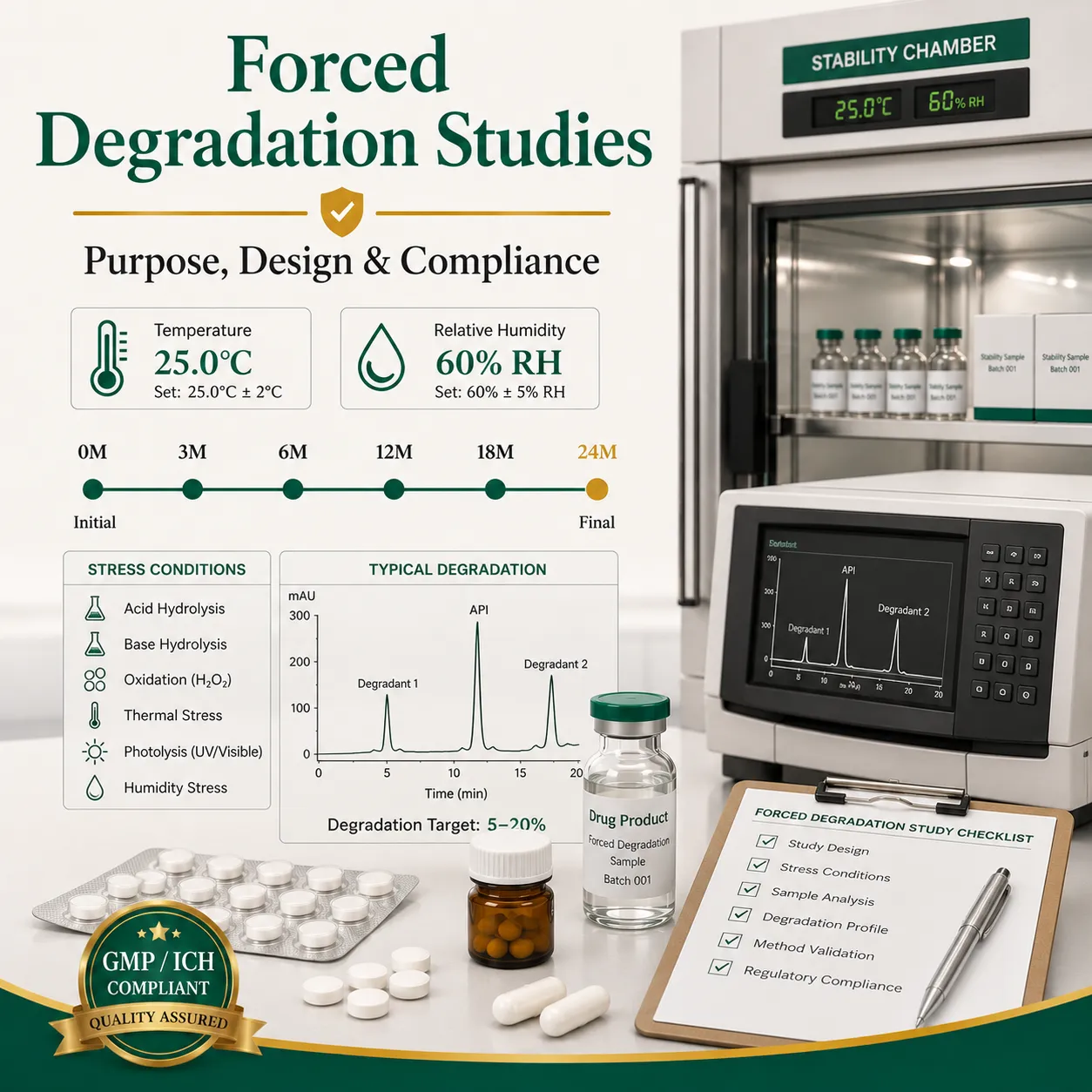

Learn forced degradation study design, stress conditions, stability-indicating methods, ICH requirements, and regulatory expectations.
Definition
Forced degradation studies are pharmaceutical stress-testing experiments that intentionally expose drug substances and drug products to extreme conditions such as heat, light, oxidation, humidity, and pH variations to identify degradation pathways, characterize impurities, and develop stability-indicating analytical methods required for regulatory approval.
Introduction
Every pharmaceutical product begins degrading from the moment it is manufactured. Understanding how, why, and under what conditions degradation occurs is critical for ensuring product quality, efficacy, and patient safety.
This is where forced degradation studies, also known as stress testing studies, become indispensable. Unlike routine stability studies that monitor degradation under normal storage conditions, forced degradation intentionally accelerates degradation using severe stress conditions to reveal a molecule’s vulnerabilities.
Regulatory agencies worldwide expect manufacturers to understand degradation mechanisms, identify degradation products, and demonstrate that analytical methods can accurately distinguish the active pharmaceutical ingredient (API) from degradants and excipients.
This article provides a comprehensive guide to forced degradation studies, including objectives, study design, stress conditions, regulatory expectations, and best practices for pharmaceutical professionals.
What Are Forced Degradation Studies?
Forced degradation studies involve exposing an API or drug product to extreme environmental and chemical stress conditions to accelerate degradation.
The studies help scientists:
- Understand degradation mechanisms
- Identify degradation products
- Develop stability-indicating methods
- Establish impurity profiles
- Support formulation development
- Meet regulatory requirements
Unlike long-term stability studies, forced degradation focuses on understanding molecular behavior rather than predicting shelf life.
Why Forced Degradation Studies Are Important
Key Objectives
| Objective | Purpose |
|---|---|
| Degradation Pathway Identification | Understand how the molecule breaks down |
| Impurity Characterization | Detect potential degradants early |
| Stability-Indicating Method Development | Demonstrate analytical specificity |
| Formulation Optimization | Improve product stability |
| Packaging Selection | Evaluate protective packaging needs |
| Regulatory Compliance | Support global submissions |
Relationship Between Forced Degradation and Stability Studies
| Parameter | Forced Degradation | Stability Studies |
|---|---|---|
| Purpose | Understand degradation mechanisms | Determine shelf life |
| Conditions | Extreme stress | Realistic storage conditions |
| Duration | Days to weeks | Months to years |
| Degradation Level | Intentional | Natural |
| Regulatory Use | Method development and validation | Product registration |
Both studies complement each other throughout product development.
Scientific Basis of Forced Degradation
Drug molecules may degrade through various chemical pathways.
Common Degradation Mechanisms
- Hydrolysis
- Oxidation
- Photolysis
- Thermolysis
- Humidity-induced degradation
- Isomerization
- Decarboxylation
- Polymerization
Understanding these mechanisms allows scientists to predict product stability risks.
Designing a Forced Degradation Study
A scientifically justified approach is essential.
Key Design Considerations
Drug Characteristics
Evaluate:
- Molecular structure
- Functional groups
- Solubility
- pKa
- Known degradation tendencies
Product Characteristics
Consider:
- Dosage form
- Excipients
- Packaging
- Manufacturing process
Analytical Capability
Methods should detect:
- Parent compound
- Known impurities
- Unknown degradants
Common Stress Conditions
1. Acid Hydrolysis
Acidic conditions evaluate susceptibility to proton-catalyzed degradation.
Typical Conditions
| Parameter | Example |
|---|---|
| Acid | HCl |
| Concentration | 0.1–1.0 N |
| Temperature | 25–80°C |
| Duration | Several hours to days |
Potential Outcome
- Ester hydrolysis
- Amide cleavage
- Rearrangement reactions
2. Base Hydrolysis
Basic conditions can degrade many APIs rapidly.
Typical Conditions
| Parameter | Example |
|---|---|
| Base | NaOH |
| Concentration | 0.01–1.0 N |
| Temperature | 25–80°C |
Common Effects
- Lactam opening
- Ester degradation
- Structural rearrangement
3. Oxidative Degradation
Oxidation is among the most common degradation pathways.
Stress Agent
Hydrogen peroxide (H₂O₂)
| Concentration | Exposure Time |
|---|---|
| 0.1% | 24–48 hours |
| 3% | 6–24 hours |
| 10% | Short exposure |
Common Targets
- Phenolic groups
- Amines
- Sulfur-containing compounds
4. Thermal Degradation
Heat accelerates chemical reactions.
Typical Conditions
| Temperature | Duration |
|---|---|
| 50°C | Several days |
| 60°C | Several days |
| 80°C | Short-term stress |
Both dry and moist heat conditions may be evaluated.
5. Photolytic Degradation
Photostability testing assesses light sensitivity.
Common Practice
Exposure levels often exceed:
- ICH Q1B requirements
- Frequently ≥2× confirmatory exposure
Light Sources
- Xenon lamps
- UV lamps
- Visible light systems
6. Humidity Stress
Particularly important for hygroscopic compounds.
Typical Conditions
| Relative Humidity | Temperature |
|---|---|
| 75% RH | 40°C |
| 80% RH | 30–40°C |
| 90% RH | Stress evaluation |
Optimal Degradation Target
The goal is not maximum degradation.
Recommended Target
| Degradation Level | Interpretation |
|---|---|
| <5% | Insufficient stress |
| 5–20% | Ideal range |
| 20–30% | Acceptable with justification |
| >30% | Excessive degradation |
Excessive degradation may generate secondary artifacts not relevant to actual product stability.
Developing Stability-Indicating Methods
One of the most important applications of forced degradation studies is developing a Stability-Indicating Method (SIM).
What Is a Stability-Indicating Method?
A method capable of:
- Separating API from degradants
- Quantifying impurities accurately
- Detecting degradation products
- Demonstrating analytical specificity
Example: HPLC Stability-Indicating Method
Before Stress
| Peak | Retention Time |
|---|---|
| API | 8.5 min |
After Oxidative Stress
| Peak | Retention Time |
|---|---|
| API | 8.5 min |
| Degradant A | 4.2 min |
| Degradant B | 11.1 min |
Successful separation demonstrates method specificity.
Practical Example: Tablet Formulation
Product
Immediate-release tablet containing an oxidation-sensitive API.
Stress Results
| Condition | Degradation |
|---|---|
| Acid | 8% |
| Base | 12% |
| Oxidation | 18% |
| Thermal | 4% |
| Photolysis | 15% |
| Humidity | 6% |
Conclusion
Major degradation pathways:
- Oxidation
- Photolysis
Development Actions
- Added antioxidant excipient
- Introduced amber packaging
- Modified storage recommendations
Regulatory Importance of Forced Degradation Studies
Forced degradation studies play a critical role in regulatory submissions.
ICH Q1A(R2)
ICH Q1A emphasizes stress testing during development to establish degradation pathways and identify likely degradation products.
Regulatory Objectives
- Understand intrinsic stability
- Predict degradation behavior
- Support stability programs
ICH Q1B
Photostability requirements help identify light-induced degradation pathways.
Manufacturers must evaluate:
- Drug substances
- Drug products
- Packaging protection
ICH Q2(R2)
Analytical validation requires demonstrating specificity.
Forced degradation studies provide evidence that methods can separate:
- API
- Impurities
- Degradation products
Without stress testing, stability-indicating capability cannot be adequately demonstrated.
ICH Q3A and Q3B
These guidelines address impurity qualification and reporting thresholds.
Regulatory Expectations
Degradation products exceeding reporting thresholds may require:
- Identification
- Structural characterization
- Qualification studies
- Toxicological assessment
GMP Considerations
Forced degradation studies should be conducted under controlled and documented conditions.
Documentation Requirements
Maintain:
- Approved protocols
- Stress conditions
- Analytical results
- Chromatograms
- Calculations
- Investigation records
Data Integrity
Follow ALCOA+ principles:
✓ Attributable
✓ Legible
✓ Contemporaneous
✓ Original
✓ Accurate
✓ Complete
✓ Consistent
✓ Enduring
✓ Available
Equipment Qualification
Equipment should be:
- Calibrated
- Maintained
- Qualified
- Fit for intended use
Common Regulatory Deficiencies
| Deficiency | Regulatory Concern |
|---|---|
| No stress testing | Incomplete development package |
| Inadequate degradation | Method specificity not proven |
| Missing degradant identification | Safety concerns |
| Excessive degradation | Artificial impurity generation |
| Poor documentation | GMP observations |
| Weak scientific justification | Regulatory questions |
Best Practices for Forced Degradation Studies
Study Design
✓ Evaluate all major degradation pathways
✓ Justify stress conditions scientifically
✓ Include both API and drug product
Analytical Methods
✓ Use validated methods
✓ Demonstrate peak purity
✓ Confirm degradation separation
Documentation
✓ Record all conditions
✓ Retain chromatograms
✓ Maintain traceability
Regulatory Compliance
✓ Follow ICH guidance
✓ Characterize significant degradants
✓ Support method validation
FAQs
1. What is a forced degradation study?
A forced degradation study intentionally exposes a drug substance or product to stress conditions to understand degradation pathways and impurity formation.
2. Why are forced degradation studies performed?
They support method development, impurity identification, formulation optimization, and regulatory compliance.
3. What is the ideal degradation level in stress studies?
Most studies target approximately 5–20% degradation of the parent compound.
4. Which stress conditions are commonly used?
Acid, base, oxidation, heat, humidity, and photolytic stress.
5. What is a stability-indicating method?
A method capable of accurately separating and quantifying the API and all degradation products.
6. Does ICH require forced degradation studies?
Yes. ICH Q1A, Q1B, and Q2 support stress testing as part of stability and analytical method development.
7. Why is oxidative stress important?
Many APIs are susceptible to oxidation, making it a common degradation pathway.
8. Can forced degradation studies be performed on finished products?
Yes. Both drug substances and drug products should be evaluated.
9. What happens if degradation exceeds 30%?
Excessive degradation may generate secondary degradants that are not representative of actual stability conditions.
10. How do forced degradation studies support regulatory submissions?
They provide evidence of degradation pathways, impurity characterization, and analytical method specificity required by health authorities.