


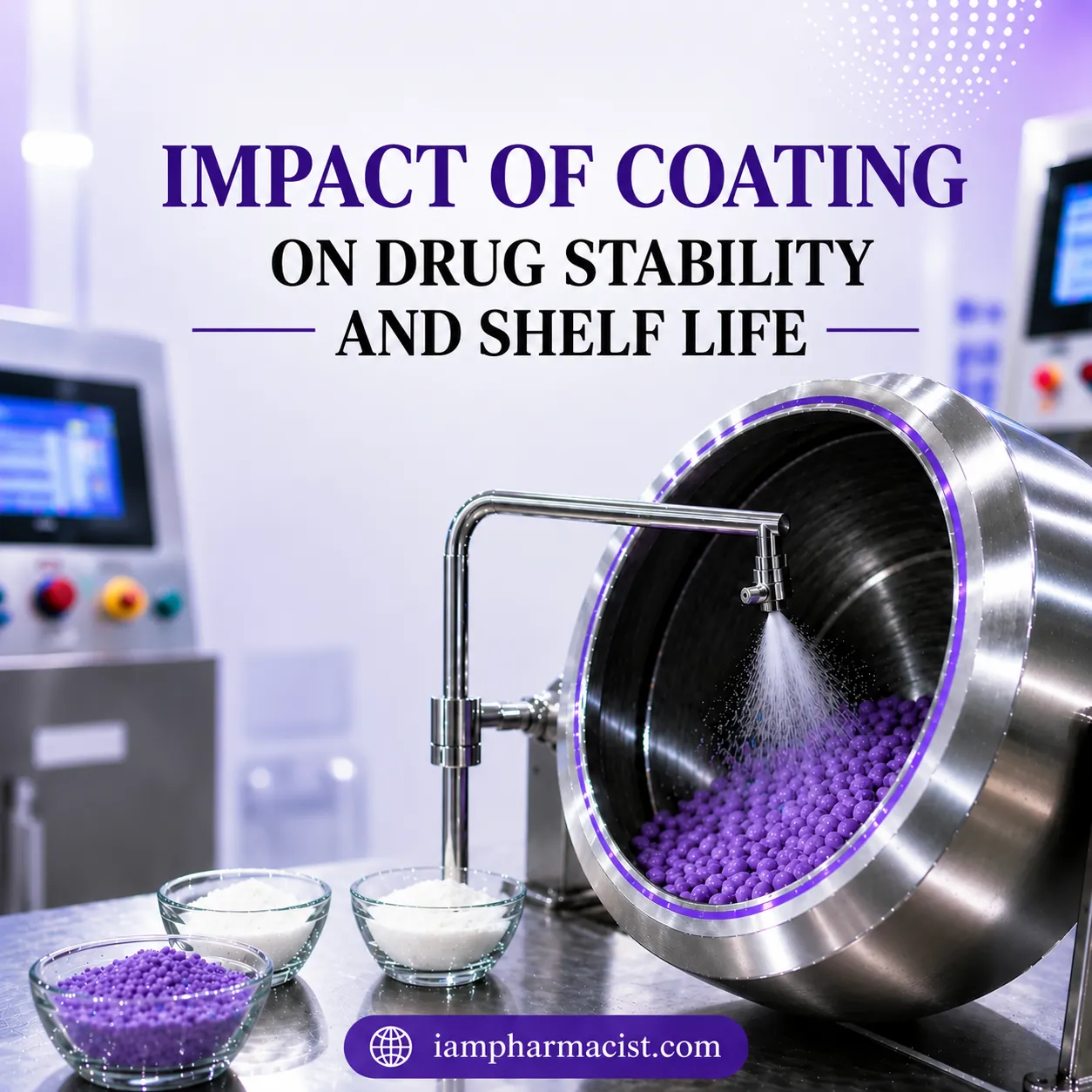

Discover how coating polymers and plasticizers influence drug stability, degradation, and shelf life in pharmaceutical tablet formulations.
What Is the Impact of Coating on Drug Stability?
Drug coating significantly influences the chemical and physical stability of pharmaceutical products by protecting active pharmaceutical ingredients (APIs) from moisture, oxygen, light, and environmental stress. The selection of coating polymers and plasticizers can either enhance or reduce drug shelf life depending on their compatibility, solubility behavior, and interaction with the API.
Introduction
In pharmaceutical manufacturing, coating is far more than a cosmetic finishing step. Modern tablet coatings play a critical role in protecting drugs from degradation pathways that reduce potency and compromise therapeutic performance. The right coating formulation can extend product shelf life, improve stability under accelerated storage conditions, and ensure regulatory compliance. https://iampharmacist.com/key-scale-up-challenges-in-tablet-coating/
A recent formulation study on peliglitazar, a drug susceptible to both acid- and base-catalyzed degradation, demonstrated how coating excipients directly influence long-term stability. Different combinations of coating polymers and plasticizers showed substantial differences in degradation rates under accelerated stability conditions.
Understanding these interactions is essential for formulation scientists, pharmaceutical manufacturers, and quality assurance teams aiming to develop stable oral solid dosage forms.
Why Tablet Coating Matters in Pharmaceutical Stability
Tablet coating creates a protective barrier around the API. This barrier can:
- Reduce moisture penetration
- Limit oxygen exposure
- Prevent light-induced degradation
- Improve chemical compatibility
- Control drug migration within the coating matrix
- Enhance mechanical integrity during storage
Coating performance depends heavily on excipient selection, particularly:
| Component | Function | Stability Impact |
|---|---|---|
| Film-forming polymer | Forms protective coating layer | Controls moisture barrier and drug mobility |
| Plasticizer | Improves flexibility | Influences API solubility within coating |
| Detackifier | Prevents sticking during coating | Affects coating uniformity |
| Solvent system | Dissolves coating materials | Influences film formation quality |
Coating Effects on Peliglitazar Stability
The study investigated the stability behavior of active pan-coated peliglitazar tablets prepared using different coating combinations.
Experimental Conditions
Coating Polymers
- Hydroxypropyl methylcellulose (HPMC)
- Polyvinyl alcohol (PVA)
Plasticizers/Detackifiers
- Triacetin (glycerol triacetate)
- Polyethylene glycol (PEG)
Stability Conditions
- 40°C / 75% RH accelerated stability
- HDPE bottles
- Open and closed storage conditions
- Stability monitored using HPLC analysis
Comparative Stability Results
The formulations demonstrated the following stability ranking:
- HPMC + Triacetin
- PVA + Triacetin
- HPMC + PEG
- PVA + PEG
This ranking clearly indicates that both the polymer and the plasticizer significantly affect chemical degradation.
| Coating Combination | Relative Stability | Key Observation |
|---|---|---|
| HPMC + Triacetin | Highest | Lowest API mobility and solubility |
| PVA + Triacetin | High | Better than PEG systems |
| HPMC + PEG | Moderate | Increased drug solubility |
| PVA + PEG | Lowest | Highest degradant formation |
Why Triacetin Improved Stability
Triacetin-based coatings showed superior stability compared with PEG systems.
Key Reasons
Lower Drug Solubility
Peliglitazar exhibited lower solubility in triacetin-containing coatings. Reduced solubility limits molecular mobility and slows degradation reactions.
Reduced Moisture Interaction
Triacetin is less hygroscopic than PEG, minimizing water uptake under humid conditions.
Better Barrier Properties
Triacetin-based films create a more hydrophobic environment that protects sensitive APIs.
Why HPMC Outperformed PVA
HPMC formulations demonstrated improved stability compared with PVA systems under identical plasticizer conditions.
Mechanisms Behind Improved Stability
Lower API Mobility
Drug diffusion within HPMC matrices was lower, reducing degradation kinetics.
Improved Film Integrity
HPMC coatings maintained structural stability under accelerated humidity conditions.
Reduced Interaction with API
HPMC exhibited lower chemical interaction potential with peliglitazar.
How Coating Influences Drug Shelf Life
1. Moisture Protection
Hydrophobic coatings reduce water penetration that can trigger hydrolysis.
2. Oxygen Barrier
Dense polymer films slow oxidation-sensitive degradation.
3. Chemical Compatibility
Incompatible excipients may catalyze degradation reactions.
4. Reduced API Migration
Lower molecular mobility stabilizes sensitive compounds.
5. Improved Storage Stability
Optimized coatings help products maintain potency throughout shelf life.
Step-by-Step: How to Optimize Coating for Drug Stability
Step 1: Evaluate API Sensitivity
Determine whether the API is sensitive to:
- Moisture
- Oxidation
- Acid/base conditions
- Heat
- Light
Step 2: Select Compatible Polymers
Choose film-forming polymers with:
- Low hygroscopicity
- Minimal API interaction
- Strong barrier properties
Common options include:
- HPMC
- PVA
- Ethyl cellulose
- Acrylate copolymers
Step 3: Optimize Plasticizer Selection
Evaluate:
- API solubility in plasticizer
- Water affinity
- Film flexibility
- Migration potential
Step 4: Conduct Accelerated Stability Studies
Use ICH stability conditions such as:
- 40°C/75% RH
- 30°C/65% RH
Step 5: Analyze Degradation Products
Use stability-indicating analytical methods including:
- HPLC
- UPLC
- LC-MS
Step 6: Assess Packaging Compatibility
Test coating performance in:
- HDPE containers
- Blister packs
- Desiccant systems
Key Pharmaceutical Insights from the Study
The study highlights several important formulation principles:
- Coating excipients are not chemically inert
- Plasticizer selection directly affects degradation kinetics
- Polymer-drug interactions influence stability outcomes
- Hydrophobic systems generally improve shelf life
- Accelerated stability testing remains essential during formulation development
Best Practices for Stable Tablet Coatings
Use Low-Hygroscopic Excipients
Moisture-sensitive drugs benefit from hydrophobic coating systems.
Minimize API Mobility
Reducing diffusion within coatings improves chemical stability.
Optimize Coating Thickness
Excessively thin coatings may provide insufficient protection.
Validate Under Realistic Conditions
Test formulations under both open and closed storage systems.
Monitor Long-Term Stability
Accelerated studies should be complemented by real-time stability data.
Regulatory Considerations
Pharmaceutical coating systems must comply with:
- ICH stability guidelines
- FDA excipient safety requirements
- GMP manufacturing standards
- Stability-indicating analytical validation protocols
Proper documentation of coating formulation rationale is increasingly important for regulatory submissions.
Conclusion
The impact of coating on drug stability and shelf life is substantial and often underestimated during formulation development. The peliglitazar study clearly demonstrates that both film-forming polymers and plasticizers significantly influence degradation behavior.
Among the evaluated systems, HPMC-triacetin coatings provided the best stability due to lower drug solubility and reduced molecular mobility within the coating matrix. In contrast, PEG-containing systems accelerated degradation because of increased API solubility and moisture interaction.
For pharmaceutical scientists, careful coating excipient selection is essential for maximizing product stability, ensuring regulatory compliance, and extending commercial shelf life.
FAQs
1. How does tablet coating improve drug stability?
Tablet coating protects APIs from moisture, oxygen, light, and environmental stress that can trigger degradation.
2. Which coating polymer provides better stability: HPMC or PVA?
HPMC generally provides better stability due to lower drug mobility and improved moisture resistance.
3. Why is PEG associated with lower stability?
PEG can increase drug solubility and moisture uptake, accelerating degradation reactions.
4. What role does triacetin play in tablet coating?
Triacetin acts as a plasticizer that improves film flexibility while reducing drug solubility within the coating.
5. What is accelerated stability testing?
Accelerated stability testing exposes products to elevated temperature and humidity to predict shelf life.
6. Why are coating excipients important in pharmaceuticals?
Coating excipients affect film integrity, chemical compatibility, moisture protection, and drug release behavior.
7. How is drug degradation measured during stability studies?
Stability-indicating HPLC methods are commonly used to quantify degradation products.
8. What packaging was used in the peliglitazar study?
HDPE bottles with desiccants were used under open and closed storage conditions.
9. Can coating increase pharmaceutical shelf life?
Yes. Optimized coating systems can significantly extend product shelf life and maintain potency.
10. What factors influence coating performance?
Polymer type, plasticizer selection, coating thickness, humidity exposure, and API compatibility all influence coating effectiveness.
{ “@context”: “https://schema.org”, “@graph”: [ { “@type”: “Article”, “headline”: “Impact of Coating on Drug Stability and Shelf Life”, “description”: “Learn how coating polymers and plasticizers influence pharmaceutical drug stability and shelf life.”, “author”: { “@type”: “Person”, “name”: “Editorial Team” }, “publisher”: { “@type”: “Organization”, “name”: “Pharma Insights” }, “mainEntityOfPage”: { “@type”: “WebPage”, “@id”: “https://example.com/impact-of-coating-on-drug-stability-and-shelf-life” }, “keywords”: [ “drug stability”, “tablet coating”, “HPMC”, “PVA”, “triacetin”, “PEG”, “pharmaceutical coating” ] }, { “@type”: “HowTo”, “name”: “How to Optimize Coating for Drug Stability”, “step”: [ { “@type”: “HowToStep”, “name”: “Evaluate API Sensitivity” }, { “@type”: “HowToStep”, “name”: “Select Compatible Polymers” }, { “@type”: “HowToStep”, “name”: “Optimize Plasticizer Selection” }, { “@type”: “HowToStep”, “name”: “Conduct Stability Studies” }, { “@type”: “HowToStep”, “name”: “Analyze Degradation Products” } ] }, { “@type”: “FAQPage”, “mainEntity”: [ { “@type”: “Question”, “name”: “How does tablet coating improve drug stability?”, “acceptedAnswer”: { “@type”: “Answer”, “text”: “Tablet coating protects APIs from moisture, oxygen, and environmental stress.” } }, { “@type”: “Question”, “name”: “Which coating polymer provides better stability: HPMC or PVA?”, “acceptedAnswer”: { “@type”: “Answer”, “text”: “HPMC generally provides better stability due to lower drug mobility and moisture interaction.” } } ] } ] }