


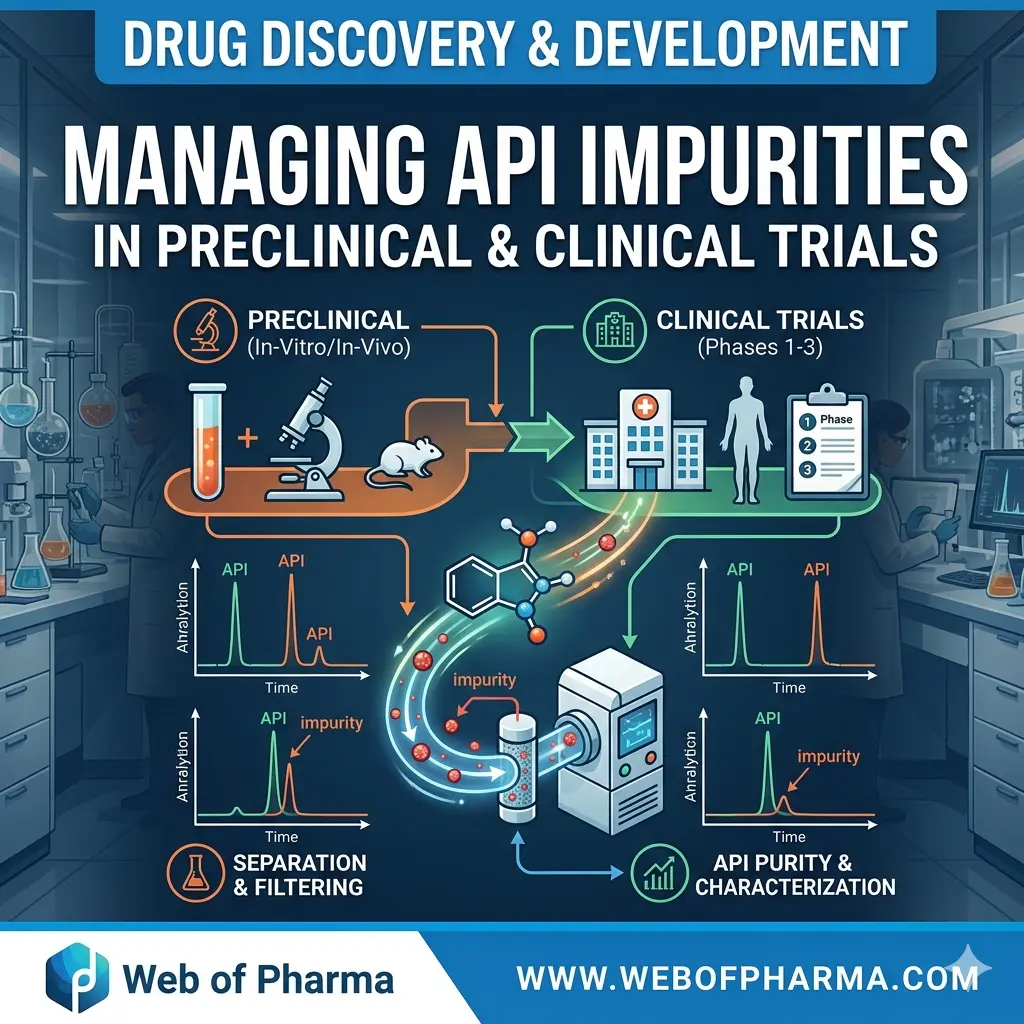

Learn how drug discovery and development companies manage impurities in APIs during preclinical and clinical trials. Explore CMC drug development, analytical strategies, regulatory compliance, and best practices for safe, effective pharmaceutical products.
Active Pharmaceutical Ingredients (APIs) are the core of every pharmaceutical product, representing the active component that delivers therapeutic effects. During drug discovery and development, ensuring that APIs are free from impurities is critical for patient safety, product efficacy, and regulatory compliance.
Even trace amounts of impurities in APIs can compromise clinical drug development and CMC drug development stages. This article explores the types and sources of impurities, analytical strategies, and best practices to address these challenges during preclinical and clinical trials.
What Are API Impurities?
Impurities are unwanted chemicals or byproducts formed during API manufacturing. They may arise from:
- Manufacturing processes
- Reaction intermediates
- Solvents or reagents
- Degradation of the final API
Even small quantities of these impurities can affect the quality and safety of the pharmaceutical product.
Types of Impurities
According to ICH Q3A and Q3B guidelines, impurities are classified as:
- Organic Impurities: Byproducts or degradation products similar to the API.
- Inorganic Impurities: Residues from catalysts, reagents, inorganic salts, or heavy metals.
- Residual Solvents: Traces of solvents not completely removed during production.
Sources of Impurities
Understanding the source is key to resolving impurity issues:
- Raw Materials: Contaminated starting materials may introduce impurities.
- Manufacturing Process: Side reactions or variations in temperature and pH may produce byproducts.
- Incomplete Reactions: Unfinished reactions leave residual impurities.
- Solvents & Reagents: Impure solvents or reagents contribute to residual contamination.
- Storage Conditions: Improper storage can lead to degradation.
- Packaging Materials: Chemical interactions with packaging may generate impurities.
Analytical Methods for Impurity Detection
Modern drug discovery companies rely on precise analytical methods to detect impurities during CMC drug development and preclinical studies:
- High-Performance Liquid Chromatography (HPLC): Identifies and quantifies organic impurities.
- Gas Chromatography (GC): Detects volatile compounds and residual solvents.
- Mass Spectroscopy (MS): Determines molecular structures of unknown impurities.
- Nuclear Magnetic Resonance (NMR): Characterizes molecular structures of impurities.
- Fourier Transform Infrared Spectroscopy (FTIR): Identifies functional groups and compares with standards.
All methods must comply with ICH Q2(R1) validation to ensure reliability, sensitivity, and specificity.
Strategies to Resolve API Impurity Issues
Once impurities are identified and their sources determined, preclinical and clinical trials benefit from implementing the following strategies:
A. Process Optimization
- Improve Raw Material Quality: Use high-quality starting materials.
- Adjust Reaction Conditions: Optimize temperature, pH, and solvents to minimize byproducts.
- Modify Manufacturing Pathway: Alternative synthesis routes may reduce impurity formation.
B. Purification Techniques
- Filtration: Removes insoluble impurities.
- Crystallization: Selectively isolates the desired API from byproducts.
- Distillation: Separates volatile solvents and residual impurities.
C. Stability Studies
- Accelerated Stability Testing: Detects degradation products early in development.
- Stress Testing: Evaluates API stability under extreme conditions like heat, light, or oxidation.
Documentation of these activities ensures compliance with regulatory standards and supports clinical drug development.
Regulatory Guidelines and Compliance
Regulatory authorities take API impurities seriously:
- ICH Q3A (R2): Impurities in New Drug Substances
- ICH Q3B (R2): Impurities in New Drug Products
- USP & EP Monographs: Provide limits and analytical methods
Agencies mandate that impurities above 0.05% must be identified, quantified, and reported. Failure to comply may result in regulatory action or product recalls.
Conclusion
Effective management of impurities in APIs is an integral part of drug discovery and development. From CMC drug development to preclinical and clinical trials, controlling impurities ensures patient safety, product quality, and regulatory compliance. By combining advanced analytical methods, optimized manufacturing processes, and rigorous stability studies, pharmaceutical companies can safeguard both product integrity and public health.
FAQs on API Impurities in Drug Development
Q1. What are API impurities?
A: API impurities are unwanted chemicals or byproducts formed during manufacturing, storage, or degradation of active pharmaceutical ingredients.
Q2. Why is impurity control important in drug discovery and development?
A: Impurity control ensures safety, efficacy, regulatory compliance, and smooth progression through preclinical and clinical trials.
Q3. What types of impurities exist in pharmaceutical products?
A: Organic impurities, inorganic impurities, and residual solvents as per ICH Q3A and Q3B guidelines.
Q4. How are impurities detected in APIs?
A: Using HPLC, GC, MS, NMR, and FTIR, validated according to ICH Q2(R1).
Q5. What are common sources of impurities?
A: Raw materials, manufacturing processes, solvents, reagents, storage conditions, and packaging interactions.
Q6. What strategies help minimize impurity formation?
A: Process optimization, purification techniques (filtration, crystallization, distillation), and stability studies.
Q7. What is the role of CMC drug development in impurity control?
A: CMC ensures that APIs and final products are consistently manufactured with controlled impurity levels.
Q8. How do stability studies help in impurity management?
A: They identify potential degradation products under stress and accelerated conditions early in development.
Q9. What regulatory guidelines govern impurity levels?
A: ICH Q3A/Q3B, USP, and EP guidelines dictate limits and testing procedures for impurities.
Q10. Who is responsible for monitoring impurities during drug development?
A: Drug discovery companies, quality control teams, and regulatory affairs professionals collectively ensure impurity control during preclinical and clinical trials.