


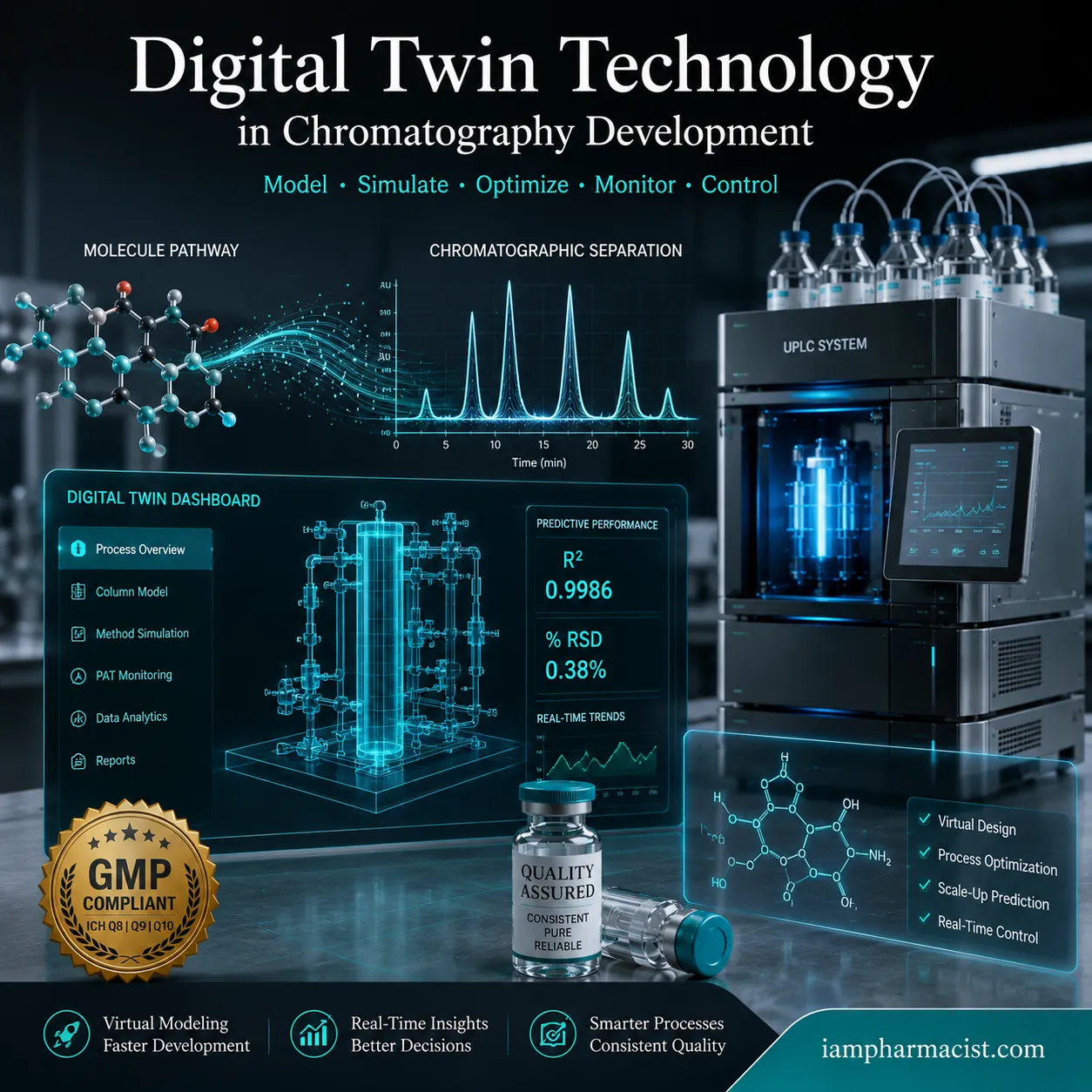

Discover how Digital Twin Technology transform chromatography process development through virtual optimization, scale-up prediction, PAT integration, and GMP compliance.
Definition
Digital Twin Technology in Chromatography Process Development is a virtual representation of a chromatography process that combines mechanistic models, process data, and real-time analytics to simulate, predict, optimize, and control chromatographic separations throughout the product lifecycle. Digital twins enable faster method development, more reliable scale-up, improved process robustness, and enhanced GMP compliance.
Introduction
Chromatography remains one of the most critical and costly operations in pharmaceutical and biopharmaceutical manufacturing. Traditionally, method development and scale-up have relied heavily on laboratory experimentation, requiring extensive trials to identify optimal process conditions.
Today, advances in digital twin technology are transforming chromatography development. Instead of relying solely on physical experiments, scientists can build highly accurate virtual representations of chromatography processes, enabling rapid simulation, optimization, troubleshooting, and scale-up before implementing changes in the laboratory.
By integrating mechanistic modeling, artificial intelligence (AI), machine learning (ML), and Process Analytical Technology (PAT), digital twins are becoming powerful tools for accelerating pharmaceutical development while supporting Quality by Design (QbD) principles and regulatory expectations.
What Is a Digital Twin?
A digital twin is a dynamic virtual model that accurately replicates a physical process, system, or asset.
Unlike traditional simulations, digital twins continuously evolve using real-world process data.
Digital Twin vs Traditional Process Modeling
| Feature | Traditional Model | Digital Twin |
|---|---|---|
| Static simulations | Yes | No |
| Real-time updates | Limited | Continuous |
| PAT integration | Minimal | Extensive |
| Predictive capabilities | Moderate | Advanced |
| Closed-loop optimization | Rare | Common |
| Lifecycle support | Partial | Full |
Why Digital Twins Matter in Chromatography
Chromatographic separations involve complex interactions between:
- Mobile phase composition
- Stationary phase chemistry
- Protein adsorption
- Mass transfer mechanisms
- Column hydrodynamics
- Process variability
Traditional experimentation can require hundreds of development runs.
Digital twins enable scientists to evaluate these variables virtually, dramatically reducing experimental burden while improving process understanding.
Core Components of a Chromatography Digital Twin
1. Mechanistic Models
Mechanistic models form the foundation of most chromatography digital twins.
These models are built on scientific principles such as:
- Adsorption kinetics
- Mass transfer equations
- Fluid dynamics
- Thermodynamics
- Column transport phenomena
Advantages
- Limited experimental data required
- High predictive capability
- Strong scientific basis
- Excellent scalability
2. Hybrid Modeling
Modern chromatography often involves highly complex biological systems.
Hybrid models combine:
Mechanistic Models
Artificial Intelligence
Machine Learning Algorithms
This approach improves prediction accuracy when process complexity exceeds purely mechanistic capabilities.
Hybrid Model Benefits
| Feature | Benefit |
|---|---|
| AI integration | Improved prediction |
| Mechanistic foundation | Scientific transparency |
| Adaptive learning | Continuous improvement |
| Process variability handling | Greater robustness |
3. Real-Time Data Integration
Advanced digital twins continuously exchange information with manufacturing systems.
Data Sources
- PAT instruments
- Online HPLC
- UPLC systems
- UV detectors
- Raman spectroscopy
- NIR sensors
- Manufacturing execution systems (MES)
This bidirectional data flow enables dynamic process adaptation.
How Digital Twins Work in Chromatography
Step 1: Process Modeling
Scientists create a virtual representation of:
- Chromatography columns
- Resin characteristics
- Feed composition
- Buffer systems
Step 2: Calibration
Experimental data are used to calibrate the model.
Calibration typically includes:
- Retention behavior
- Binding capacity
- Mass transfer characteristics
- Elution profiles
Step 3: Validation
Model predictions are compared against actual process data.
Acceptance criteria are established for:
- Accuracy
- Precision
- Predictive performance
Step 4: Virtual Experimentation
Hundreds of process conditions can be evaluated virtually.
Examples include:
- pH optimization
- Salt concentration changes
- Gradient profile adjustments
- Loading capacity evaluations
Step 5: Continuous Updating
PAT systems continuously feed data back into the model.
This allows the digital twin to remain synchronized with the physical process.
Key Applications in Chromatography Process Development
Rapid Method Optimization
Traditional optimization often requires numerous laboratory experiments.
Digital twins can evaluate hundreds of scenarios within hours.
Variables Commonly Optimized
| Parameter | Impact |
|---|---|
| pH | Binding selectivity |
| Conductivity | Protein elution |
| Salt gradients | Separation efficiency |
| Flow rate | Throughput |
| Column loading | Productivity |
Benefits
- Faster development
- Lower material consumption
- Improved process understanding
Scale-Up and Technology Transfer
One of the greatest challenges in chromatography development is scaling from laboratory to manufacturing.
Digital twins can predict:
- Pressure behavior
- Resolution changes
- Capacity utilization
- Flow distribution
Scale-Up Benefits
| Challenge | Digital Twin Solution |
|---|---|
| Scale uncertainty | Predictive modeling |
| Development delays | Virtual testing |
| Technology transfer risks | Process forecasting |
| Manufacturing variability | Robustness evaluation |
Process Robustness Testing
Regulatory agencies increasingly expect thorough process understanding.
Digital twins enable virtual stress testing.
Simulated Scenarios
- Feed variability
- Buffer preparation errors
- Resin aging
- Flow fluctuations
- Temperature excursions
This helps identify potential process vulnerabilities before commercial production.
Digital Twins and Continuous Chromatography
Digital twins are particularly valuable in continuous purification systems.
Example: MCSGP
Multi-Column Countercurrent Solvent Gradient Purification
MCSGP systems involve:
- Complex flow paths
- Dynamic switching events
- Continuous process adjustments
Physical experimentation can be challenging and expensive.
Digital twins simplify optimization through virtual experimentation.
Benefits
- Improved productivity
- Enhanced recovery
- Reduced development time
- Better process control
Industry Platforms Supporting Digital Twins
Several commercial platforms support chromatography digital twin development.
| Platform | Key Capability |
|---|---|
| Cytiva GoSilico | Mechanistic chromatography modeling |
| Siemens Simatic PCS neo | Digital process twin integration |
| gPROMS FormulatedProducts | Advanced process simulation |
| AspenTech Solutions | Process optimization |
| AVEVA Process Simulation | Manufacturing modeling |
Step-by-Step Guide to Implement a Chromatography Digital Twin
Step 1: Define Objectives
Determine goals such as:
- Method optimization
- Scale-up prediction
- Process monitoring
- Continuous manufacturing support
Step 2: Gather Process Data
Collect:
- Chromatograms
- Process parameters
- Resin properties
- Feed composition data
Step 3: Build Mechanistic Models
Develop mathematical representations of:
- Adsorption
- Mass transfer
- Column behavior
Step 4: Integrate AI and Hybrid Modeling
Enhance prediction accuracy using machine learning.
Step 5: Connect PAT Systems
Enable real-time process monitoring.
Step 6: Validate the Digital Twin
Verify predictive accuracy against experimental results.
Step 7: Deploy for Decision Support
Use the model for:
- Process development
- Troubleshooting
- Scale-up
- Continuous improvement
Practical Example
Monoclonal Antibody Capture Step
Traditional Development
- 60–80 laboratory experiments
- Several weeks of testing
- Significant resin consumption
Digital Twin Approach
- Virtual simulation of loading conditions
- Automated optimization of gradient profiles
- Scale-up prediction
Outcome
| Metric | Improvement |
|---|---|
| Development Time | Reduced |
| Experimental Runs | Reduced |
| Material Consumption | Reduced |
| Process Understanding | Increased |
GMP and Regulatory Considerations
Digital twins support modern regulatory expectations for enhanced process understanding.
Relevant Guidelines
ICH Q8
Pharmaceutical Development
ICH Q9
Quality Risk Management
ICH Q10
Pharmaceutical Quality System
ICH Q12
Lifecycle Management
ICH Q13
Continuous Manufacturing
FDA PAT Guidance
Digital twins complement these frameworks by enabling science-based decision-making and risk reduction.
Digital Twins and Quality by Design (QbD)
Digital twins strengthen QbD implementation through:
- Enhanced process understanding
- Design space development
- Risk assessment
- Process control strategy optimization
QbD Benefits
- Faster regulatory submissions
- Reduced development risk
- Improved lifecycle management
FAQs
1. What is a digital twin in chromatography?
A digital twin is a virtual representation of a chromatography process that continuously mirrors and predicts real-world process behavior.
2. How do digital twins improve chromatography development?
They enable virtual experimentation, rapid optimization, scale-up prediction, and process robustness evaluation.
3. What is mechanistic chromatography modeling?
It uses scientific principles such as adsorption kinetics and mass transfer equations to simulate chromatography processes.
4. What is hybrid modeling?
Hybrid modeling combines mechanistic models with AI and machine learning to improve predictive performance.
5. Can digital twins reduce development costs?
Yes. They reduce laboratory experimentation, material consumption, and process development time.
6. How do PAT tools support digital twins?
PAT systems provide real-time process data that continuously update and refine digital twin models.
7. Are digital twins useful for chromatography scale-up?
Yes. They can accurately predict performance when moving from laboratory to manufacturing scales.
8. What software is commonly used for chromatography digital twins?
Examples include Cytiva GoSilico, gPROMS, Siemens Simatic PCS neo, and AspenTech solutions.
9. How do digital twins support GMP compliance?
They improve process understanding, risk management, lifecycle control, and validation activities.
10. What is the future of digital twin technology in pharma?
AI-enabled optimization, autonomous process control, predictive analytics, and fully integrated Pharma 4.0 ecosystems.