


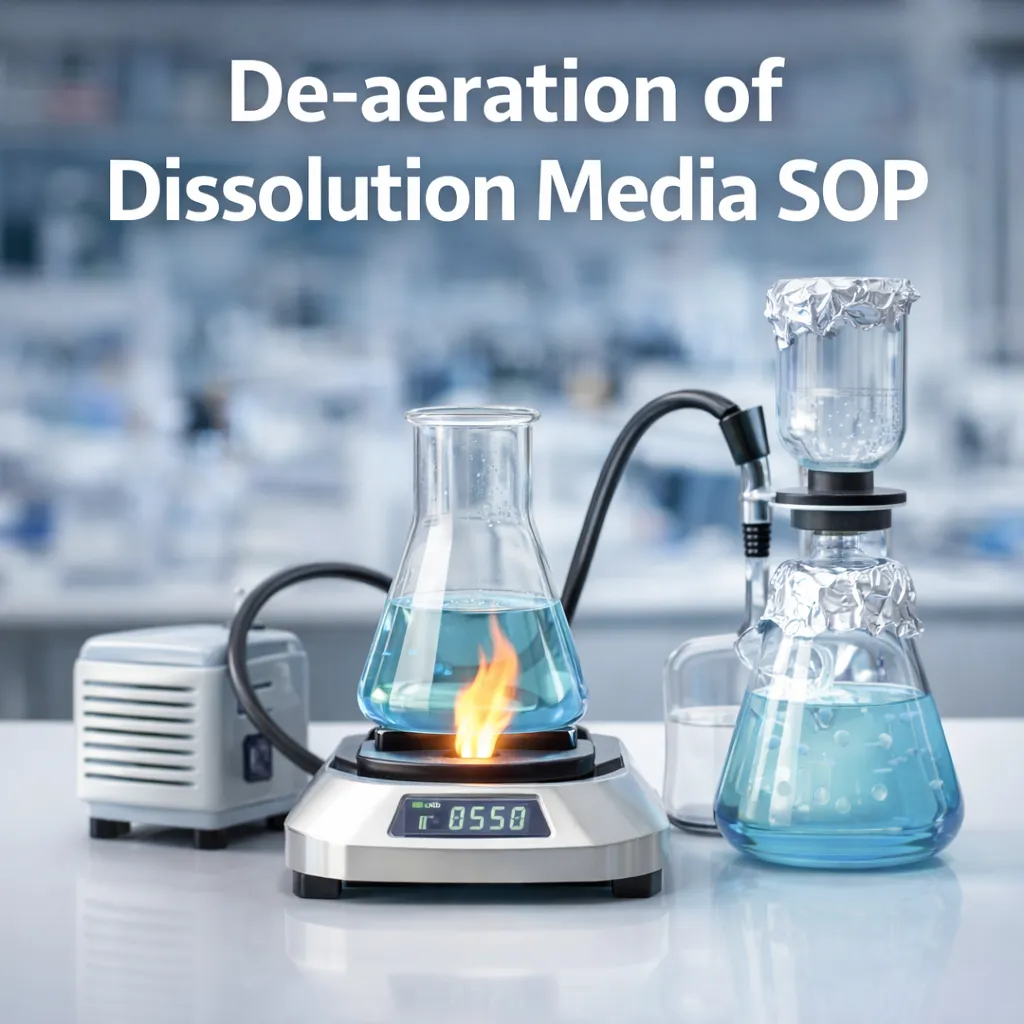

Learn SOP for de-aeration of dissolution media in pharma QC. Ensure accurate results & compliance.
Introduction
In pharmaceutical dissolution testing, even tiny air bubbles can affect drug release results. That’s why following a proper de-aeration of dissolution media SOP is critical. This procedure ensures accurate, reproducible, and compliant dissolution testing in Quality Control laboratories.
What is De-aeration of Dissolution Media?
De-aeration is the process of removing dissolved gases (air bubbles) from dissolution media to ensure accurate and consistent dissolution test results.
Objective
To define a standard procedure for de-aeration of dissolution media.
Scope
This SOP applies to all dissolution methods requiring de-aerated media in Quality Control laboratories.
Responsibility & Accountability
- Technical Assistant: Perform the procedure
- Executive/Manager: Verify compliance
- Head of Department: Overall accountability
Key Importance of De-aeration
- Prevents air bubbles from affecting dissolution rate
- Ensures reproducible and accurate results
- Maintains compliance with pharmacopeial standards
- Improves reliability of QC testing
Step-by-Step SOP Procedure
- Heat the required volume of dissolution medium to approximately 41°C with gentle stirring.
- Immediately filter the medium under vacuum filtration using a filter with 0.45 micron or less porosity.
- Continue stirring during filtration to ensure uniform deaeration.
- Collect the filtrate in a suitable flask equipped with a stirring device.
- Seal the flask with aluminium foil.
- Continue applying vacuum with stirring for an additional 5 minutes.
- Immediately transfer the medium to the dissolution vessel.
- Avoid any air exposure or interruption during transfer.
Equipment & Materials Required
- Dissolution medium
- Heating setup
- Vacuum filtration system
- Filter (≤ 0.45 micron)
- Filtration flask
- Stirring device
- Aluminium foil
Safety Precautions
- Handle hot media carefully to avoid burns
- Ensure proper vacuum handling
- Use appropriate PPE (gloves, lab coat)
- Avoid contamination during transfer
- Follow equipment SOPs
Common Mistakes to Avoid
- Inadequate heating of media
- Delayed filtration after heating
- Using improper filter size
- Exposure of media to air after deaeration
- Skipping vacuum step
Best Practices
- Perform deaeration immediately before use
- Maintain consistent temperature control
- Use calibrated equipment
- Minimize handling time
- Document all steps properly
Abbreviations
- °C: Degree Centigrade
- SOP: Standard Operating Procedure
FAQs
1. What is deaeration in dissolution testing?
It is the removal of dissolved gases from the dissolution medium to improve test accuracy.
2. Why is deaeration important?
Air bubbles can interfere with drug release and affect dissolution results.
3. What temperature is used for deaeration?
Typically around 41°C.
4. What filter size is recommended?
A filter with 0.45 micron or smaller porosity.
5. How long should vacuum be applied?
Usually for about 5 minutes after filtration.
6. Can deaerated media be stored?
It is best used immediately to avoid reabsorption of air.
7. What happens if deaeration is not done?
Results may be inaccurate and inconsistent.
8. Is vacuum filtration necessary?
Yes, it helps remove dissolved gases effectively.
9. What are common errors in deaeration?
Improper temperature, delay in filtration, and air exposure.
10. Who is responsible for this SOP?
Technical staff perform it, while managers verify and approve.