


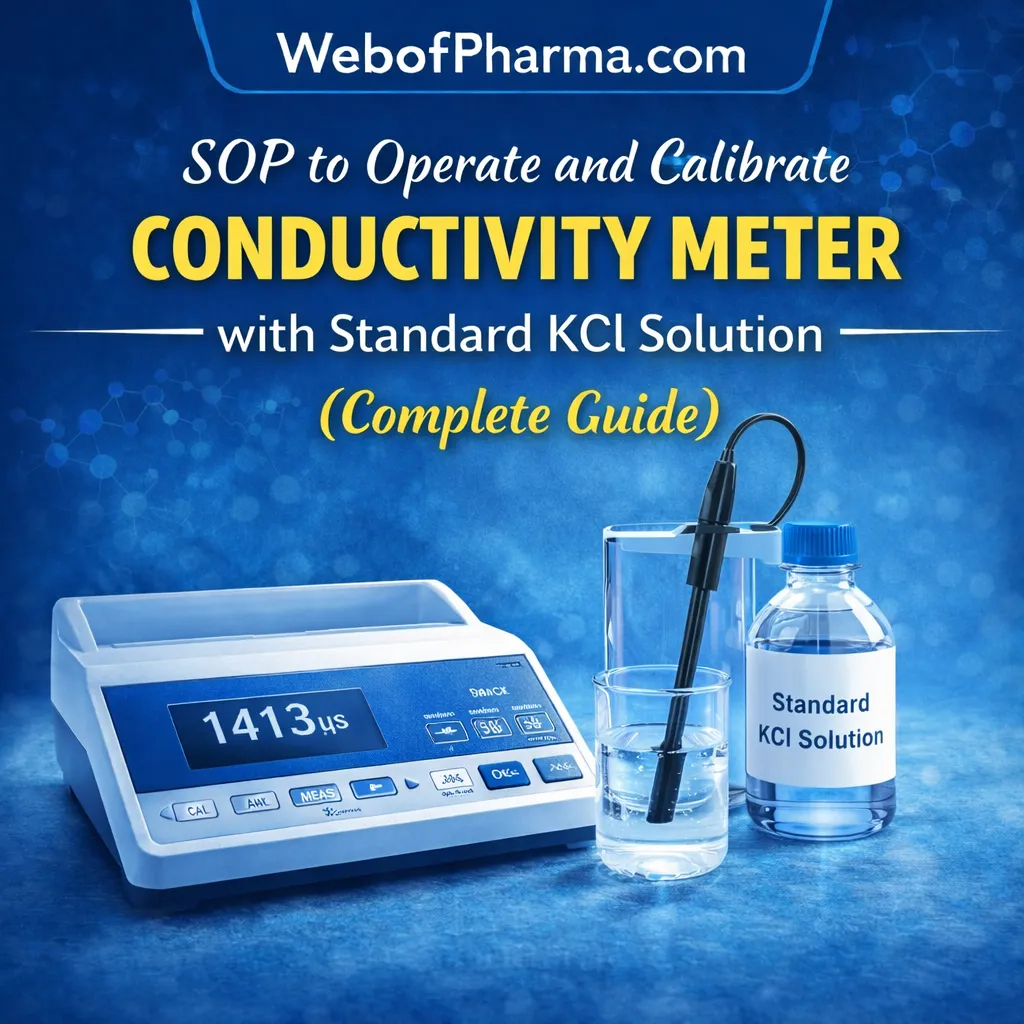

Learn the Standard operating procedure to operate and calibrate the Conductivity Meter with standard KCl solution including step-by-step operation, calibration, electrode care, and best practices for accurate results.
Accurate conductivity measurement is essential in pharmaceutical quality control, especially for water systems and solution analysis. This guide explains the Standard operating procedure to operate and calibrate the Conductivity Meter with standard KCl solution in a simple, practical, and compliant manner.
🎯 Purpose
To establish a standardized procedure for the operation and calibration of the conductivity meter.
📍 Scope
Applicable to conductivity meters used in the Quality Control (QC) department.
👨🔬 Responsibility
- QC Analyst / Microbiologist
🧾 Accountability
- Head of Department
⚙️ 5.0 Procedure
▶️ 5.1 Operation of the Conductivity Meter
🔌 Step 1: Power ON
- Switch ON the main power supply.
- Press the ON/OFF button to start the meter.
🌡️ Step 2: Automatic Temperature Compensation (ATC)
- Attach the conductivity/TDS electrode properly.
- Ensure ATC mode is enabled.
- ✔ ATC indicator ON = working properly
- ⚠ Blinking “Ur” = electrode issue or improper connection
💧 Step 3: Electrode Preparation
- Rinse electrode with deionized/distilled water.
- Shake gently or air dry.
- Rinse with sample before measurement to avoid contamination.
🧪 Step 4: Measurement
- Dip electrode into the sample.
- Ensure liquid level is above the upper steel band.
- Stir gently to homogenize the sample.
- Allow reading to stabilize.
- Record the displayed conductivity value.
🧪 5.2 Calibration of Conductivity Meter
Calibration is critical to ensure measurement accuracy. Follow this procedure to calibrate the conductivity meter with standard KCl solution.
🔧 Step 1: Preparation
- Ensure correct measurement mode is selected.
- Clean electrode with deionized water.
📏 Step 2: Standard Solution
- Use standard KCl solution (1413 µS/cm).
- Replace buffer weekly or as required.
⚙️ Step 3: Calibration Process
- Press MODE to select conductivity mode.
- Rinse electrode thoroughly (do not wipe).
- Immerse probe fully in KCl standard solution.
- Stir gently for uniformity.
- Press CAL/MEAS to enter calibration mode.
- Press HOLD/ENTER to confirm calibration.
- Calibration is complete.
🧼 Step 4: Post Calibration
- Rinse electrode with deionized water.
- Store electrode properly.
🧽 5.3 Electrode Care and Maintenance
Proper maintenance ensures long-term accuracy:
- Keep electrode clean at all times
- Soak dry electrode for 5–10 minutes before use
- Avoid scratching or damaging electrode bands
- Do not hit electrode against hard surfaces
- Avoid contact with oily substances
- Clean with mild detergent or isopropyl alcohol
- Rinse with tap water and recalibrate before use
⚠️ Precautions
- Always rinse electrode before and after use
- Avoid wiping probe (prevents static charge)
- Use fresh calibration solution
- Ensure proper immersion depth
- Maintain stable temperature conditions
📚 Abbreviations
- SOP: Standard Operating Procedure
- QC: Quality Control
- ATC: Automatic Temperature Compensation
- TDS: Total Dissolved Solids
🔧 Conclusion
Following this SOP ensures:
- Accurate conductivity measurements
- Reliable calibration results
- Compliance with quality standards
❓ Frequently Asked Questions (FAQs)
1. Why is conductivity meter calibration important?
It ensures accurate measurement of ionic concentration in solutions.
2. What is KCl solution used for in calibration?
KCl provides a stable and known conductivity value for calibration.
3. What is the standard calibration value for KCl?
Typically 1413 µS/cm.
4. What is ATC in conductivity meters?
Automatic Temperature Compensation adjusts readings based on temperature.
5. Why should the electrode not be wiped?
Wiping creates static charges that can affect readings.
6. How often should calibration be performed?
Regularly—daily or before critical measurements.
7. What does “Ur” display on the meter mean?
It indicates electrode error or improper connection.
8. Why is rinsing with sample important?
It prevents contamination or dilution errors.
9. How should electrodes be stored?
Clean, dry, and properly maintained as per manufacturer guidelines.
10. What affects conductivity readings?
Temperature, contamination, electrode condition, and calibration accuracy.