


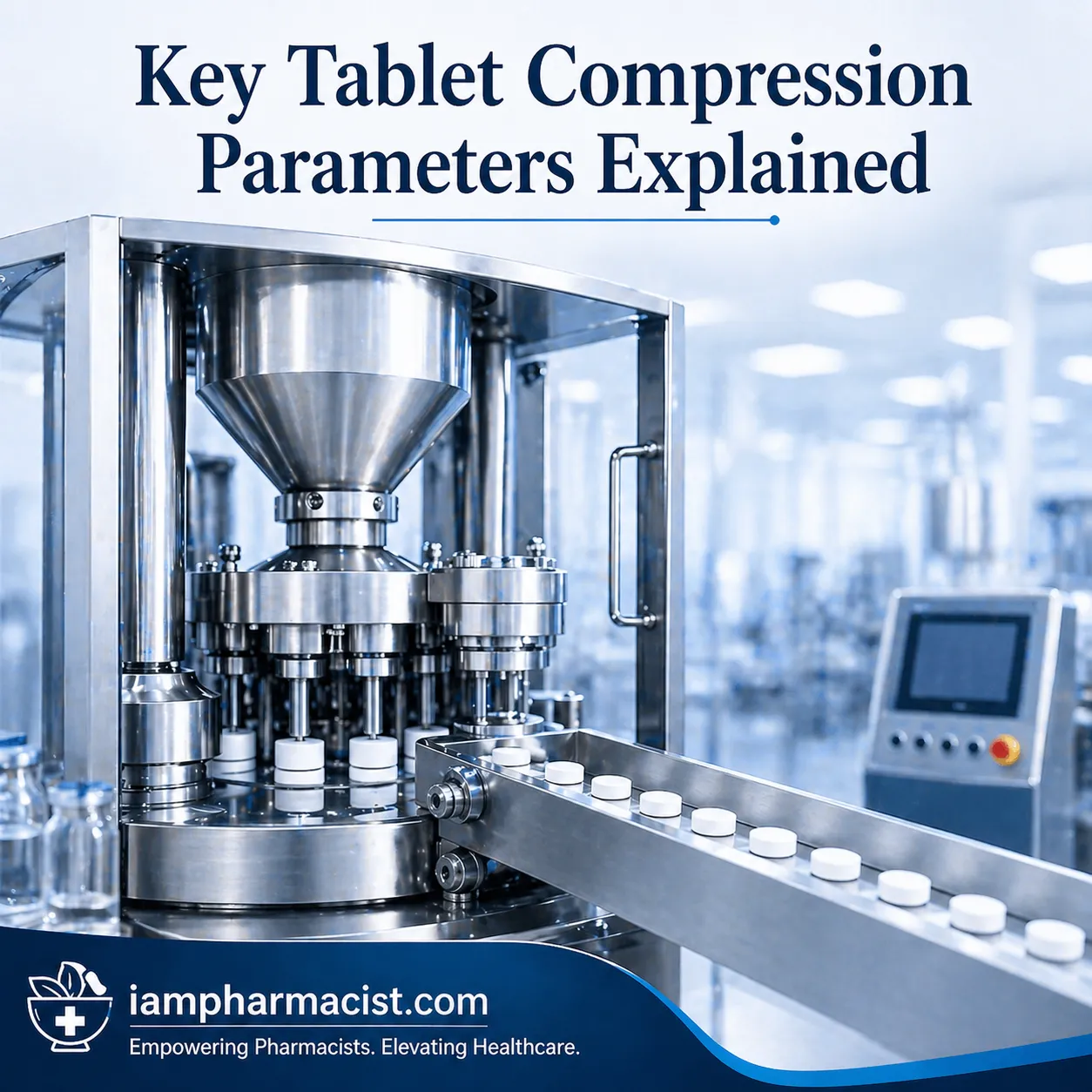

Learn how compression parameters i.e; force, speed, and dwell time impact tablet quality. Optimize tablet manufacturing for consistent hardness, weight, and performance.
Definition
Tablet compression quality depends on three critical machine parameters—compression force, turret speed, and dwell time—which directly influence tablet hardness, weight uniformity, friability, and dissolution performance.
Introduction
In pharmaceutical manufacturing, achieving consistent tablet quality is both a science and an engineering challenge. Even with an optimized formulation, improper machine settings can lead to defects like capping, lamination, or weight variation.
Among all process variables, compression force, turret speed, and dwell time are the most influential. Understanding how these parameters interact allows manufacturers to fine-tune production, reduce waste, and meet regulatory standards efficiently.
Quick Overview Table
| Parameter | Definition | Impact on Tablet Quality | Risk if Mismanaged |
|---|---|---|---|
| Compression Force | Pressure applied to powder in die | Hardness, friability, dissolution | Capping, lamination, slow release |
| Turret Speed | Rotation speed of tablet press | Output rate, dwell time | Weight variation, weak tablets |
| Dwell Time | Duration of compression force application | Bond strength, density | Poor compaction, friability |
1. Compression Force
Compression force determines how tightly powder particles are packed together.
Why It Matters
- Higher force → stronger, harder tablets
- Lower force → softer, more fragile tablets
Optimization Tips
- Balance hardness and dissolution rate
- Avoid excessive force to prevent lamination
- Adjust based on material compressibility
👉 Related internal link: See our guide on tablet hardness testing methods
2. Turret Speed (Compression Speed)
Turret speed controls how fast tablets are produced.
Why It Matters
- High speed increases production output
- But reduces dwell time (less bonding time)
Risks of High Speed
- Inconsistent tablet weight
- Reduced hardness
- Increased friability
Best Practice
- Optimize speed without compromising quality
- Monitor weight variation closely during high-speed runs
3. Dwell Time
Dwell time is the duration the powder remains under compression.
Why It Matters
- Longer dwell time improves particle bonding
- Enhances tablet strength and uniformity
Key Insight
Dwell time is inversely related to turret speed:
- Higher speed → shorter dwell time
- Lower speed → longer dwell time
How to Optimize Tablet Compression Parameters
Step 1: Evaluate Material Properties
- Check particle size and moisture content
- Assess compressibility of formulation
Step 2: Set Initial Compression Force
- Start with moderate force
- Measure hardness and friability
Step 3: Adjust Turret Speed
- Begin at lower speeds
- Gradually increase while monitoring quality
Step 4: Monitor Dwell Time Effects
- Ensure sufficient bonding time
- Adjust speed or tooling if needed
Step 5: Perform In-Process Testing
- Check tablet weight, thickness, hardness
- Use statistical process control
Step 6: Fine-Tune Parameters
- Balance all three variables together
- Document optimal settings for repeatability
Additional Factors That Influence Compression Quality
While machine parameters are critical, other variables also play a role:
- Raw material properties (particle size, moisture)
- Excipient selection and formulation design
- Environmental conditions (temperature, humidity)
- Tooling condition and alignment
- Operator expertise and process control systems
FAQs
1. What is compression force in tablet manufacturing?
Compression force is the pressure applied to powder to form a tablet, affecting hardness and durability.
2. How does turret speed affect tablet quality?
Higher turret speed reduces dwell time, which can weaken tablets and cause inconsistencies.
3. What is dwell time in tablet compression?
Dwell time is the duration the powder is under الضغط (compression), impacting bonding strength.
4. Why do tablets crack during compression?
Cracking often results from excessive force or insufficient dwell time.
5. What happens if compression force is too high?
It can cause lamination, slow dissolution, and overly hard tablets.
6. How can I improve tablet hardness?
Optimize compression force and ensure adequate dwell time.
7. Does humidity affect tablet compression?
Yes, high humidity can cause sticking and poor flow properties.
8. What is the ideal turret speed?
It depends on formulation but should balance production and quality.
9. Why is uniform die filling important?
It ensures consistent tablet weight and dosage accuracy.
10. How do you control tablet weight variation?
By optimizing fill depth, flow properties, and turret speed.
{ “@context”: “https://schema.org”, “@type”: “Article”, “headline”: “Key Tablet Compression Parameters Explained”, “description”: “Learn how compression force, speed, and dwell time impact tablet quality.”, “author”: { “@type”: “Person”, “name”: “SEO Technical Writer” }, “publisher”: { “@type”: “Organization”, “name”: “Pharma Insights Hub” } } { “@context”: “https://schema.org”, “@type”: “FAQPage”, “mainEntity”: [ { “@type”: “Question”, “name”: “What is compression force in tablet manufacturing?”, “acceptedAnswer”: { “@type”: “Answer”, “text”: “Compression force is the pressure applied to powder to form tablets.” } } ] } { “@context”: “https://schema.org”, “@type”: “HowTo”, “name”: “Optimize Tablet Compression Parameters”, “step”: [ {“@type”: “HowToStep”, “text”: “Evaluate material properties”}, {“@type”: “HowToStep”, “text”: “Set compression force”}, {“@type”: “HowToStep”, “text”: “Adjust turret speed”}, {“@type”: “HowToStep”, “text”: “Monitor dwell time”}, {“@type”: “HowToStep”, “text”: “Perform in-process testing”} ] }