


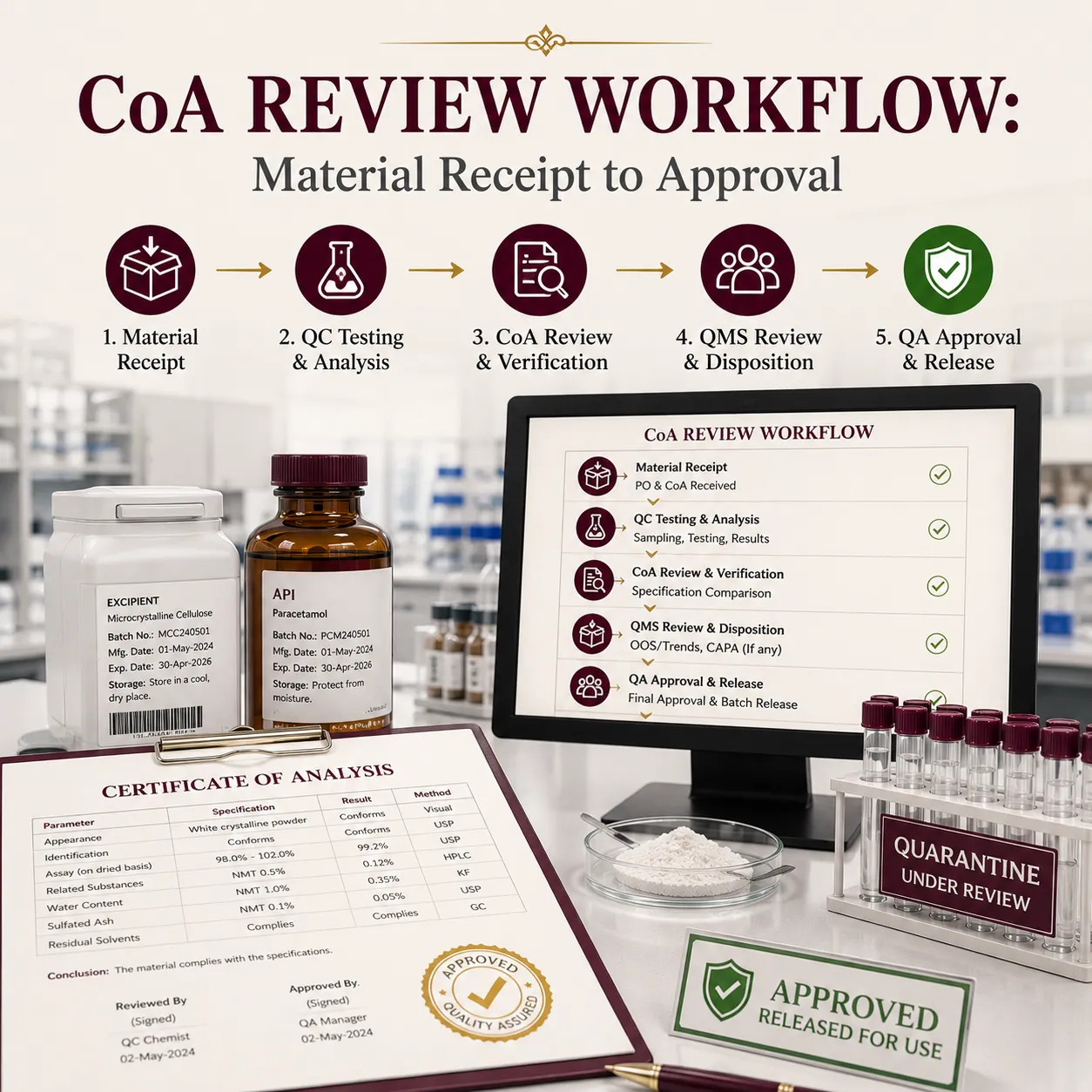

Learn the complete CoA review workflow in pharmaceuticals, from material receipt and QC testing to QA approval, GMP compliance, and batch release.
Definition
The CoA review workflow is a structured pharmaceutical quality process that verifies incoming materials meet predefined specifications before release for manufacturing. It includes material receipt, quarantine, QC sampling and testing, supplier CoA verification, QA review, disposition decisions, and final approval under GMP requirements.
In pharmaceutical manufacturing, every raw material, active pharmaceutical ingredient (API), excipient, and packaging component must undergo rigorous quality verification before entering production. One of the most critical quality processes supporting this verification is the Certificate of Analysis (CoA) review workflow.
A robust CoA review process ensures incoming materials comply with approved specifications, supplier quality agreements, pharmacopoeial standards, and regulatory requirements. It serves as a key control point within the Quality Management System (QMS), preventing non-conforming materials from entering the manufacturing process.
This guide explains the complete CoA review workflow—from material receipt through final Quality Assurance (QA) approval.
Why Is the CoA Review Workflow Important?
The CoA review process helps organizations:
- Verify material quality and compliance
- Prevent use of unsuitable materials
- Support GMP compliance
- Maintain data integrity
- Strengthen supplier qualification programs
- Facilitate regulatory inspections
- Improve traceability throughout the supply chain
Without an effective CoA review workflow, organizations risk product quality failures, batch rejections, and regulatory observations.
Overview of the CoA Review Workflow
| Stage | Responsible Department | Outcome |
|---|---|---|
| Material Receipt | Warehouse / QC | Material quarantined |
| Sampling & Testing | QC | Analytical results generated |
| Supplier CoA Verification | QC / QA | Data comparison completed |
| QMS Review | QC / QA | Disposition decision made |
| Final QA Approval | QA | Material released or rejected |
Step 1: Material Receipt and Quarantine
The workflow begins when incoming material arrives at the facility.
Documentation Review
Personnel collect and review:
- Supplier Certificate of Analysis
- Delivery documents
- Purchase order details
- Shipping documentation
Verification Checklist
| Requirement | Verification |
|---|---|
| Batch Number | Match shipment and CoA |
| Manufacturing Date | Present |
| Retest/Expiry Date | Present |
| Authorized Signature | Verified |
| Product Name | Correct |
Incomplete documentation should trigger immediate follow-up with the supplier.
Physical Inspection
Warehouse and QC personnel inspect:
- Container condition
- Seal integrity
- Label accuracy
- Evidence of contamination
- Packaging damage
Any discrepancies must be documented according to deviation procedures.
Quarantine Status
Materials are assigned a Quarantine status to prevent accidental use.
GMP Requirement
Only approved materials may be used in production.
Typical controls include:
- Quarantine labels
- Segregated storage areas
- ERP inventory restrictions
Goods Receipt Note (GRN)
The received lot is entered into:
- ERP systems
- Inventory management systems
- Warehouse tracking systems
This creates complete traceability from receipt through final disposition.
Step 2: QC Sampling and Testing
After receipt, Quality Control performs representative sampling.
Sampling Process
Sampling must follow approved SOPs and validated procedures.
Key Sampling Controls
- Trained personnel
- Controlled environment
- Approved sampling tools
- Contamination prevention measures
Laboratory Testing
Samples are analyzed against approved specifications.
Common Tests
| Test | Purpose |
|---|---|
| Identification | Verify material identity |
| Assay | Confirm potency |
| Related Substances | Measure impurities |
| Water Content | Assess moisture |
| Particle Size | Evaluate physical properties |
| Microbial Limits | Confirm microbiological quality |
Raw Data Review
Analysts compare results against:
- Internal specifications
- USP standards
- EP standards
- BP standards
- JP standards
All analytical records must comply with ALCOA+ data integrity principles.
Step 3: Supplier CoA Verification and Comparison
One of the most important workflow steps involves comparing supplier documentation with internal quality requirements.
Specification Comparison
QA and QC verify whether supplier specifications are equivalent to or more stringent than company standards.
Example
| Parameter | Supplier Spec | Internal Spec | Acceptable |
|---|---|---|---|
| Assay | 98–102% | 98–102% | Yes |
| Water Content | NMT 1.0% | NMT 1.0% | Yes |
| Impurity A | NMT 0.5% | NMT 0.3% | No |
In this example, additional evaluation is required because the supplier specification is less stringent.
Method Verification
The review should confirm that supplier testing methods align with:
- Pharmacopoeial requirements
- Approved validated methods
- Quality agreements
Methods must be scientifically justified and suitable for intended use.
Missing Data Assessment
If critical information is missing:
- Additional testing may be performed
- Supplier clarification may be requested
- Revised CoA may be required
The workflow should not proceed until all critical quality attributes are adequately addressed.
Step 4: QMS Review and Disposition Decision
Following analytical review, data undergoes formal quality assessment.
OOS and OOT Management
Any:
- Out-of-Specification (OOS)
- Out-of-Trend (OOT)
- Atypical Results
must be investigated before final disposition.
Investigation Process
- Laboratory assessment
- Root cause analysis
- Deviation investigation
- CAPA implementation
- Final quality decision
Reviewer Approval
Qualified reviewers verify:
✔ Data completeness
✔ Calculation accuracy
✔ Method suitability
✔ Specification compliance
✔ Documentation integrity
Electronic Signatures
Many facilities use electronic quality systems compliant with:
21 CFR Part 11
Requirements include:
- Secure authentication
- Audit trails
- Electronic signatures
- Controlled access
Material Disposition
Following review, one of three decisions is made.
| Disposition | Meaning |
|---|---|
| Accepted | Material meets requirements |
| Rejected | Material fails requirements |
| Conditionally Accepted | Approved with restrictions |
Step 5: Final QA Approval and Release
The final approval authority belongs to Quality Assurance.
QA Review
QA reviews:
- Supplier CoA
- QC analytical results
- Investigation records
- Vendor qualification status
- Deviations and CAPAs
Material Release
Upon approval:
- Quarantine status is removed
- Approved labels are applied
- ERP status is updated
The material becomes available for production use.
Record Retention and Traceability
The approved CoA should be retained within:
- Quality Management Systems (QMS)
- Laboratory Information Management Systems (LIMS)
- Electronic Document Management Systems (EDMS)
These records support:
- Regulatory inspections
- Product investigations
- Supplier audits
- Batch record review
Practical Example: API CoA Review Workflow
Scenario
A manufacturer receives an API shipment from a qualified supplier.
QC Results
| Parameter | Specification | Result |
|---|---|---|
| Identification | Positive | Positive |
| Assay | 98–102% | 99.1% |
| Water Content | NMT 1.0% | 0.42% |
| Impurity A | NMT 0.2% | 0.08% |
QA Review Outcome
| Review Area | Status |
|---|---|
| Supplier Qualified | Yes |
| Documentation Complete | Yes |
| Results Compliant | Yes |
| OOS/OOT Findings | None |
Final Decision
Material Approved and Released for Manufacturing
GMP and Regulatory Expectations
FDA cGMP
Relevant regulations include:
- 21 CFR Part 210
- 21 CFR Part 211
These require scientifically sound testing and quality oversight.
ICH Guidelines
ICH Q7
Provides GMP requirements for API manufacturing and quality systems.
ICH Q9
Supports risk-based decision-making throughout material review activities.
ICH Q10
Defines pharmaceutical quality system expectations.
WHO GMP Guidance
WHO emphasizes:
- Material traceability
- Documentation integrity
- Supplier qualification
- Controlled release processes
Frequently Asked Questions (FAQs)
1. What is a CoA review workflow?
A structured process used to verify incoming materials meet approved specifications before release.
2. Who is responsible for CoA review?
QC performs testing and data review, while QA performs final approval and release.
3. Why are materials quarantined upon receipt?
To prevent accidental use before quality verification is complete.
4. What is verified during supplier CoA review?
Specifications, test methods, analytical results, signatures, and document authenticity.
5. What happens if a CoA contains missing information?
Additional testing or supplier clarification may be required before approval.
6. What is the role of QC in the workflow?
QC performs sampling, testing, and analytical data review.
7. What is the role of QA in the workflow?
QA performs final review, disposition decisions, and material release.
8. How are OOS results handled?
Through formal investigation, root cause analysis, and CAPA procedures.
9. What regulations apply to CoA review?
FDA cGMP, ICH Q7, ICH Q9, ICH Q10, WHO GMP, and regional GMP requirements.
10. Why is traceability important in CoA management?
It supports investigations, audits, inspections, and product quality assurance.