


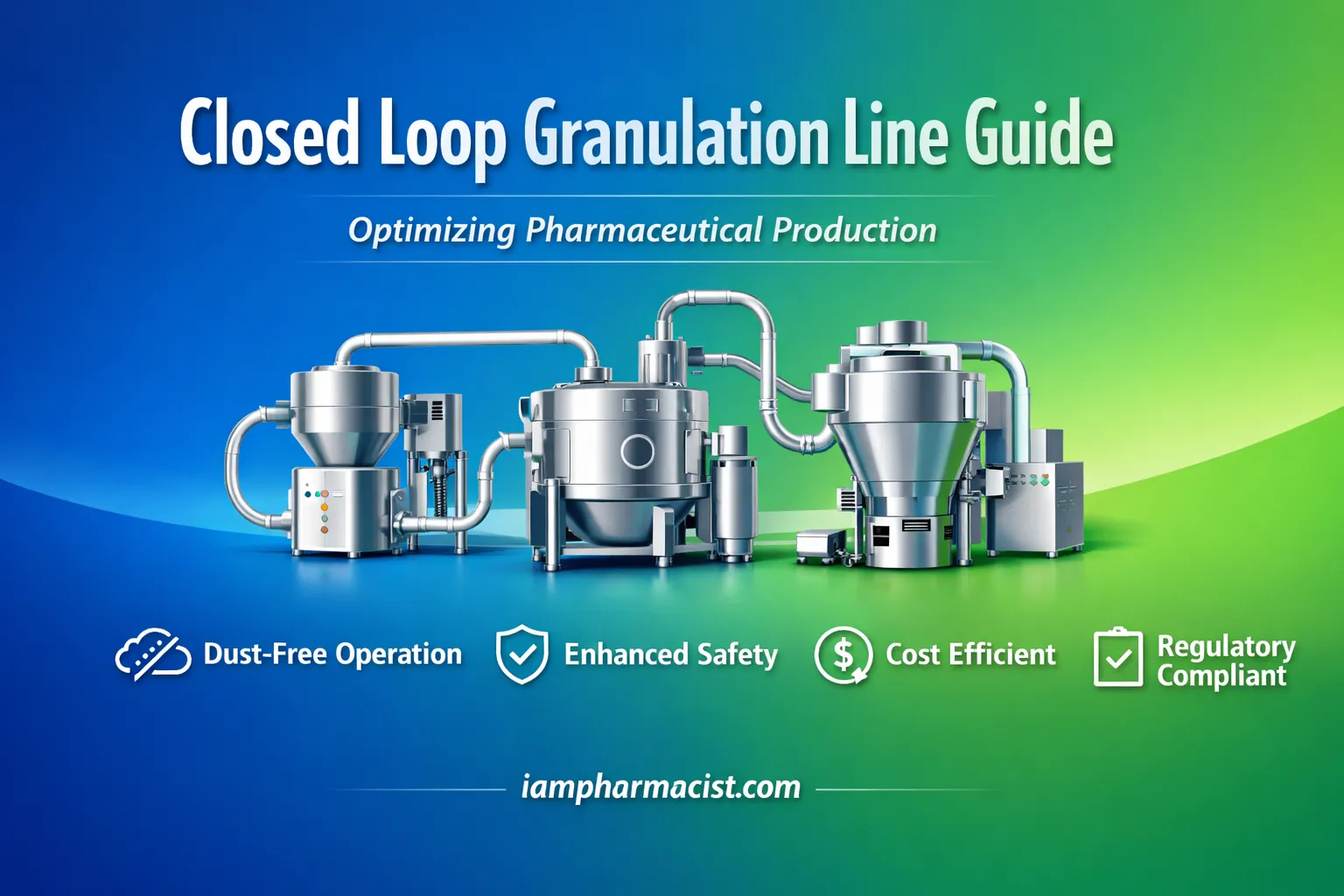

Learn how a Closed Loop Granulation Line improves safety, efficiency, and compliance in pharmaceutical manufacturing.
Closed Loop Granulation Line: Complete Guide
A Closed Loop Granulation Line is an advanced pharmaceutical manufacturing system where multiple pieces of equipment are interconnected using sealed, flexible transfer pipes. This design ensures that materials are processed without any exposure to the external environment, making it a critical solution for modern wet granulation processes.
With increasing regulatory demands and the need for higher safety standards, the Closed Loop Granulation Line has become an essential part of pharmaceutical production.
What is a Closed Loop Granulation Line?
A Closed Loop Granulation Line is a fully integrated system that allows material transfer between different processing stages using pneumatic conveying. Because the system is sealed, it eliminates contamination risks, reduces human intervention, and enhances both product and operator safety.
Key Components of a Closed Loop Granulation Line
A typical Closed Loop Granulation Line includes the following equipment:
- Sifter
- Rapid Mixing Granulator (RMG)
- Fluid Bed Dryer (FBD)
- Co-Mill
- Blender
- Flexible Transfer Pipes
- Pneumatic Conveying System
Each component plays a crucial role in maintaining a continuous, contamination-free process flow.
Working Principle of Closed Loop Granulation Line
The Closed Loop Granulation Line operates on the principle of pneumatic transfer, where materials move through sealed pipelines using controlled air pressure.
This system ensures:
- No manual handling
- No environmental exposure
- Continuous and efficient material flow
Step-by-Step Working Process
- Material Transfer to Sifter
Raw materials are transferred pneumatically through flexible pipes into the sifter. - Sifting and Storage
After sifting, materials are collected in a sealed container. - Transfer to RMG
Sieved materials are pneumatically transferred to the Rapid Mixing Granulator. - Granulation Process
Binder solution is added, initiating mixing and kneading. - Wet Milling
The wet mass is passed through an inline wet mill. - Drying Stage
The material is transferred to the Fluid Bed Dryer via closed pipes. - Milling (Co-Mill)
Dried granules are transferred directly to the co-mill without exposure. - Final Blending
The processed granules are transferred to the blender for final mixing.
All stages occur within a sealed loop, ensuring minimal human involvement.
Benefits of Closed Loop Granulation Line
1. Dust-Free Operation
Since all transfers occur through sealed pipes, dust generation is eliminated, maintaining cleanroom standards.
2. Enhanced Product Safety
The closed system prevents contamination, ensuring consistent product quality.
3. Improved Operator Safety
Operators are not exposed to potent or hazardous materials.
4. Reduced Line Loss
Pneumatic transfer minimizes product wastage during processing.
5. Faster Processing Time
Automation eliminates delays caused by manual handling.
6. Cost Efficiency
Lower product loss and shorter processing time reduce overall production costs.
7. Regulatory Compliance
Closed Loop Granulation Lines comply with strict pharmaceutical standards such as FDA, 21 CFR, and cGMP.
Why Closed Loop Granulation Lines Matter
As pharmaceutical manufacturing evolves, the demand for safer, cleaner, and more efficient systems continues to grow. The Closed Loop Granulation Line addresses all these needs by combining automation, containment, and compliance into a single streamlined process.
Frequently Asked Questions (FAQs)
1. What is a Closed Loop Granulation Line?
It is a sealed system used in pharmaceutical manufacturing to transfer and process materials without environmental exposure.
2. How does a Closed Loop Granulation Line work?
It uses pneumatic pressure to move materials through enclosed pipelines between equipment.
3. What are the main components of the system?
Key components include a sifter, RMG, FBD, co-mill, blender, and pneumatic transfer system.
4. Why is it called a “closed loop” system?
Because the entire process occurs within sealed connections, preventing exposure to the external environment.
5. What industries use Closed Loop Granulation Lines?
Primarily pharmaceutical and nutraceutical industries.
6. How does it improve product safety?
By eliminating contamination risks through sealed processing.
7. Does it reduce human involvement?
Yes, most transfers are automated, reducing manual handling.
8. What is pneumatic conveying?
It is the process of moving materials using air pressure through pipes.
9. Is it compliant with regulatory standards?
Yes, it meets FDA, 21 CFR, and cGMP requirements.
10. What are the cost benefits?
Reduced material loss, faster processing, and improved efficiency lead to lower operational costs.