


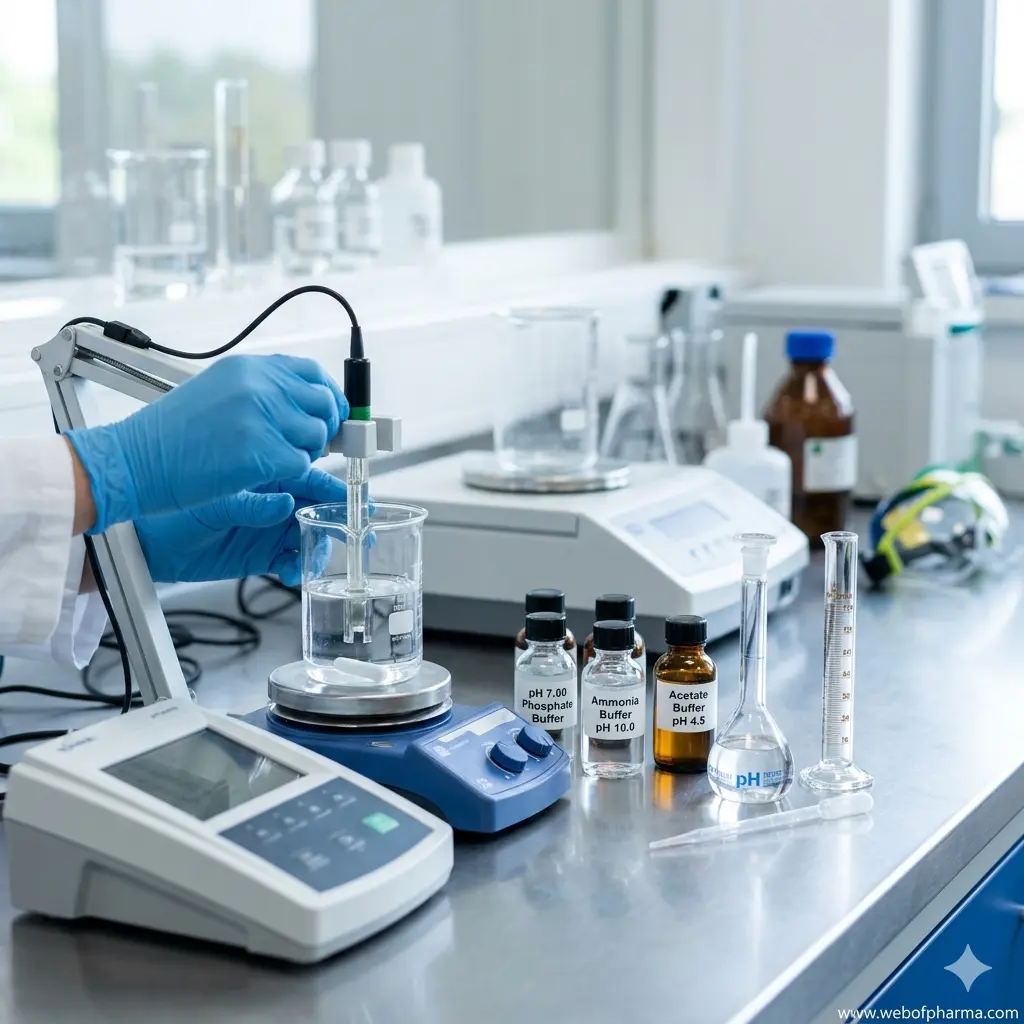

Learn how to prepare different types of buffer solutions like phosphate, ammonia, ammonium, acetate, and citrate buffers as per USP, BP, and IP standards used in pharmaceutical analysis.
Buffer solutions are essential in pharmaceutical science, ensuring product stability and providing the ideal environment for chemical and biochemical reactions. From analytical testing to formulation development, buffers play a critical role in maintaining consistent pH conditions.
In pharmaceutical laboratories, professionals must accurately prepare different types of buffer solutions like phosphate buffer solution, ammonia buffers, ammonium buffers, acetate buffers and citrate buffers from USP, BP and IP used in chemical analysis of pharmaceutical ingredients. Proper preparation ensures reliable results and regulatory compliance.
This guide explains the principles, preparation methods, types, and quality considerations of buffer solutions used in the pharmaceutical industry.
What is a Buffer Solution?
A buffer solution is a system that resists changes in pH when small amounts of acid or base are added. It maintains a stable hydrogen ion concentration, which is crucial for:
- Drug stability
- Enzyme activity
- Analytical accuracy
- Biological reactions
In the pharmaceutical industry, buffers are widely used in:
- Drug formulations
- Analytical methods
- Stability studies
- Microbiological media
Standard Buffer Solutions (USP, BP, IP)
Standard buffer solutions are solutions of known and reproducible pH values, used for:
- Calibration of pH meters
- Pharmacopoeial testing
- Analytical method validation
Important Preparation Guidelines
- Dry crystalline reagents (except boric acid) at 110–120°C for 1 hour
- Use carbon dioxide-free water
- Store in alkali-free glass containers
- Use within 3 months
- Discard if cloudy or deteriorated
General Method for Buffer Preparation
Buffers in the pH range 1.2 to 10.0 are prepared by combining:
- 0.2 M Hydrochloric Acid (HCl)
- 0.2 M Sodium Hydroxide (NaOH)
- Standard buffer salts (as per USP/BP/IP)
The final pH should be accurate within ±0.02 units at 25°C.
Common Reagents Used
- Boric Acid & Potassium Chloride (0.2 M)
- Disodium Hydrogen Phosphate (0.2 M)
- Potassium Dihydrogen Phosphate (0.2 M)
- Potassium Hydrogen Phthalate (0.2 M)
- Sodium Hydroxide (0.2 M) (use within 1 month)
Types of Buffer Solutions in Pharmaceutical Analysis
1. Phosphate Buffer Solution
One of the most widely used buffers in pharmaceutical analysis.
Example (pH 6.8):
- Mix disodium hydrogen phosphate and potassium dihydrogen phosphate
- Adjust pH if required
Applications:
- Dissolution testing
- Biological studies
- Drug stability analysis
2. Ammonia and Ammonium Buffers
Prepared using ammonia solution and ammonium chloride.
Example (pH 10.0):
- Dissolve ammonium chloride
- Add ammonia solution
- Dilute to volume
Applications:
- Complexometric titrations
- Analytical chemistry
3. Acetate Buffers
Prepared using acetic acid and sodium/ammonium acetate.
Example (pH 4.0):
- Mix glacial acetic acid with sodium hydroxide
- Dilute to required volume
Applications:
- pH-sensitive drug formulations
- Enzyme reactions
4. Citrate Buffers
Prepared using citric acid and sodium phosphate.
Example:
- Mix citric acid with disodium hydrogen phosphate
Applications:
- Biological buffers
- Protein and enzyme studies
5. Borate Buffers
Prepared using boric acid and sodium hydroxide.
Applications:
- Alkaline pH systems
- Analytical chemistry
Storage and Stability of Buffer Solutions
To maintain quality:
- Store in tightly closed containers
- Protect from CO₂ absorption
- Avoid contamination
- Label with preparation date
- Monitor for clarity and pH changes
Applications of Buffer Solutions in Pharmaceuticals
Buffer solutions are used in:
- Drug formulation development
- Stability testing
- Quality control laboratories
- Analytical methods (HPLC, titration)
- Microbiological assays
Key Considerations in Buffer Preparation
- pKa should be close to desired pH
- Maintain temperature control
- Ensure compatibility with drug substance
- Use accurate weighing and calibration
- Validate pH using a calibrated pH meter
Frequently Asked Questions (FAQs)
1. What is a buffer solution in pharmaceutical chemistry?
A buffer solution resists changes in pH and maintains a stable environment for chemical and biological reactions.
2. Why are buffer solutions important in pharmaceutical analysis?
They ensure accurate results by maintaining constant pH during testing, formulation, and stability studies.
3. How do you prepare a phosphate buffer solution?
By mixing appropriate ratios of potassium dihydrogen phosphate and disodium hydrogen phosphate and adjusting pH if needed.
4. What are ammonia buffer solutions used for?
They are commonly used in analytical chemistry, especially in complexometric titrations.
5. What is the role of acetate buffers in pharmaceuticals?
Acetate buffers are used in acidic pH conditions for drug stability and biochemical reactions.
6. What are citrate buffers used for?
They are widely used in biological systems, enzyme studies, and protein stabilization.
7. Which pharmacopoeias provide buffer preparation methods?
USP (United States Pharmacopeia), BP (British Pharmacopoeia), and IP (Indian Pharmacopoeia).
8. How should buffer solutions be stored?
In airtight, chemically resistant containers, protected from contamination and CO₂ exposure.
9. Can buffer solutions expire?
Yes, most buffers should be used within 1–3 months depending on stability and storage conditions.
10. What factors affect buffer solution performance?
Temperature, pH accuracy, ionic strength, and contamination can impact buffer effectiveness.