


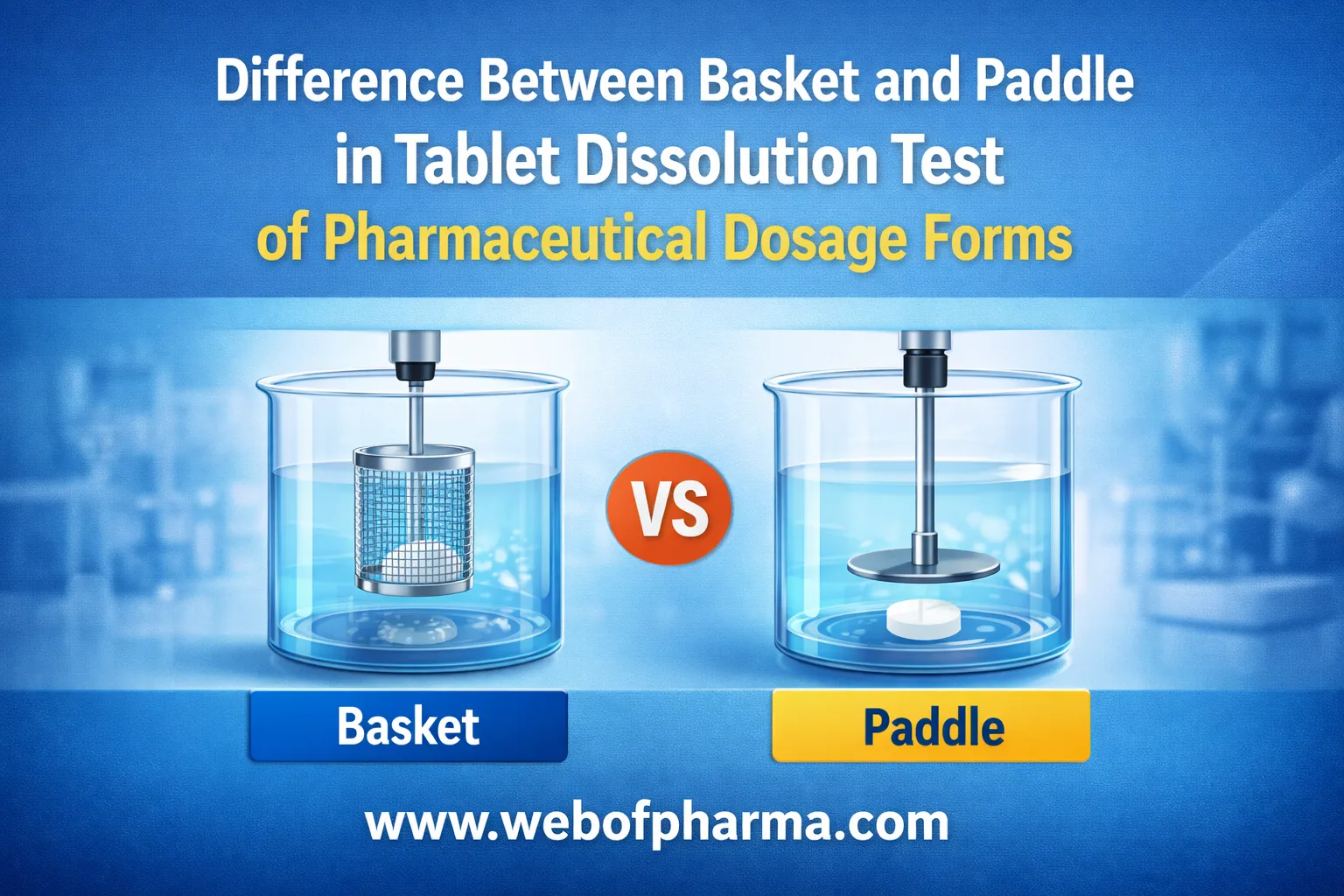

Learn how basket and paddle both are used in tablet dissolution test of pharmaceutical dosage forms but both of these have considerable difference. Explore working principles, applications, and key differences in dissolution testing.
When a drug is administered orally, it must first dissolve in the gastrointestinal fluid before being absorbed into the bloodstream. The rate of dissolution directly impacts the drug’s bioavailability and therapeutic effectiveness.
If a drug dissolves too quickly, it may lead to toxicity or overdose. On the other hand, if dissolution is too slow, it may result in sub-therapeutic effects. That’s why pharmaceutical companies perform dissolution testing to ensure consistent drug release profiles.
The statement “baskets and paddles both are used in tablet dissolution test of pharmaceutical dosage forms but both of these have considerable difference” highlights the importance of selecting the appropriate method during quality control and formulation development.
Importance of Dissolution Testing in Pharmaceuticals
Dissolution testing is a critical quality control tool used to:
- Evaluate drug release rate
- Ensure batch-to-batch consistency
- Predict in vivo drug performance
- Meet regulatory requirements
These tests simulate conditions similar to the human stomach by controlling:
- तापमान (Temperature)
- Agitation speed
- Dissolution medium
Overview of Dissolution Apparatus
Both paddle and basket methods are performed using a standard dissolution apparatus consisting of:
- Transparent dissolution vessel
- Rotating shaft (motor-driven)
- Controlled temperature system (~37°C)
- Dissolution medium
The shaft rotates at a defined speed to facilitate drug dissolution.
Paddle Dissolution Method (USP Apparatus II)
In the paddle method:
- A blade (paddle) is attached to the rotating shaft
- The dosage form is placed directly at the bottom of the vessel
- The paddle stirs the dissolution medium to mix the drug
Key Features:
- Simple and widely used method
- Suitable for tablets that sink easily
- Provides uniform mixing
Use of Sinker:
Sometimes, the tablet may float or stick to the vessel wall. To prevent this:
- A sinker is used
- Made of inert material
- Keeps the tablet centered beneath the paddle
Basket Dissolution Method (USP Apparatus I)
In the basket method:
- A cylindrical mesh basket is attached to the rotating shaft
- The dosage form is placed inside the basket
- The basket rotates, allowing the drug to dissolve through mesh openings
Key Features:
- Ideal for floating or sticky dosage forms
- Prevents tablet adherence to vessel walls
- Provides controlled exposure to dissolution medium
When is Basket Used?
- Capsules
- Tablets containing HPMC (swelling polymers)
- Sticky or buoyant formulations
Key Differences Between Basket and Paddle Dissolution Methods
The core idea that “baskets and paddles both are used in tablet dissolution test of pharmaceutical dosage forms but both of these have considerable difference” can be better understood through the following comparison:
| Feature | Paddle Method | Basket Method |
|---|---|---|
| Apparatus Type | Blade (paddle) | Cylindrical mesh basket |
| Placement of Drug | Bottom of vessel | Inside basket |
| Suitable For | Non-floating tablets | Floating or sticky dosage forms |
| Use of Sinker | Often required | Not required |
| Mixing Mechanism | Direct stirring | Rotation within basket |
| Risk of Sticking | Higher | Lower |
How to Choose Between Paddle and Basket Method
The selection depends on the nature of the dosage form:
- Use Paddle Method when:
- Tablet sinks easily
- No sticking issues
- Immediate-release formulations
- Use Basket Method when:
- Tablet floats or swells
- Sticky formulations (e.g., HPMC-based)
- Capsules or coated dosage forms
Conclusion
In pharmaceutical dissolution testing, both paddle and basket methods play a crucial role. While both techniques aim to evaluate drug release, their applications differ significantly based on the formulation characteristics.
Understanding that baskets and paddles both are used in tablet dissolution test of pharmaceutical dosage forms but both of these have considerable difference helps analysts choose the right method for accurate and reliable results.
Frequently Asked Questions (FAQs)
1. What is dissolution testing in pharmaceuticals?
Dissolution testing measures how quickly a drug dissolves in a specific medium, simulating conditions in the body.
2. What is the main difference between paddle and basket method?
The paddle method uses a stirring blade, while the basket method uses a rotating mesh basket to hold the dosage form.
3. Why are baskets used for some tablets?
Baskets are used for floating or sticky tablets to prevent them from sticking to the vessel walls.
4. What is USP Apparatus I and II?
USP Apparatus I refers to the basket method, and USP Apparatus II refers to the paddle method.
5. What is a sinker in dissolution testing?
A sinker is an inert device used to keep tablets submerged in the paddle method.
6. Which method is more commonly used?
The paddle method is more commonly used due to its simplicity and versatility.
7. Why is temperature controlled in dissolution testing?
Temperature is maintained at ~37°C to simulate human body conditions.
8. Can capsules be tested using paddle method?
Yes, but basket method is generally preferred for capsules.
9. What happens if a tablet sticks to the vessel wall?
It can lead to inaccurate dissolution results, which is why sinkers or baskets are used.
10. How does dissolution affect drug absorption?
Faster dissolution increases absorption rate, while slower dissolution may delay therapeutic effect.