


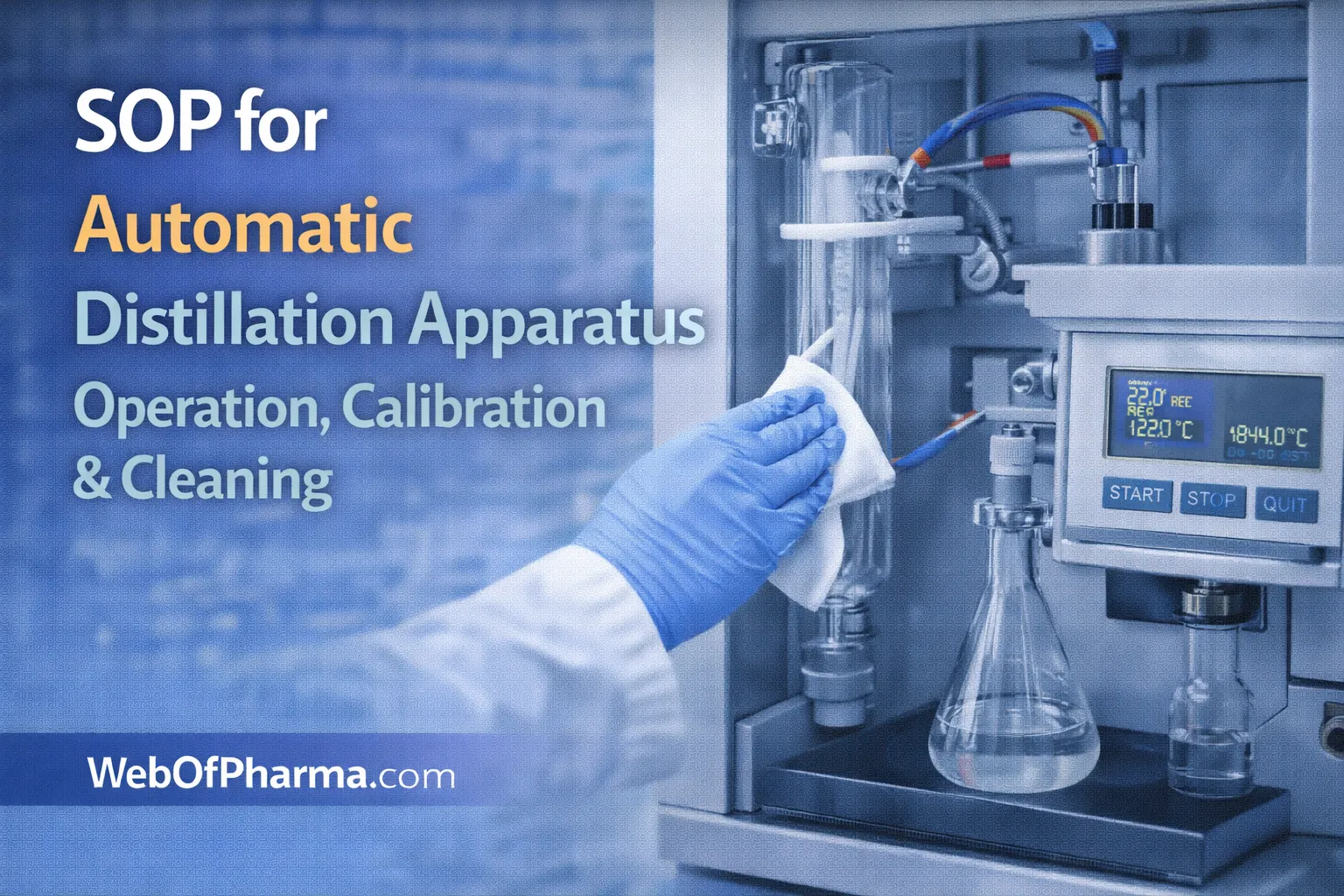

Learn SOP for automatic distillation apparatus operation, calibration & cleaning.
In pharmaceutical quality control laboratories, precision and cleanliness are essential for accurate analytical results. Instruments like the automatic distillation apparatus play a key role in various chemical analyses. Therefore, following a proper SOP for automatic distillation apparatus is crucial to ensure reliable performance and compliance.
This SOP provides a clear guide for operating, calibrating, and cleaning the distillation and digestion units.
1. Objective of the SOP
The objective is to:
- Define proper cleaning and maintenance procedures
- Ensure accurate and consistent distillation results
- Maintain equipment efficiency and lifespan
- Prevent contamination and residue buildup
2. Scope
This SOP applies to:
- Automatic distillation apparatus used in QC laboratories
- Distillation and digestion units
- Routine cleaning and maintenance processes
3. Roles and Responsibilities
3.1 Responsible Personnel
- Technical Assistant / Executive: Perform operation and cleaning
- Executive / Manager: Verify and supervise
3.2 Accountability
- Head of Department: Ensure SOP compliance
4. Operation of Automatic Distillation Apparatus
Before starting:
- Ensure the apparatus is clean and properly assembled
- Check all connections and glassware
- Confirm availability of distilled water
Basic Operation Steps:
- Switch ON the instrument
- Load sample into digestion/distillation unit
- Start the distillation process
- Monitor the process until completion
👉 Always follow manufacturer instructions for operation.
5. Calibration Procedure (General Guidelines)
Calibration ensures accuracy of results.
Steps:
- Use standard reference samples
- Verify temperature and distillation efficiency
- Check volume accuracy of collected distillate
- Record calibration data
👉 Perform calibration periodically as per SOP.
6. Cleaning Procedure
Cleaning is critical to prevent contamination and ensure consistent results.
6.1 Cleaning of Distillation Unit
- Switch OFF the instrument
- Switch OFF the mains power supply
- Remove:
- Distillation tubes
- Collecting flask
- Clean tubes with distilled water
- Clean collecting flask thoroughly
- Wipe outer surface with clean cotton cloth
👉 Ensure no residue remains.
6.2 Cleaning of Digestion Unit
- Clean tube with distilled water
- Rinse with warm distilled water to remove residues
- Clean manifold rack and tube stand
- Remove acid spills using cotton cloth
- Clean splash head after each distillation
👉 Proper cleaning avoids cross-contamination.
7. Documentation
- Record cleaning and maintenance in instrument log book
- Include date, time, and operator signature
👉 Documentation ensures traceability and compliance.
8. Safety Precautions
- Handle hot surfaces carefully
- Use PPE (gloves, goggles, lab coat)
- Avoid contact with acids and chemicals
- Ensure proper ventilation
9. Best Practices
- Clean immediately after use
- Use only distilled water for cleaning
- Inspect glassware for cracks
- Avoid chemical buildup
- Maintain regular calibration
10. Common Mistakes to Avoid
- Skipping cleaning after use
- Using contaminated water
- Improper handling of glassware
- Ignoring residue buildup
- Lack of documentation
FAQs
1. What is an automatic distillation apparatus used for?
It is used for separating components based on boiling points.
2. Why is cleaning important?
To prevent contamination and ensure accurate results.
3. What water is used for cleaning?
Distilled water.
4. Who operates the apparatus?
Technical assistant or executive.
5. What is digestion unit cleaning?
Cleaning of tubes and racks used before distillation.
6. How often should cleaning be done?
After each use.
7. What PPE is required?
Gloves, goggles, and lab coat.
8. Why is calibration important?
To ensure accurate measurement.
9. What happens if cleaning is skipped?
It may cause contamination and incorrect results.
10. Why is documentation necessary?
For audit compliance and traceability.