



Learn Analytical Method Lifecycle Management according to ICH Q14, including ATP, AQbD, MODR, Established Conditions, and continuous verification.
Definition
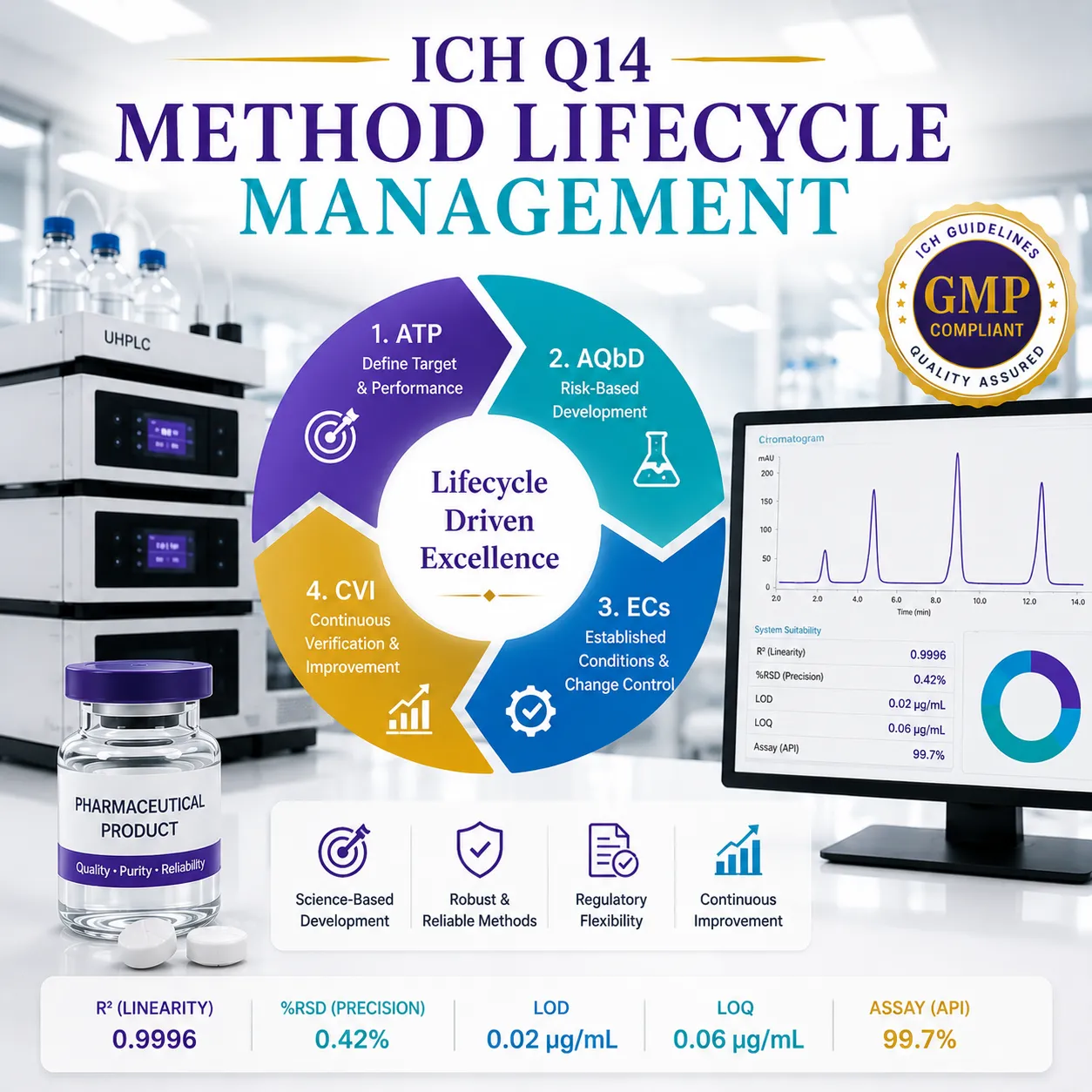
Analytical Method Lifecycle Management (AMLM) according to ICH Q14 is a science- and risk-based framework that ensures analytical procedures remain fit for purpose throughout their lifecycle. The approach is built on four pillars: Analytical Target Profile (ATP), Enhanced Method Development (AQbD), Established Conditions (ECs), and Continuous Verification & Improvement.
Modern pharmaceutical manufacturing depends on reliable analytical methods to ensure product quality, safety, efficacy, and regulatory compliance. Historically, analytical method development often relied on trial-and-error experimentation followed by validation. While effective, this approach sometimes lacked a structured strategy for managing method performance throughout the product lifecycle.
To address these limitations, the International Council for Harmonisation (ICH) introduced ICH Q14 Analytical Procedure Development, which works alongside ICH Q2(R2) Validation of Analytical Procedures.
ICH Q14 introduces a comprehensive lifecycle approach that emphasizes scientific understanding, risk management, method robustness, and continuous improvement from development through commercial use.
This article explains the core principles of Analytical Method Lifecycle Management (AMLM), the four pillars of ICH Q14, implementation strategies, regulatory expectations, and practical pharmaceutical applications.
What Is Analytical Method Lifecycle Management?
Analytical Method Lifecycle Management (AMLM) is a systematic framework that ensures analytical procedures remain scientifically sound, validated, and suitable for their intended purpose throughout a product’s commercial life.
The lifecycle extends beyond validation and includes:
- Method development
- Risk assessment
- Method validation
- Change management
- Continuous monitoring
- Ongoing improvement
Why ICH Q14 Matters
Traditional analytical development often focused on validation as the final milestone.
ICH Q14 shifts the focus toward:
- Scientific understanding
- Knowledge management
- Risk-based decision making
- Continuous improvement
This reduces:
- Method failures
- OOS results
- Regulatory observations
- Costly investigations
Overview of the Four Pillars of ICH Q14
| Pillar | Purpose |
|---|---|
| Analytical Target Profile (ATP) | Define method objectives |
| Enhanced Method Development (AQbD) | Build robustness scientifically |
| Established Conditions (ECs) | Manage regulatory flexibility |
| Continuous Verification & Improvement | Maintain performance over time |
Pillar 1: Analytical Target Profile (ATP)
What Is ATP?
The Analytical Target Profile (ATP) is the foundation of analytical method lifecycle management.
It defines:
- What the method must measure
- Required performance characteristics
- Acceptance criteria
- Intended use
The ATP focuses on outcomes rather than technology.
ATP Components
| Element | Example |
|---|---|
| Analyte | API assay |
| Purpose | Quantitative determination |
| Accuracy | Recovery 98–102% |
| Precision | %RSD ≤ 2.0% |
| Specificity | No interference |
| Reportable Range | 80–120% of target concentration |
Example ATP
For an HPLC assay method:
Objective: Quantify API content in tablets.
Performance Criteria:
- Accuracy: 98–102%
- Precision: ≤ 2.0% RSD
- Specificity: Complete separation from degradants
- Linearity: R² ≥ 0.999
Why ATP Is Important
The ATP provides a clear scientific target that guides:
- Method selection
- Development strategy
- Validation activities
- Lifecycle monitoring
Pillar 2: Enhanced Method Development (AQbD)
What Is AQbD?
Analytical Quality by Design (AQbD) applies scientific and risk-based principles to analytical method development.
Instead of trial-and-error optimization, AQbD systematically evaluates method variables.
AQbD Objectives
- Improve robustness
- Increase method understanding
- Reduce variability
- Support lifecycle management
Critical Method Attributes (CMAs)
CMAs are performance characteristics that determine whether the method meets the ATP.
Examples of CMAs
| CMA | Importance |
|---|---|
| Resolution | Peak separation |
| Accuracy | Reliable results |
| Precision | Reproducibility |
| Sensitivity | Detection capability |
| Specificity | Freedom from interference |
Critical Method Parameters (CMPs)
CMPs are variables that influence CMAs.
Examples of CMPs
| Parameter | Impact |
|---|---|
| Mobile Phase pH | Peak shape |
| Flow Rate | Retention time |
| Column Temperature | Resolution |
| Organic Solvent Ratio | Selectivity |
| Injection Volume | Sensitivity |
Risk Assessment in AQbD
Risk assessment tools help identify high-impact variables.
Common tools include:
- Ishikawa diagrams
- FMEA (Failure Mode and Effects Analysis)
- Risk ranking matrices
Method Operable Design Region (MODR)
What Is MODR?
The Method Operable Design Region (MODR) is a multidimensional range of method parameters where acceptable performance is consistently achieved.
Example MODR
| Parameter | Range |
|---|---|
| pH | 3.0–3.5 |
| Flow Rate | 0.9–1.1 mL/min |
| Temperature | 28–32°C |
Within this region, the method remains robust and compliant.
Benefits of MODR
- Increased flexibility
- Reduced method failures
- Easier optimization
- Better regulatory confidence
Pillar 3: Established Conditions (ECs)
What Are Established Conditions?
Established Conditions (ECs) are the operating parameters necessary to ensure consistent analytical performance.
These conditions become part of the regulatory submission.
Examples of ECs
| Parameter | Established Condition |
|---|---|
| Column Type | C18 |
| Mobile Phase pH | 3.2 ± 0.2 |
| Flow Rate | 1.0 ± 0.1 mL/min |
| Detection Wavelength | 254 nm |
Regulatory Importance of ECs
Changes within ECs often require minimal regulatory reporting.
Changes outside ECs may require:
- Risk assessment
- Revalidation
- Regulatory notification
Change Management Under ICH Q14
Change management allows controlled method evolution without compromising quality.
Typical Method Changes
| Change | Evaluation Required |
|---|---|
| New Column Supplier | Risk assessment |
| pH Adjustment | Impact study |
| Detector Replacement | Verification |
| New Laboratory Site | Transfer validation |
Pillar 4: Continuous Verification & Improvement
Lifecycle Does Not End at Validation
Traditional thinking viewed validation as the endpoint.
ICH Q14 views validation as the beginning of routine lifecycle monitoring.
Continuous Verification Activities
- System suitability trending
- OOS monitoring
- OOT investigations
- Audit trail reviews
- Method performance reviews
Key Performance Indicators (KPIs)
| KPI | Purpose |
|---|---|
| Resolution | Chromatographic performance |
| %RSD | Precision monitoring |
| Retention Time | Method consistency |
| SST Pass Rate | Operational reliability |
| OOS Frequency | Risk indicator |
Practical Example
HPLC Assay Lifecycle Management
ATP Defined
- Assay range: 80–120%
- Accuracy: 98–102%
- Precision: ≤2.0% RSD
AQbD Study
Evaluated:
- pH
- Flow rate
- Column temperature
MODR Established
Robust performance demonstrated across parameter ranges.
Continuous Monitoring
Three years of SST trending showed:
- Stable resolution
- Consistent retention times
- No OOS results
Result:
Improved reliability and reduced laboratory investigations.
Relationship Between ICH Q14 and ICH Q2(R2)
The two guidelines work together.
Practical Example
HPLC Assay Lifecycle Management
ATP Defined
- Assay range: 80–120%
- Accuracy: 98–102%
- Precision: ≤2.0% RSD
AQbD Study
Evaluated:
- pH
- Flow rate
- Column temperature
MODR Established
Robust performance demonstrated across parameter ranges.
Continuous Monitoring
Three years of SST trending showed:
- Stable resolution
- Consistent retention times
- No OOS results
Result:
Improved reliability and reduced laboratory investigations.
Relationship Between ICH Q14 and ICH Q2(R2)
The two guidelines work together.
| Guideline | Focus |
|---|---|
| ICH Q14 | Analytical procedure development |
| ICH Q2(R2) | Analytical procedure validation |
Lifecycle Flow
ATP ↓ AQbD Development ↓ MODR Establishment ↓ Method Validation (ICH Q2) ↓ Established Conditions ↓ Routine Use ↓ Continuous Verification ↓ Continuous ImprovementGMP and Regulatory Considerations
Regulatory agencies increasingly expect lifecycle-based analytical strategies.
FDA and EMA Focus Areas
Inspectors often evaluate:
- ATP justification
- Risk assessments
- Development studies
- Validation reports
- Change management controls
- Method performance trending
Common Deficiencies
| Observation | Regulatory Concern |
|---|---|
| Weak ATP definition | Poor lifecycle planning |
| Limited robustness data | Method variability |
| No trending program | Missed performance drift |
| Inadequate change control | Compliance risk |
| Incomplete risk assessment | Scientific weakness |
Step-by-Step Guide to Implement ICH Q14
Step 1
Define the Analytical Target Profile (ATP).
Step 2
Identify Critical Method Attributes (CMAs).
Step 3
Perform risk assessment.
Step 4
Identify Critical Method Parameters (CMPs).
Step 5
Conduct AQbD studies.
Step 6
Establish the Method Operable Design Region (MODR).
Step 7
Validate the method according to ICH Q2(R2).
Step 8
Define Established Conditions (ECs).
Step 9
Implement change management procedures.
Step 10
Perform ongoing verification and improvement.
Best Practices Checklist
| Best Practice | Status |
|---|---|
| ATP documented | ✓ |
| Risk assessment completed | ✓ |
| AQbD development applied | ✓ |
| CMAs identified | ✓ |
| CMPs evaluated | ✓ |
| MODR established | ✓ |
| ICH Q2(R2) validation completed | ✓ |
| Established Conditions documented | ✓ |
| Continuous monitoring active | ✓ |
| Change control program implemented | ✓ |
FAQs
1. What is ICH Q14?
ICH Q14 is a guideline that provides a science- and risk-based framework for analytical procedure development and lifecycle management.
2. What is Analytical Method Lifecycle Management?
It is a systematic approach that ensures analytical methods remain fit for purpose throughout their lifecycle.
3. What is an Analytical Target Profile (ATP)?
ATP defines the method objective and required performance characteristics.
4. What is AQbD in analytical development?
Analytical Quality by Design uses scientific understanding and risk assessment to develop robust analytical methods.
5. What are Critical Method Parameters (CMPs)?
CMPs are variables that influence method performance, such as pH, flow rate, and temperature.
6. What is a Method Operable Design Region (MODR)?
MODR is a multidimensional space where acceptable method performance is consistently achieved.
7. What are Established Conditions (ECs)?
ECs are operating conditions necessary to assure method performance and regulatory compliance.
8. How does ICH Q14 differ from ICH Q2(R2)?
ICH Q14 focuses on method development, while ICH Q2(R2) focuses on method validation.
9. Why is continuous verification important?
It detects performance drift and supports ongoing method reliability.
10. How does ICH Q14 improve regulatory flexibility?
Well-defined Established Conditions allow certain method changes with reduced regulatory burden.