


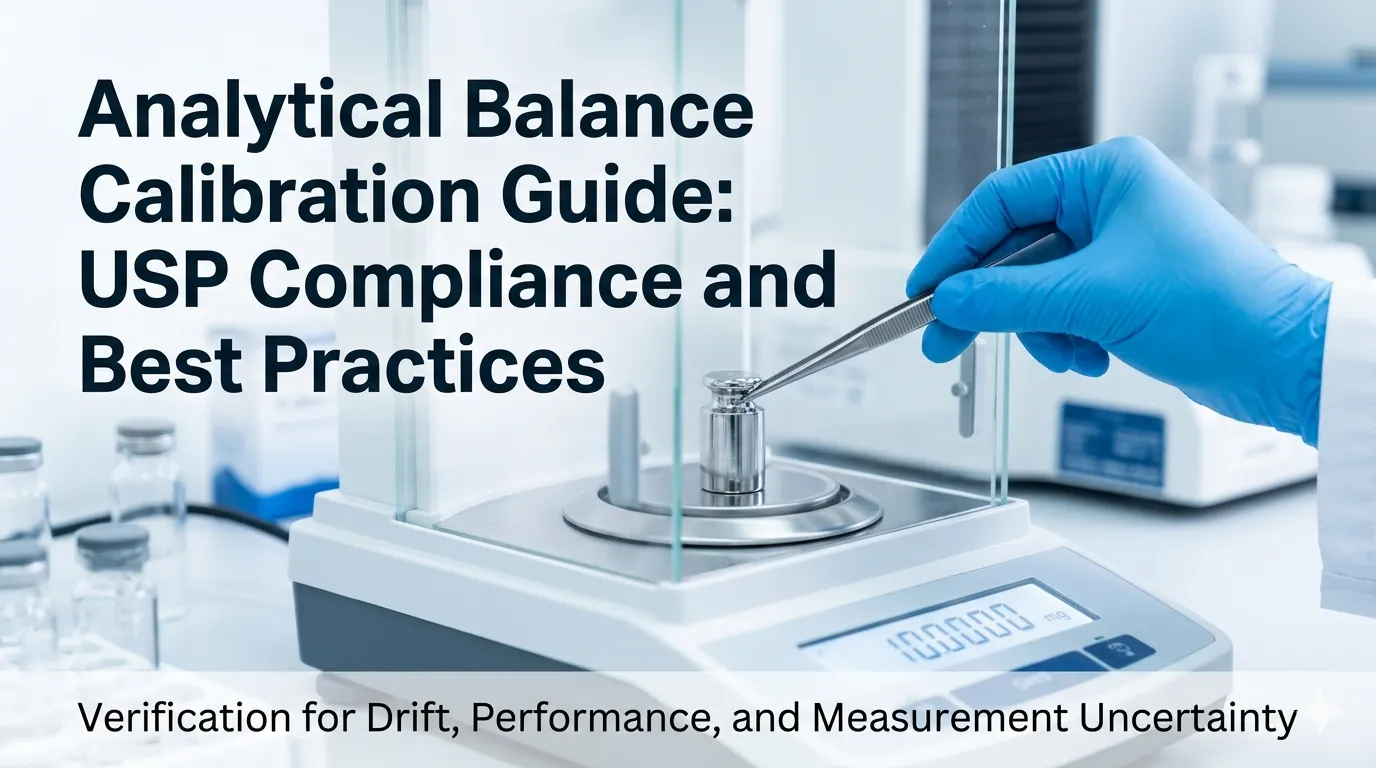

Learn the professional procedure to calibrate the Analytical Balance as Drift check, Performance check and Measurement uncertainty check as per USP. Ensure laboratory accuracy with our step-by-step guide and compliance tips.
In a pharmaceutical or high-precision laboratory, the analytical balance is often the starting point of every experiment. If your initial weight is off, every subsequent calculation—from molarity to yield—will be fundamentally flawed.
To maintain data integrity, you must follow a rigorous procedure to calibrate the Analytical Weighing Balance as Drift check, Performance check and Measurement uncertainty check as per USP (United States Pharmacopeia) guidelines. This post breaks down these technical requirements into a clear, human-readable format.
1. Preparation and Leveling
Before starting any calibration, verify the physical state of the balance:
- Leveling: Ensure the level bubble is perfectly centered. A tilted balance introduces mechanical errors.
- Environment: Ensure the balance is away from direct sunlight, drafts, or vibrating equipment.
- Internal Calibration: If your balance has an “Internal Cal” or “Auto-Cal” feature, perform this daily before moving to external checks.
2. The Drift Check
The drift check assesses the stability of the balance over a short period.
- Standard Weight: Typically, a 10 mg weight is used.
- Process: Record 10 consecutive measurements of the 10 mg weight.
- Acceptance Criteria: * The variation from the mean value must not exceed ± 0.2 mg.
- Individual measurements must stay within 0.1% of the actual mass value (e.g., for a 10 mg weight, the variation cannot exceed 0.01 mg).
3. Performance Check (Sensitivity & Linearity)
The performance check ensures the balance is accurate across its functional range.
- Method: After auto-calibration, test a series of individual weights: 1 mg, 2 mg, 5 mg, 10 mg, and 20 mg.
- Selection: Ensure your check weights cover the range you intend to use. For example, if your balance capacity is 150 mg, use a check weight around 100 mg to verify the upper range.
- Acceptance Criteria: Each measurement must be within ± 0.1% of the certified mass value of the specific weight used.
4. Measurement Uncertainty Check (USP Compliance)
USP <41> emphasizes that the uncertainty of a measurement must be small compared to the amount being weighed.
- Procedure: Place a 10 mg external weight on the pan and record 10 separate measurements.
- Calculation:$$Measurement Uncertainty = \frac{Standard Deviation \times 2}{Actual Mass Value}$$
- Acceptance Criteria: The final value must be Not More Than (NMT) 0.10. If the value is higher, the balance is considered too “noisy” or inconsistent for micro-weighing tasks.
Calibration Frequency
To remain compliant, calibration is not a one-time event. It must be performed:
- Daily: Before any samples are weighed.
- Maintenance: After any servicing or repair.
- Relocation: Even moving the balance to a different bench requires a re-check.
- Power Failure: A surge or loss of power can affect electronic sensitivity.
Note: If the balance fails any of these checks, it must be taken out of service immediately and labeled “Out of Calibration.” Check with the supplier or party responsible for maintenance to rectify the issue.
Frequently Asked Questions (FAQ)
1. Why is 0.99602 used in glassware calibration but not for balances?
The 0.99602 factor is specifically used to convert the mass of water to volume (ml) at 25°C. For balance calibration, we are measuring mass directly against certified standard weights, so this factor is not required.
2. What is the difference between internal and external calibration?
Internal calibration uses a built-in motorized weight to adjust the electronics. External calibration uses certified weights (like Class E2 or F1) to verify the balance’s accuracy against a known standard.
3. Why do I need to record 10 measurements for the drift check?
Recording 10 measurements allows for a statistically significant average and helps identify small fluctuations in the balance’s performance that might be missed in a single reading.
4. What happens if the level bubble is not centered?
If the balance is not level, the force of gravity is not perpendicular to the weighing pan, leading to a “cosine error” where the balance displays a weight lower than the actual mass.
5. Can I use any weights for the performance check?
No, you must use calibrated, certified weights (traceable to national standards). Handle them with forceps, as skin oils can change their mass.
6. Is a daily calibration necessary if I only use the balance once a week?
Yes. In a regulated environment, you must prove the balance was accurate at the time of use. Daily calibration (on the days used) is the standard practice to ensure reliability.
7. What is “Measurement Uncertainty”?
It is a statistical value that quantifies the doubt surrounding a measurement. It tells you the range within which the “true” value likely lies.
8. Why is USP compliance important for analytical balances?
USP standards ensure that medicines and medical devices are manufactured with consistent quality. Following USP guidelines for weighing ensures that active ingredients are measured accurately.
9. What should I do if my balance fails the performance check?
Stop all weighing immediately. Clean the pan, check the leveling, perform an internal calibration, and try again. If it fails a second time, call a technician.
10. Why is a 10 mg weight commonly used for uncertainty checks?
10 mg is often used because it represents a “minimum weight” threshold. If a balance can accurately and consistently measure 10 mg within USP limits, it is generally considered fit for most analytical weighing tasks.