


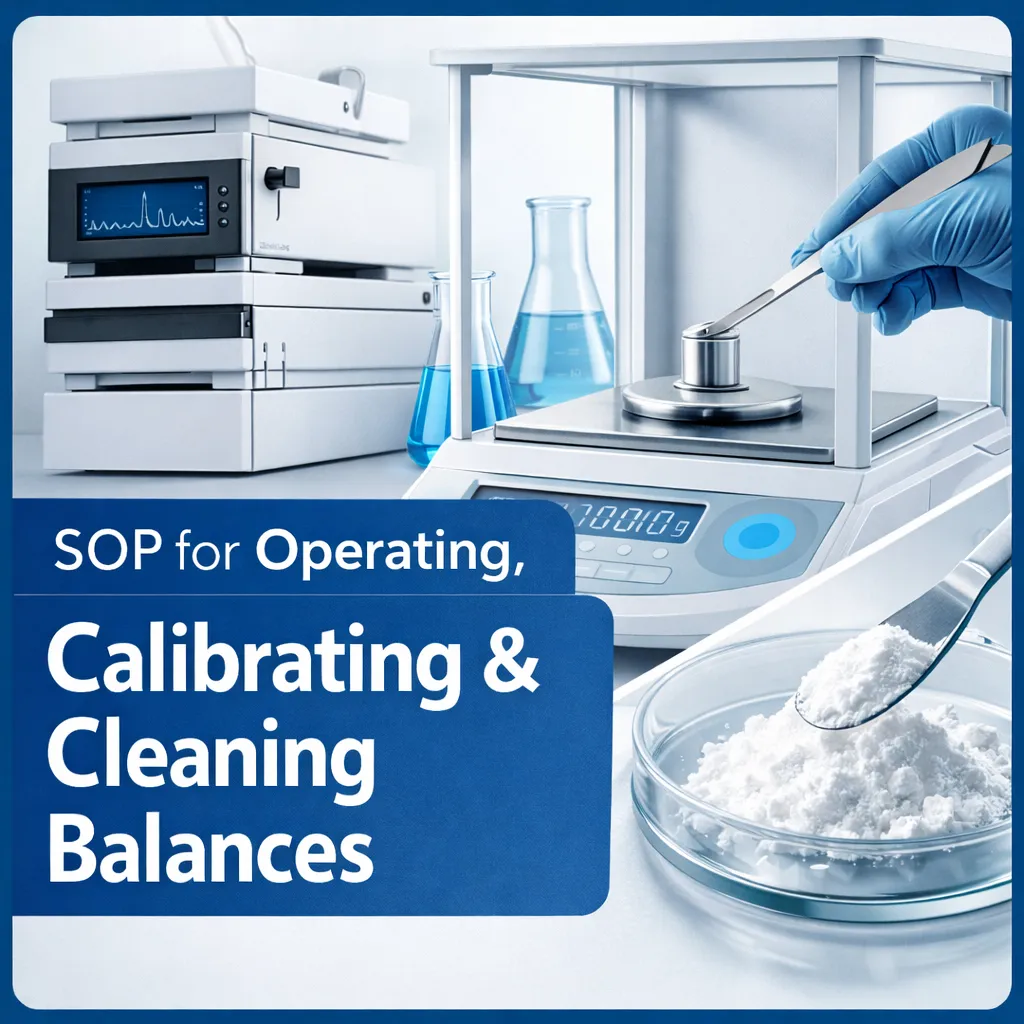

Learn SOP for operating, calibrating & cleaning balances in QC labs. Ensure accuracy, compliance, and reliability.
📌 Introduction
In pharmaceutical and quality control laboratories, balances are among the most critical instruments. Even minor inaccuracies can lead to significant errors in results, affecting product quality and compliance.
This comprehensive SOP for operating, calibrating, and cleaning balances ensures precision, reliability, and adherence to GMP/GLP standards while extending the instrument’s lifespan.
1.0 OBJECTIVE
To clearly lay down the procedure for operating, calibrating, and cleaning laboratory balances.
2.0 SCOPE
This procedure is applicable to all balances installed in the Quality Control laboratory.
3.0 RESPONSIBILITY
3.1 Doing: Technical Assistant / Executive
3.2 Checking: Executive / Manager
4.0 ACCOUNTABILITY
Head of the Department
5.0 PROCEDURE
🔹 A. SOP for Operating Laboratory Balances
Step-by-Step Operation
- Ensure the balance is clean and leveled.
- Switch ON the mains and the instrument.
- Allow stabilization (15–30 minutes).
- Perform internal or external calibration.
- Place sample carefully at the center of the pan.
- Close the draft shield (shutter).
- Record the displayed weight once stable.
- Remove sample and clean if required.
Key Operating Guidelines
- Always use clean containers or weighing paper
- Avoid direct handling of samples
- Minimize air currents and vibrations
- Do not overload the balance
🔹 B. SOP for Calibration of Balances
Step-by-Step Calibration
- Ensure the balance is ON and stabilized.
- Check leveling using the bubble indicator.
- Select calibration mode (internal/external).
- Use certified standard weights for calibration.
- Allow the balance to complete calibration.
- Record calibration results in the logbook.
Types of Calibration
- Internal Calibration: Automatic, built-in system
- External Calibration: Using certified weights
Calibration Frequency
- Daily before use
- After cleaning
- After relocation
- As per SOP schedule
🔹 C. SOP for Cleaning Laboratory Balances
Cleaning Frequency
- Once a week or whenever necessary
Step-by-Step Cleaning
- Switch OFF the instrument.
- Switch OFF the mains.
- Open the shutter and remove the weighing pan.
- Remove dust and powder using tissue paper.
- Clean internal parts using tissue soaked in isopropyl alcohol (IPA).
- Wipe with dry tissue and ensure complete drying.
- Clean external surfaces with IPA and dry tissue.
- Clean shutters using IPA and dry tissue.
- Reassemble and close the shutter.
- Record cleaning, check leveling, and perform calibration.
Detailed Cleaning Instructions
- Use lint-free tissue to avoid contamination
- Apply minimal IPA to prevent liquid damage
- Ensure all components are completely dry before use
6.0 ABBREVIATIONS
- SOP – Standard Operating Procedure
- IPA – Isopropyl Alcohol
- QC – Quality Control
⚠️ Safety Tips
- Always switch OFF before cleaning
- Wear gloves to prevent contamination
- Avoid spilling liquids inside the balance
- Handle weights with forceps or gloves
- Maintain a clean and controlled environment
❌ Common Mistakes to Avoid
- Skipping calibration before use
- Using unclean or wet containers
- Applying excess cleaning solvent
- Ignoring leveling of balance
- Not recording cleaning or calibration
✅ Best Practices for Balance Management
- Maintain calibration and cleaning logs
- Use dedicated tools for each balance
- Keep balances in vibration-free areas
- Train staff regularly on SOP compliance
- Perform routine preventive maintenance
❓ FAQs (Frequently Asked Questions)
1. What is the purpose of calibrating balances?
To ensure accuracy and reliability of measurements.
2. How often should balances be calibrated?
Daily or before each use, and after cleaning.
3. Can balances be used immediately after switching ON?
No, allow stabilization time (15–30 minutes).
4. Why is leveling important?
Improper leveling leads to inaccurate readings.
5. What is the best cleaning agent?
Isopropyl alcohol (IPA) due to quick evaporation.
6. Can I use bare hands to handle weights?
No, use gloves or forceps to avoid contamination.
7. What happens if calibration fails?
Do not use the balance; inform supervisor immediately.
8. Is cleaning required daily?
Not necessarily, but after spills or contamination.
9. Why should the shutter be closed during weighing?
To prevent air currents affecting readings.
10. Who is accountable for SOP compliance?
Head of the Department.