


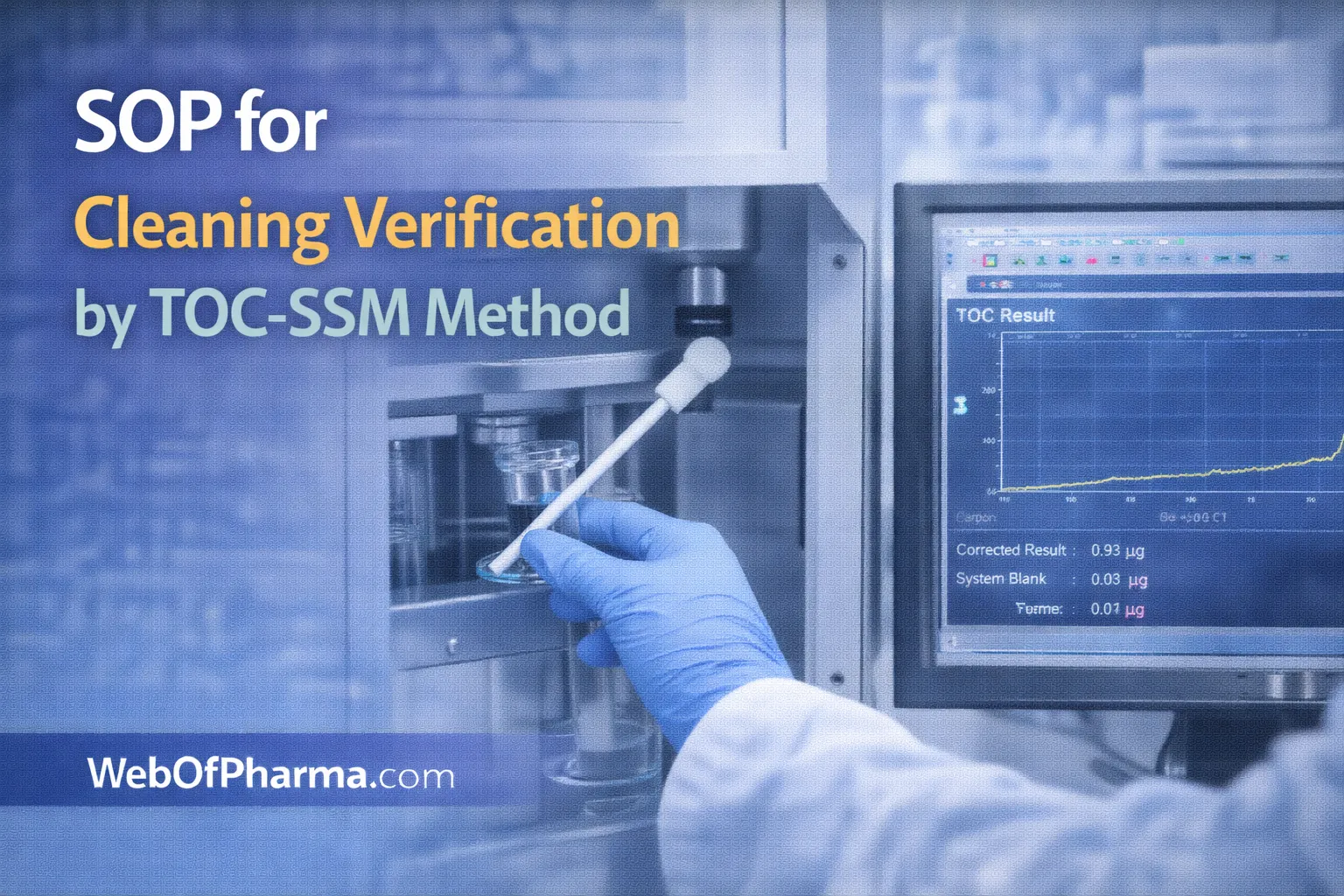

Learn SOP for cleaning verification by TOC-SSM method.
In pharmaceutical manufacturing, cleanliness is not just important—it is critical for product safety and regulatory compliance. Even trace residues can lead to contamination and product failure. That’s why implementing a robust SOP for cleaning verification by TOC-SSM method is essential.
This SOP outlines how to establish limits and verify cleaning effectiveness using Total Organic Carbon (TOC) analysis through the swab sampling method (SSM).
1. Objective of the SOP
The objective is to:
- Verify the effectiveness of cleaning procedures
- Ensure no harmful residues remain on equipment
- Establish product-specific TOC limits
- Maintain compliance with GMP requirements
2. Scope
This SOP applies to:
- Establishment of TOC limits product-wise
- Routine cleaning verification of tablet dosage forms
- QC laboratory analysis using TOC method
3. Roles and Responsibilities
3.1 Responsible Personnel
- Technical Assistant: Perform analysis
- Executive / Manager: Review and verify
3.2 Accountability
- Head of Department: Ensure SOP compliance
4. Principle of TOC-SSM Method
The TOC-SSM method measures:
- Organic carbon residues left after cleaning
- Swab samples collected from equipment surfaces
👉 Higher TOC values indicate inadequate cleaning.
5. Procedure
5.1 Establishment of TOC Limits (Product-wise)
Step-by-Step Process
- Refer to MAR (Maximum Allowable Residue) value
- Based on worst-case product
- Calculate sample weight using formula:
Weight=Label claimMAR value × Average weight of tablet
- Take calculated weight of tablet granules into sample boat
- Analyze sample using TOC analyzer
- Record corrected carbon value (ABSc.) in µg
- Establish acceptable TOC limits
- Prepare product-wise limit list
👉 This ensures scientifically justified limits.
5.2 Routine Cleaning Verification
Step-by-Step Process
- Receive Cleaning Test Request Slip with swab sample from QA
- Operate TOC instrument as per SOP
- Place swab into sample boat
- Analyze sample
Recording Results
- Results expressed in µg of absolute carbon
- Compare with established limits
- Record in cleaning test request slip
Documentation
- Send results to tablet department
- File:
- TOC graph
- Copy of request slip
👉 Proper documentation ensures traceability.
6. Acceptance Criteria
- Results must be within established TOC limits
👉 Exceeding limits indicates inadequate cleaning.
7. Safety Precautions
- Handle swabs carefully to avoid contamination
- Wear PPE (gloves, lab coat, goggles)
- Avoid direct contact with samples
- Ensure instrument calibration
8. Best Practices
- Use validated swabbing techniques
- Analyze samples immediately
- Maintain instrument calibration
- Ensure proper documentation
- Train staff regularly
9. Common Mistakes to Avoid
- Incorrect MAR calculation
- Improper swab sampling
- Delayed analysis
- Poor documentation
- Ignoring limit criteria
FAQs
1. What is TOC in cleaning validation?
Total Organic Carbon measures organic residue on equipment.
2. What is SSM method?
Swab Sampling Method used for collecting residues.
3. What is MAR?
Maximum Allowable Residue for a product.
4. Why is TOC testing important?
It ensures effective cleaning and prevents contamination.
5. What units are used in TOC results?
Micrograms (µg) of carbon.
6. Who performs TOC analysis?
Technical assistant.
7. What happens if TOC exceeds limit?
Re-cleaning and re-testing are required.
8. What is ABSc.?
Absolute carbon value obtained from analysis.
9. Why is documentation important?
For audit and compliance purposes.
10. How are TOC limits established?
Using MAR values and product-specific calculations.