


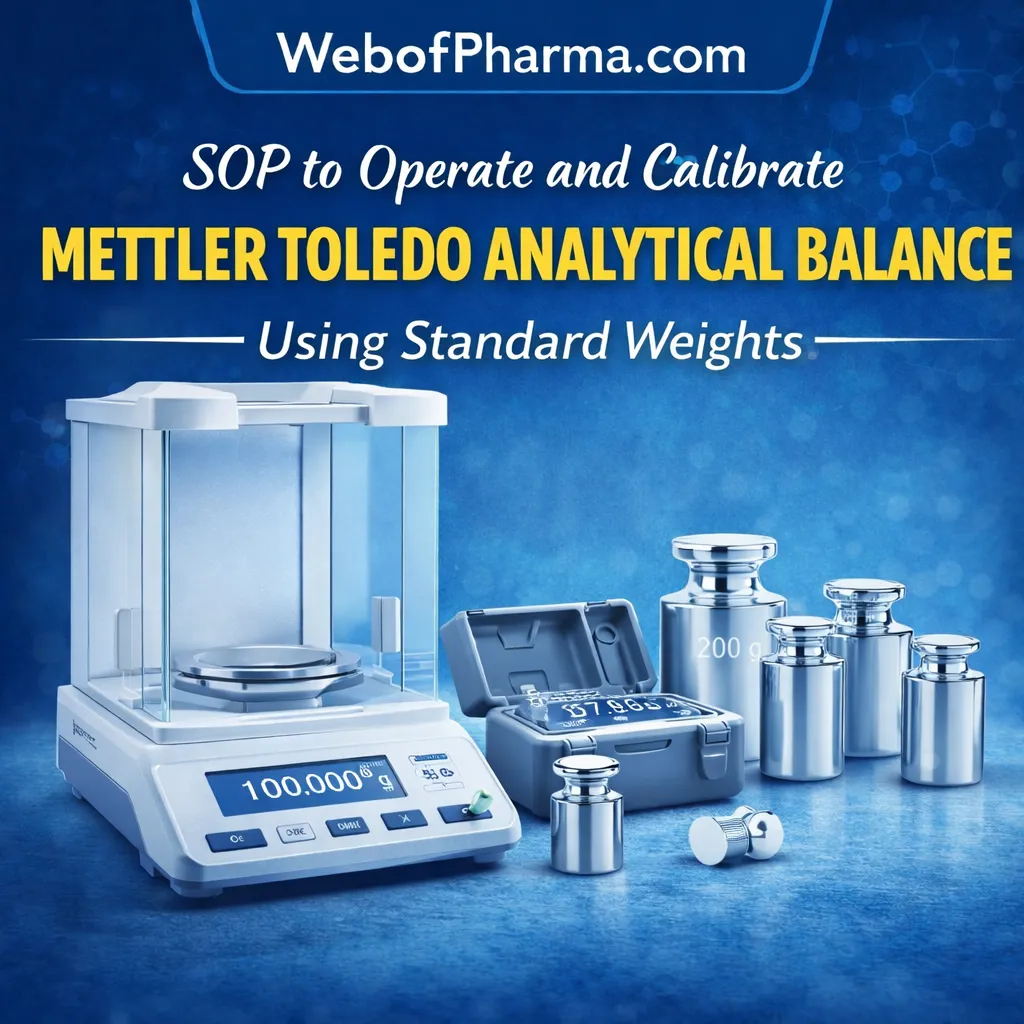

Learn the Standard operating procedure to operate and calibrate the Mettler Toledo analytical balance using standard weights, precautions during operation and calibration of balances and acceptance criteria with step-by-step guidance for QC labs.
Accurate weighing is the backbone of pharmaceutical quality control. A properly calibrated analytical balance ensures precise measurements, compliance, and data integrity. This guide explains the Standard operating procedure to operate and calibrate the Mettler Toledo analytical balance using standard weights, precautions during operation and calibration of balances and acceptance criteria in a clear and practical way.
🎯 Purpose
To define a standardized procedure for the operation and calibration of analytical balances.
📍 Scope
Applicable to Mettler Toledo analytical balances used in Quality Control (QC) laboratories, especially in microbiology.
👨🔬 Responsibility
- Microbiologist
🧾 Accountability
- Head of Department
⚙️ 5.0 Procedure
🧩 5.1 Installation
- Place the weighing pan correctly using the conical peg.
- Position the draft shield properly.
- Adjust leveling screws until the bubble is centered.
- Connect the AC adapter and power supply.
▶️ 5.2 Operation Procedure
- Turn ON the balance using the On/Off key.
- Ensure proper leveling before use.
- Turn OFF by holding the On/Off key until display shows “OFF”.
⚖️ 5.3 Taring
- Open the glass door.
- Place container or butter paper on the pan.
- Press →O/T← key to zero the display.
- Close and reopen the door after taring.
🧪 5.4 Weighing
- Place sample on the pan.
- Close the draft shield door for accurate reading.
- Wait for stability indicator to disappear.
- Record or print the stable weight.
🧼 5.5 Care and Maintenance
- Turn OFF after use.
- Clean using a soft, moist cloth.
- Use a brush for residue removal.
- ❗ Do not blow air into the chamber.
⚠️ 5.6 Precautions
- Avoid vibrations and air currents.
- Protect from sunlight, moisture, and temperature fluctuations.
- Always use clean and calibrated weights.
🔄 5.7 Auto Calibration
- Switch ON balance and printer.
- Press and hold CAL/MENU key.
- Allow automatic internal calibration.
- “CAL DONE” message confirms completion.
📅 5.8 Daily Calibration
- Use standard weights: 1g, 10g, 100g, 200g.
- Record readings after stabilization.
- Maintain calibration records with printouts.
📆 5.9 Monthly Calibration
- Perform self-calibration.
- Repeat daily calibration checks.
- Conduct additional verification tests.
📏 5.10 Calibration for Uncertainty Measurement
🧪 Procedure
- Use certified weights: 1g, 50g, 200g
- Weigh each 10 times and record values.
📊 Calculation
Uncertainty=Standard Weight2×Standard Deviation
✅ Acceptance Criteria
- Not more than 0.10%
🧪 5.11 External Calibration
- Use weights: 200g, 100g, 50g, 10g, 5g, 2g, 1g
- Record readings for each weight.
- Maintain documentation with printouts.
✅ Acceptance Criteria
- Tolerance limit: ± 0.1% of standard weight
- Balance must display weight within specified limits.
❗ Out of Calibration Handling
- If results are out of tolerance:
- Clean weights and recheck
- If issue persists, call service engineer
- Do not use the balance
- Recalibrate after maintenance
📚 Abbreviations
- SOP: Standard Operating Procedure
- QC: Quality Control
- SD: Standard Deviation
- g: Gram
- mg: Milligram
🔧 Conclusion
The balance is considered:
- ✅ Satisfactory if within limits
- ❌ Not satisfactory if outside limits
Next calibration should be scheduled as per SOP.
❓ Frequently Asked Questions (FAQs)
1. Why is calibration of analytical balance important?
It ensures accuracy and reliability in weighing results.
2. What standard weights are used for calibration?
Common weights include 1g, 10g, 100g, and 200g.
3. What is the acceptable tolerance limit?
± 0.1% of the standard weight.
4. How often should daily calibration be performed?
Before use or at least once daily.
5. What is uncertainty in calibration?
It measures variability in repeated measurements.
6. What is the acceptable uncertainty limit?
Not more than 0.10%.
7. Why is leveling important in a balance?
Improper leveling can cause inaccurate readings.
8. What should be done if calibration fails?
Stop using the balance and arrange maintenance.
9. Why should the draft shield door be closed?
To prevent air currents affecting measurements.
10. What precautions should be taken during weighing?
Avoid vibrations, temperature changes, and contamination.