


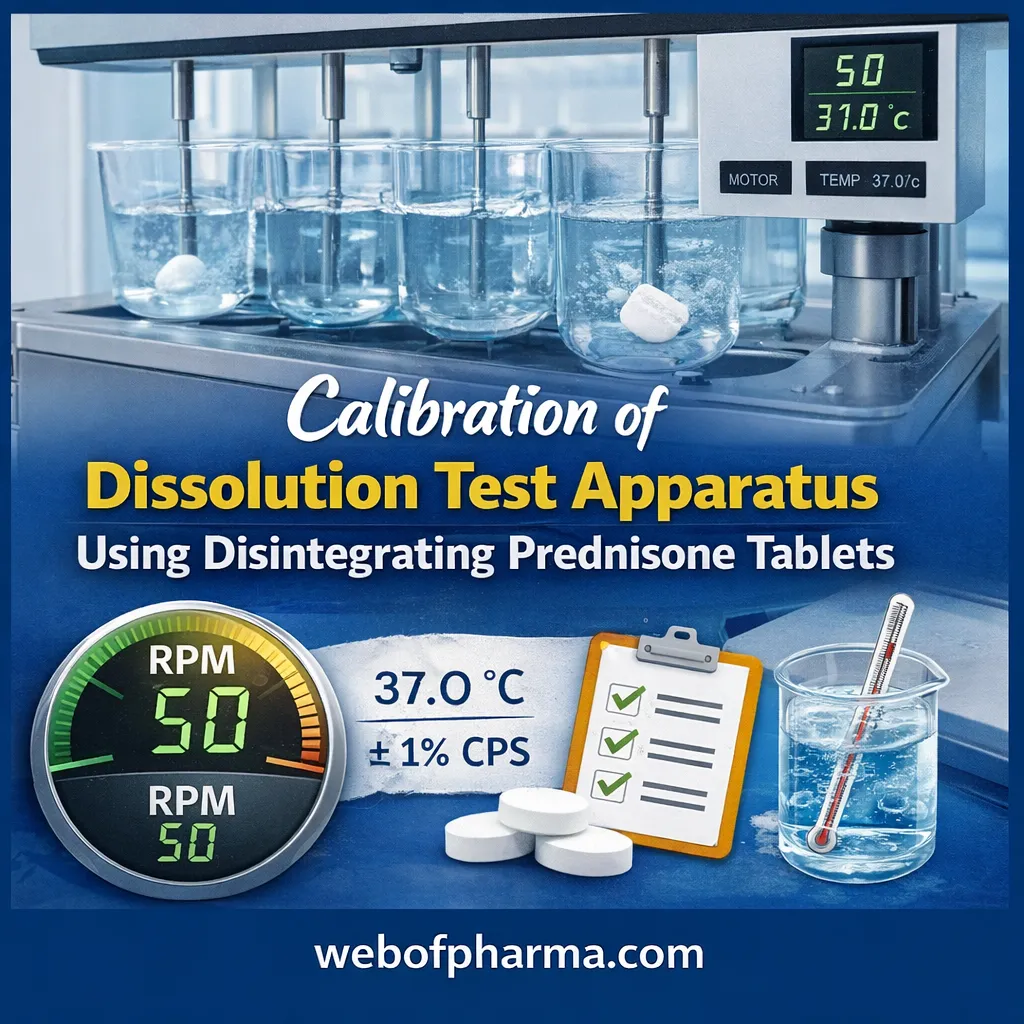

Learn the complete procedure for calibration of Dissolution Test Apparatus using Disintegrating Prednisone tablets, including RPM and temperature calibration, mechanical checks, physical parameters, and GMP documentation requirements.
The Dissolution Test Apparatus is one of the most critical instruments in pharmaceutical quality control laboratories. It is used to evaluate the rate and extent of drug release from solid dosage forms such as tablets and capsules. Proper calibration of this instrument ensures accurate dissolution results, regulatory compliance, and consistent product quality.
This article explains the complete procedure for calibration of Dissolution Test Apparatus using Disintegrating Prednisone tablets, including RPM calibration, temperature calibration, mechanical verification, and documentation requirements according to pharmacopeial and GMP standards.
Objective
To describe the standard procedure for the calibration of Dissolution Test Apparatus using Disintegrating Prednisone tablets and to ensure that the instrument operates within specified limits for reliable dissolution testing.
Scope
This procedure applies to calibration and performance verification of the Dissolution Test Apparatus used in:
- Pharmaceutical Quality Control laboratories
- Research and Development laboratories
- Stability testing laboratories
- Manufacturing facilities
Principle of Dissolution Apparatus Calibration
Calibration of the dissolution apparatus ensures that the instrument provides accurate and reproducible dissolution results. Performance verification using Disintegrating Prednisone tablets confirms that the system meets pharmacopeial requirements.
Calibration typically involves:
- RPM verification
- Temperature verification
- Mechanical parameter checks
- Performance testing using standard tablets
- Documentation and labeling
RPM Calibration Procedure
Step-by-Step Procedure
- Enter the required RPM value within the range of 30 to 200 RPM.
- Press the ENTER key to confirm the value.
- The SET RPM LED will turn OFF after confirmation.
- If the RPM value is outside the allowable range, an error message “Er” will appear on the display.
- Reset the value if an error message appears.
- Record the RPM value manually in the calibration log.
Example:
To set 100 RPM:
- Press SET RPM
- Press number 1 once
- Press number 0 twice
- Press ENTER
- The display will show 100 RPM
Temperature Calibration Procedure
Step-by-Step Procedure
- Press the SET TEMP key.
- The temperature LED will illuminate.
- Enter the required temperature between:
30°C to 100°C
- Press ENTER to confirm.
- If the temperature is outside the range, the display will show:
“Er”
- Set and verify the following temperatures:
- 35°C
- 37°C
- 40°C
- Measure the actual temperature using a calibrated thermometer.
- Record the observed values in the calibration log.
Acceptance Criteria for Temperature and RPM
| Parameter | Set Value | Acceptance Limit |
|---|---|---|
| Temperature | 35°C | 34.5 – 35.5°C |
| Temperature | 37°C | 36.5 – 37.5°C |
| Temperature | 40°C | 39.5 – 40.5°C |
| RPM | 50 RPM | 48 – 52 RPM |
| RPM | 100 RPM | 96 – 104 RPM |
| RPM | 150 RPM | 144 – 156 RPM |
Calibration Using Disintegrating Prednisone Tablets (Performance Verification Test)
This test verifies the performance of the dissolution apparatus using standard reference tablets.
Step-by-Step Procedure
- Ensure the instrument power supply is ON.
- Set the following parameters:
- Time: 30 minutes
- Temperature: 37°C ± 0.5°C
- Speed: 50 RPM
- Install the paddle apparatus.
- Add 900 ml of deaerated water into each dissolution vessel.
- Allow the temperature to stabilize.
- Place one Disintegrating Prednisone tablet (50 mg) into each vessel.
- Start the dissolution program.
Sample Preparation and Analysis
After completion of the test:
- Withdraw the sample solution from each vessel.
- Filter using Whatman Filter Paper No. 41.
- Discard the first 50 ml of filtrate.
- Take 5 ml filtrate and dilute to 25 ml with water.
- Measure absorbance at:
242 nm
using a UV spectrophotometer.
Preparation of Standard Solution
- Dissolve 25 mg Prednisone in 50 ml water.
- Dilute 5 ml to 50 ml with water.
- Further dilute 5 ml to 25 ml with water.
- Measure absorbance at:
242 nm
If necessary, add not more than 2.5 ml alcohol to assist dissolution.
Additional Verification Steps
Repeat the procedure under the following conditions:
- 100 RPM using paddle apparatus
- 100 RPM using basket apparatus
Record all results in the calibration log.
Checking Physical Parameters of Dissolution Apparatus
Paddle Parameters
Verify the following:
- Shaft diameter
- Blade upper chord
- Lower chord
- Paddle height
- Thickness
- Distance from vessel bottom
All values must fall within specified limits.
Basket Parameters
Verify:
- Total height of basket
- Height of screen
- Internal diameter
- External diameter
- Ring diameter
- Hole diameter
- Distance from bottom
Mechanical Calibration Checks
1. Wobbling Test
- Attach paddle or basket apparatus
- Install wobbling meter
- Measure wobble movement
- Verify within acceptable limit
2. Rotation Verification
- Set RPM (50 or 100)
- Use tachometer
- Measure rotational speed
- Record observed value
3. Distance Verification
Measure the distance between:
- Paddle/basket bottom
- Vessel bottom
Using vernier calipers.
Acceptance Criteria for Mechanical Parameters
| Parameter | Limit |
|---|---|
| Paddle wobble | ≤ 2.0 mm |
| Basket wobble | ≤ 2.0 mm |
| RPM accuracy | ± 4% |
| Distance from vessel bottom | 25 ± 2 mm |
Calibration Frequency
Calibration of the Dissolution Test Apparatus should be performed:
- Every 6 months (typical)
- After major maintenance
- After relocation
- After repair
- As per GMP schedule
- Before regulatory inspection
Documentation Requirements
After calibration:
Record the following:
- Instrument model and code
- Temperature readings
- RPM readings
- Mechanical parameters
- Performance verification results
- Calibration status
- Next calibration due date
- Signatures of responsible personnel
Then:
Affix the calibration label on the instrument
When Calibration Fails
If calibration results fall outside specified limits:
Immediately:
- Inform the QC Head
- Stop instrument use
- Investigate the cause
- Perform corrective action
- Recalibrate the instrument
Importance of Calibration Using Prednisone Tablets
Calibration using Disintegrating Prednisone tablets is important because it:
- Verifies system performance
- Ensures dissolution accuracy
- Detects mechanical issues
- Supports regulatory compliance
- Maintains product quality
- Ensures patient safety
Conclusion
Proper calibration of Dissolution Test Apparatus using Disintegrating Prednisone tablets ensures accurate dissolution testing, reliable product quality, and compliance with pharmacopeial and GMP requirements. Routine calibration of RPM, temperature, mechanical parameters, and performance verification testing is essential for maintaining instrument reliability and regulatory readiness.
10 Frequently Asked Questions (FAQs)
1. Why are Disintegrating Prednisone tablets used for calibration?
They are standard reference tablets used to verify dissolution apparatus performance.
2. What is the standard temperature for dissolution testing?
Typically 37°C ± 0.5°C.
3. What is the acceptable RPM tolerance?
Usually ± 4% of the set RPM.
4. How much dissolution medium is used in calibration?
Typically 900 ml of deaerated water.
5. What wavelength is used to measure Prednisone absorbance?
242 nm
6. What is wobbling in a dissolution apparatus?
It is the lateral movement of the paddle or basket during rotation.
7. What instrument is used to measure RPM?
A tachometer.
8. What happens if calibration results fail?
The instrument must be stopped and the QC Head informed immediately.
9. How often should dissolution apparatus calibration be performed?
Usually every 6 months or after maintenance.
10. Why is mechanical calibration important?
It ensures proper alignment, rotation accuracy, and reliable dissolution results.