


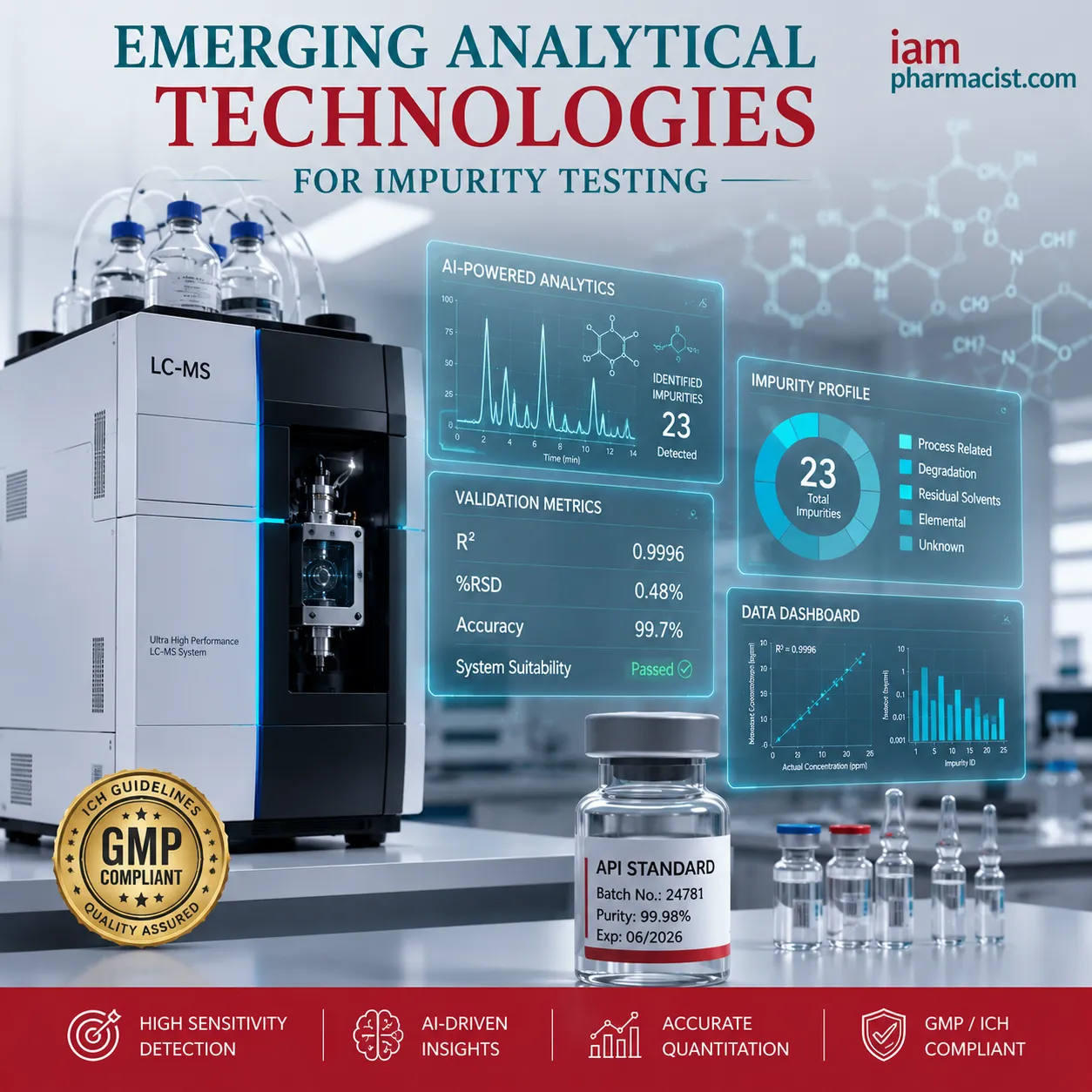

Explore emerging analytical technologies for pharmaceutical impurity testing, including HRMS, PAT, AI, automation, and GMP compliance.
Definition
Emerging analytical technologies for pharmaceutical impurity testing are advanced scientific tools and digital platforms that enable highly sensitive detection, identification, monitoring, and control of trace impurities, degradation products, elemental contaminants, and genotoxic compounds throughout the pharmaceutical product lifecycle.
Introduction
Pharmaceutical impurity testing has evolved dramatically over the past decade. Increasingly stringent global regulations, heightened patient safety expectations, and the growing complexity of drug products have pushed laboratories toward more sophisticated analytical solutions.
Today, trace impurities present at parts-per-million (ppm) or even parts-per-billion (ppb) levels can trigger regulatory concerns, especially when dealing with genotoxic impurities, nitrosamines, elemental contaminants, degradation products, and process-related residues.
To address these challenges, pharmaceutical companies are adopting emerging analytical technologies that combine ultra-high sensitivity, automation, real-time monitoring, and artificial intelligence. These innovations are transforming impurity profiling from a reactive quality-control activity into a proactive quality-by-design strategy.
This article explores the latest analytical technologies shaping pharmaceutical impurity testing, their regulatory significance, practical applications, and future impact on GMP compliance.
Why Advanced Impurity Testing Matters
Impurities can originate from multiple sources throughout the drug lifecycle.
Common Sources of Pharmaceutical Impurities
| Source | Examples |
|---|---|
| Raw Materials | Residual solvents, contaminants |
| Manufacturing Process | By-products, intermediates |
| Packaging Materials | Extractables and leachables |
| Storage Conditions | Oxidative degradation products |
| Environmental Exposure | Trace elemental contamination |
| Transportation | Stability-related degradation |
Even low-level contaminants may affect:
- Patient safety
- Product efficacy
- Regulatory approval
- Brand reputation
- Market authorization
This is why regulatory agencies increasingly require advanced analytical approaches.
Regulatory Drivers Behind Advanced Impurity Testing
Modern impurity testing programs must comply with multiple international standards.
| Guideline | Focus Area |
|---|---|
| ICH Q3A | Impurities in Drug Substances |
| ICH Q3B | Impurities in Drug Products |
| ICH M7 | Genotoxic Impurities |
| ICH Q9 | Quality Risk Management |
| USP <232> | Elemental Impurities |
| USP <233> | Elemental Impurity Procedures |
| FDA Guidance | Nitrosamine Risk Assessment |
| EU GMP Annex 15 | Validation Requirements |
As impurity limits continue to tighten, conventional analytical methods often struggle to provide sufficient sensitivity.
The Rise of High-Resolution Mass Spectrometry (HRMS)
What Is HRMS?
High-Resolution Mass Spectrometry (HRMS) provides extremely accurate molecular mass measurements, enabling scientists to identify unknown impurities with remarkable precision.
Leading HRMS Technologies
- Orbitrap Mass Spectrometry
- Time-of-Flight (TOF-MS)
- Quadrupole Time-of-Flight (QTOF)
- Fourier Transform Ion Cyclotron Resonance (FT-ICR)
Advantages of HRMS in Impurity Testing
| Benefit | Impact |
|---|---|
| Accurate Mass Detection | Rapid impurity identification |
| Structural Elucidation | Characterization of unknown peaks |
| Ultra-High Sensitivity | Detection at ppb levels |
| Comprehensive Profiling | Simultaneous impurity screening |
| Reduced Sample Preparation | Faster analysis |
Practical Example
During stability studies, an unexpected chromatographic peak appears at 0.03%.
Traditional UV detection cannot identify the compound, but HRMS determines its exact molecular formula and fragmentation pattern, enabling rapid root-cause investigation.
Advanced LC-MS/MS for Genotoxic Impurity Analysis
Genotoxic impurities are among the most critical contaminants in pharmaceuticals.
Common Targets
- Nitrosamines
- Alkyl sulfonates
- Epoxides
- Hydrazines
Why LC-MS/MS?
Liquid Chromatography-Tandem Mass Spectrometry offers:
- Exceptional selectivity
- Ultra-low detection limits
- Regulatory acceptance
- High throughput
Many laboratories now use LC-MS/MS as the gold standard for nitrosamine testing.
Automation: Reducing Human Error in Analytical Laboratories
Manual sample preparation remains one of the largest sources of analytical variability.
Automated Laboratory Technologies
Robotic Liquid Handling
Automates:
- Dilutions
- Standard preparations
- Sample aliquoting
- Extraction procedures
Automated Sample Preparation Benefits
| Manual Process Risk | Automation Benefit |
|---|---|
| Pipetting errors | Improved precision |
| Calculation mistakes | Automated calculations |
| Operator variability | Standardized workflows |
| Documentation gaps | Electronic traceability |
GMP Benefits of Automation
Automation supports:
- Data integrity
- Audit readiness
- ALCOA+ principles
- Increased throughput
- Reduced deviations
Process Analytical Technology (PAT): Quality Built Into Manufacturing
What Is PAT?
Process Analytical Technology (PAT) is a framework that enables real-time monitoring and control of manufacturing processes.
Rather than detecting impurities after production, PAT helps prevent their formation.
Key PAT Technologies
Near-Infrared Spectroscopy (NIR)
Used for:
- Blend uniformity
- Moisture content
- Process monitoring
Raman Spectroscopy
Provides:
- Real-time chemical fingerprinting
- Reaction monitoring
- Polymorph identification
Online Mass Spectrometry
Supports:
- Reaction optimization
- Impurity control
- Continuous manufacturing
PAT Benefits
| Traditional QC | PAT Approach |
|---|---|
| End-product testing | Real-time monitoring |
| Reactive quality control | Proactive quality assurance |
| Batch failures | Early intervention |
| Delayed decisions | Immediate process adjustments |
Elemental Impurity Testing Technologies
Following implementation of USP <232> and USP <233>, elemental impurity testing has become a major analytical focus.
ICP-MS: The Industry Standard
Detectable Elements
- Lead
- Cadmium
- Arsenic
- Mercury
- Nickel
- Palladium
- Platinum
Benefits
- Extremely low detection limits
- Multi-element analysis
- Regulatory compliance
ICP-MS has largely replaced traditional heavy metal testing methods.
Artificial Intelligence in Pharmaceutical Impurity Analysis
AI is rapidly transforming analytical science.
Applications of AI
Chromatographic Peak Analysis
AI can:
- Identify hidden trends
- Detect anomalous peaks
- Improve peak integration
Predictive Stability Modeling
Machine learning algorithms predict:
- Degradation pathways
- Shelf-life risks
- Stability failures
Raw Material Risk Assessment
AI can correlate:
- Supplier variability
- Impurity profiles
- Process performance
Practical Example
A machine-learning model analyzes three years of stability data and predicts a degradation impurity likely to exceed specification under accelerated storage conditions.
Scientists can reformulate the product before regulatory submission.
Digital Data Integration and Smart Laboratories
Modern analytical platforms are increasingly connected through:
- Laboratory Information Management Systems (LIMS)
- Electronic Laboratory Notebooks (ELN)
- Chromatography Data Systems (CDS)
- Quality Management Systems (QMS)
Benefits of Digital Integration
Enhanced Data Integrity
Supports:
- Audit trails
- Electronic signatures
- Secure record retention
Faster Investigations
Integrated systems enable rapid retrieval of:
- Analytical data
- Instrument logs
- Validation records
Regulatory Readiness
Improves compliance with:
- FDA 21 CFR Part 11
- EU GMP Annex 11
- MHRA Data Integrity Guidance
Step-by-Step Guide: Implementing Emerging Analytical Technologies
Step 1: Assess Current Impurity Risks
Evaluate:
- Genotoxic impurities
- Degradation products
- Elemental impurities
- Process contaminants
Step 2: Review Regulatory Requirements
Map applicable regulations:
- ICH Q3A
- ICH Q3B
- ICH M7
- USP <232>
- USP <233>
Step 3: Select Appropriate Technologies
| Testing Objective | Recommended Technology |
|---|---|
| Unknown impurities | HRMS |
| Nitrosamines | LC-MS/MS |
| Elemental impurities | ICP-MS |
| Process monitoring | PAT |
| Predictive analysis | AI/ML Platforms |
Step 4: Validate Analytical Methods
Perform:
- Accuracy
- Precision
- Specificity
- Robustness
- Detection limit studies
According to ICH Q2(R2) expectations.
Step 5: Implement Data Integrity Controls
Ensure:
- Audit trails
- User access controls
- Electronic signatures
- Backup procedures
Step 6: Train Laboratory Personnel
Training should cover:
- Instrument operation
- Data integrity
- GMP expectations
- Analytical troubleshooting
Step 7: Establish Continuous Improvement
Monitor:
- Technology performance
- Regulatory updates
- Emerging impurity risks
GMP and Regulatory Considerations
Regulators increasingly expect pharmaceutical companies to adopt scientifically justified analytical technologies.
Key Inspection Focus Areas
- Method validation
- Data integrity
- Instrument qualification
- Audit trail review
- Computerized system validation
- Change control
Advanced technologies must operate within validated GMP frameworks.
Future Trends in Pharmaceutical Impurity Testing
Several innovations are expected to shape the next generation of analytical laboratories.
Emerging Trends
- AI-driven impurity prediction
- Autonomous laboratories
- Continuous manufacturing analytics
- Digital twins for process monitoring
- Cloud-connected analytical platforms
- Advanced multi-omics characterization
- Real-Time Release Testing (RTRT)
These developments will further strengthen pharmaceutical quality and patient safety.
Conclusion
The future of pharmaceutical impurity testing is increasingly defined by precision, automation, and digital intelligence. Emerging analytical technologies such as High-Resolution Mass Spectrometry, LC-MS/MS, ICP-MS, Process Analytical Technology, and Artificial Intelligence are enabling laboratories to detect, identify, and control impurities at unprecedented levels.
As regulatory agencies continue tightening impurity limits and expectations around data integrity, pharmaceutical organizations must invest in advanced analytical capabilities that support both compliance and scientific excellence. The combination of cutting-edge instrumentation, automation, and predictive analytics represents the next evolution in impurity control—ensuring safer medicines, more efficient manufacturing, and greater confidence in pharmaceutical quality worldwide.
FAQs
1. What are emerging analytical technologies in pharmaceutical impurity testing?
They are advanced tools such as HRMS, LC-MS/MS, ICP-MS, PAT, and AI that improve impurity detection and characterization.
2. Why is impurity testing important in pharmaceuticals?
Impurity testing ensures product safety, efficacy, quality, and compliance with regulatory requirements.
3. What is High-Resolution Mass Spectrometry (HRMS)?
HRMS is an analytical technique that provides accurate mass measurements for identifying unknown impurities.
4. How does LC-MS/MS help detect genotoxic impurities?
LC-MS/MS offers exceptional sensitivity and selectivity, enabling detection of impurities at trace levels.
5. What is Process Analytical Technology (PAT)?
PAT is a framework that uses real-time analytical measurements to monitor and control manufacturing processes.
6. Why is ICP-MS used for elemental impurity testing?
ICP-MS can detect trace metal contaminants at extremely low concentrations and supports USP <232>/<233> compliance.
7. How does automation improve pharmaceutical testing?
Automation reduces human error, improves reproducibility, increases throughput, and strengthens data integrity.
8. What role does AI play in impurity analysis?
AI helps identify analytical trends, predict degradation pathways, and improve risk assessment.
9. Which regulations govern pharmaceutical impurity testing?
Key regulations include ICH Q3A, ICH Q3B, ICH M7, USP <232>, USP <233>, and various FDA and EMA guidelines.
10. What is the future of pharmaceutical impurity testing?
The future includes AI-powered analytics, autonomous laboratories, continuous monitoring, and real-time release testing.