


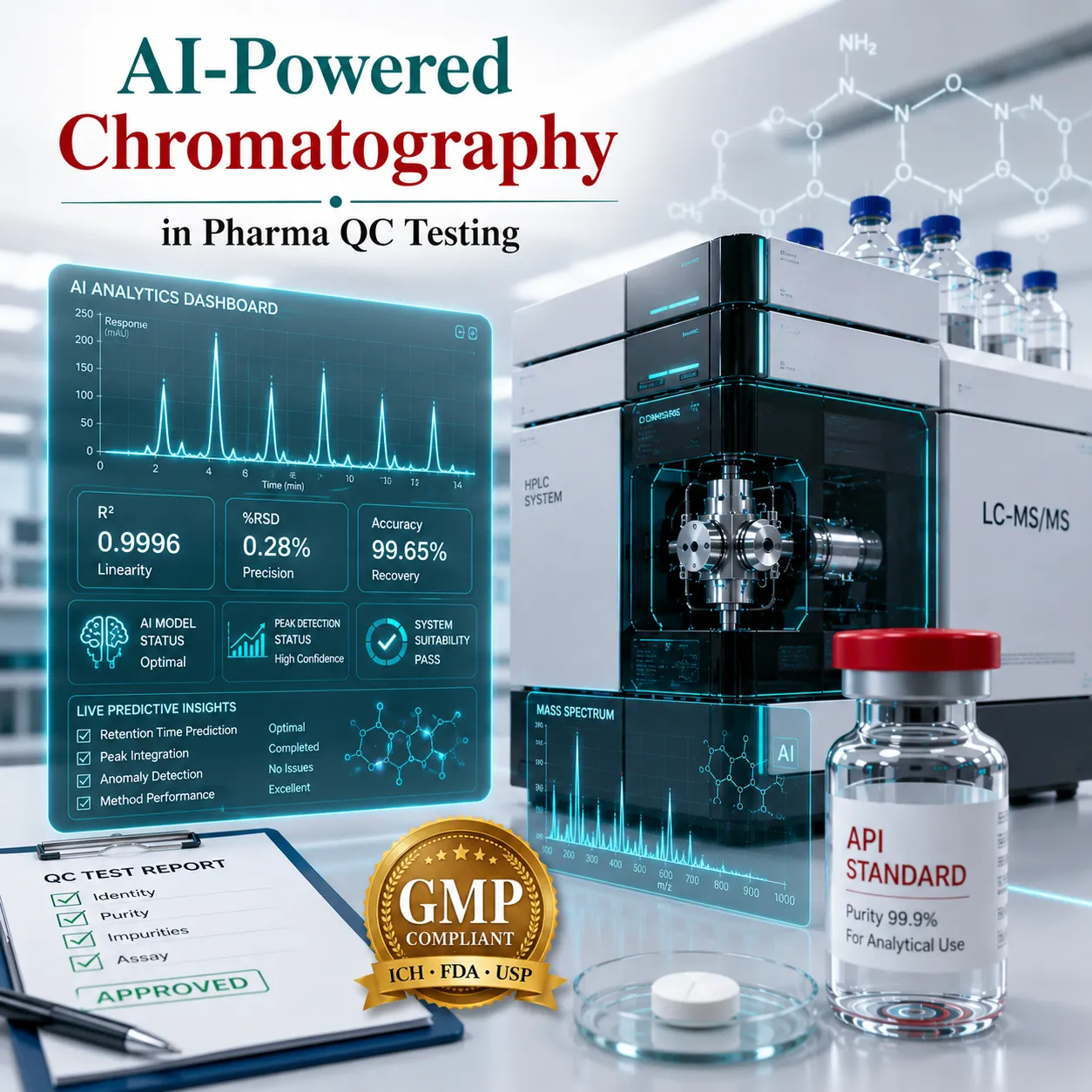

Discover how AI-powered chromatography data analysis improves QC testing, method development, data integrity, and GMP compliance in pharma labs.
Definition
AI-powered chromatography data analysis uses artificial intelligence (AI) and machine learning (ML) algorithms to automate chromatogram interpretation, optimize analytical methods, predict retention behavior, improve peak identification, and accelerate pharmaceutical quality control (QC) testing. These technologies enhance efficiency, accuracy, and regulatory compliance while reducing manual workload in analytical laboratories.
Introduction
Pharmaceutical quality control laboratories generate enormous volumes of chromatography data every day. From raw material testing and in-process controls to impurity profiling and stability studies, High-Performance Liquid Chromatography (HPLC), Ultra-Performance Liquid Chromatography (UPLC), and LC-MS/MS remain the backbone of pharmaceutical analysis.
However, traditional chromatography method development and data interpretation are often labor-intensive, expensive, and time-consuming. Scientists spend significant effort optimizing chromatographic conditions, integrating peaks, reviewing audit trails, and investigating outliers.
Artificial Intelligence (AI) and Machine Learning (ML) are transforming this landscape.
Modern AI-powered chromatography platforms can predict retention behavior, automate peak identification, optimize separation conditions, and even recommend method parameters with minimal human intervention. These capabilities are helping pharmaceutical companies accelerate method development, improve QC efficiency, and support Pharma 4.0 initiatives.
Why Traditional Chromatography Workflows Are Challenging
Method development remains one of the most resource-intensive activities in analytical chemistry.
Common Challenges
| Challenge | Impact |
|---|---|
| Trial-and-error optimization | Long development timelines |
| Complex chromatograms | Increased review burden |
| Peak integration variability | Analyst-dependent results |
| Large datasets | Manual processing delays |
| Method transfer issues | Revalidation requirements |
| Data review workload | Reduced productivity |
Traditional workflows often require dozens or hundreds of experimental runs before achieving acceptable chromatographic performance.
Where AI Fits into Chromatography
AI can support multiple stages of the chromatographic lifecycle.
AI Applications Across the Workflow
| Stage | AI Contribution |
|---|---|
| Method Screening | Predict suitable columns and mobile phases |
| Method Optimization | Automated parameter tuning |
| Signal Processing | Noise reduction and peak recognition |
| Peak Identification | Automated compound assignment |
| Data Review | Outlier detection and trend analysis |
| QC Testing | Faster result interpretation |
| Lifecycle Management | Continuous performance monitoring |
AI-Powered Method Development
1. Intelligent Screening of Chromatographic Conditions
One of the most time-consuming steps in liquid chromatography is selecting suitable stationary and mobile phases.
Traditionally, scientists evaluate multiple combinations through experimental screening.
AI Advantage
Machine learning models can analyze:
- Molecular structures
- Physicochemical properties
- Historical chromatography data
- Retention behavior
to predict optimal chromatographic conditions before experiments begin.
Result
Fewer screening runs and significantly reduced development time.
2. Quantitative Structure-Retention Relationship (QSRR) Models
QSRR models establish relationships between molecular structure and chromatographic retention.
AI Enhancements
Modern deep learning architectures improve prediction accuracy by analyzing:
- Molecular fingerprints
- Chemical descriptors
- Structural similarities
- Physicochemical properties
Benefits
| Traditional Approach | AI-Assisted Approach |
|---|---|
| Multiple trial runs | Predictive retention modeling |
| Higher solvent consumption | Reduced experimentation |
| Manual condition selection | Data-driven optimization |
AI-Driven Optimization of Chromatographic Parameters
Bayesian Optimization
Bayesian optimization is increasingly used to identify optimal chromatographic conditions with fewer experiments.
Parameters Optimized
- Flow rate
- Gradient profile
- Column temperature
- Mobile phase composition
- pH conditions
Benefits
✓ Reduced experimental runs
✓ Faster method development
✓ Improved resolution
✓ Lower solvent consumption
Reinforcement Learning for Self-Optimizing Chromatography
Reinforcement learning enables systems to learn from previous chromatographic outcomes and continuously improve performance.
Example
An AI model automatically adjusts:
- Gradient slope
- Flow rate
- Temperature
until predefined separation objectives are achieved.
This significantly reduces analyst intervention.
AI-Powered Signal Processing and Peak Analysis
Automated Peak Detection
Peak identification is traditionally dependent on analyst expertise.
AI algorithms can automatically:
- Detect peaks
- Separate co-eluting compounds
- Correct baseline drift
- Remove noise
Advantages
| Conventional Analysis | AI Analysis |
|---|---|
| Manual integration | Automated integration |
| Analyst variability | Consistent processing |
| Time-intensive review | Rapid interpretation |
Intelligent Peak Purity Assessment
AI systems can evaluate:
- Peak symmetry
- Peak purity
- Co-elution risks
- Impurity trends
This supports more robust method validation and routine QC testing.
AI in Pharmaceutical QC Laboratories
Faster Batch Release Testing
AI-assisted chromatography can:
- Process chromatograms automatically
- Detect anomalies
- Flag out-of-specification trends
- Generate reports
Business Impact
Reduced turnaround time for:
- API release testing
- Finished product testing
- Stability sample analysis
Predictive Quality Control
AI systems analyze historical laboratory data to identify patterns that may predict future issues.
Examples
- Emerging chromatographic drift
- Instrument performance decline
- Method robustness concerns
- Potential OOS events
This enables proactive quality management.
Practical Example
Traditional HPLC Method Development
A QC laboratory developing an impurity method for a new API performs:
- 50 screening experiments
- 30 optimization experiments
- Multiple manual integrations
Total timeline: 8–12 weeks
AI-Assisted Method Development
Using AI-based chromatography software:
- Retention behavior predicted
- Column selection optimized
- Gradient conditions recommended
- Peak integration automated
Total timeline: 3–5 weeks
Outcome
- 50% reduction in development time
- Lower solvent consumption
- Faster validation readiness
AI and Data Integrity
One of the most significant benefits of AI is improving laboratory data governance.
AI Supports ALCOA+ Compliance
AI systems can automatically monitor:
- Audit trails
- Data modifications
- User activities
- Electronic records
Benefits
✓ Improved traceability
✓ Reduced human error
✓ Enhanced audit readiness
✓ Better regulatory compliance
GMP and Regulatory Considerations
Although AI offers significant benefits, pharmaceutical companies must maintain compliance with GMP requirements.
Key Regulatory Expectations
FDA
- 21 CFR Part 11 compliance
- Data integrity controls
- Validated computerized systems
EMA
- Annex 11 computerized systems requirements
- Data governance expectations
ICH
- Q9 Quality Risk Management
- Q10 Pharmaceutical Quality System
- Q14 Analytical Procedure Development
Challenges of AI Adoption
Current Limitations
| Challenge | Description |
|---|---|
| Data Quality | AI depends on reliable datasets |
| Model Validation | Regulatory scrutiny of AI models |
| Explainability | Decision transparency requirements |
| System Integration | Legacy software compatibility |
| Change Management | Workforce adaptation |
Despite these challenges, AI adoption continues to accelerate across pharmaceutical laboratories.
Step-by-Step Guide: Implementing AI-Powered Chromatography
Step 1: Assess Current Chromatography Workflows
Identify bottlenecks in:
- Method development
- Peak review
- Reporting
Step 2: Digitize Historical Data
Create structured datasets from:
- HPLC
- UPLC
- LC-MS/MS systems
Step 3: Deploy AI Analytics Tools
Implement software capable of:
- Predictive modeling
- Peak analysis
- Trend detection
Step 4: Validate AI Models
Ensure:
- Accuracy
- Reliability
- Regulatory compliance
Step 5: Integrate with LIMS and CDS
Connect AI tools with:
- Laboratory Information Management Systems (LIMS)
- Chromatography Data Systems (CDS)
Step 6: Continuously Monitor Performance
Track:
- Method performance
- Prediction accuracy
- Compliance metrics
Future of AI in Chromatography
Emerging technologies will enable:
- Fully autonomous method development
- Real-time chromatographic optimization
- Self-correcting analytical methods
- AI-driven laboratory operations
- Digital twin chromatography systems
As Pharma 4.0 evolves, AI-powered chromatography will become a standard component of pharmaceutical quality systems.
Key Takeaways
✅ Faster method development
✅ Automated peak integration
✅ Reduced analyst workload
✅ Enhanced data integrity
✅ Improved QC efficiency
✅ Better predictive analytics
✅ Support for GMP compliance
✅ Accelerated product release
FAQs
1. What is AI-powered chromatography data analysis?
AI-powered chromatography uses machine learning algorithms to automate chromatographic data interpretation, optimization, and quality control processes.
2. How does AI improve HPLC method development?
AI predicts retention behavior, recommends chromatographic conditions, and reduces trial-and-error experimentation.
3. What is a QSRR model?
A Quantitative Structure-Retention Relationship (QSRR) model predicts chromatographic retention based on molecular properties.
4. Can AI automate peak integration?
Yes. AI can automatically detect, integrate, and classify chromatographic peaks with high consistency.
5. What are the benefits of Bayesian optimization in chromatography?
Bayesian optimization identifies optimal chromatographic parameters using fewer experimental runs.
6. Is AI compliant with GMP regulations?
AI can be GMP compliant when systems are validated and meet data integrity and computerized system requirements.
7. How does AI support data integrity?
AI can monitor audit trails, detect anomalies, and improve traceability of laboratory records.
8. What chromatography techniques benefit from AI?
HPLC, UPLC, UHPLC, LC-MS/MS, and other separation techniques can leverage AI-driven analytics.
9. What challenges exist when implementing AI in QC laboratories?
Data quality, model validation, explainability, regulatory acceptance, and integration with legacy systems.
10. Will AI replace chromatographers?
AI is expected to augment expert scientists by automating repetitive tasks, not replace scientific judgment.