


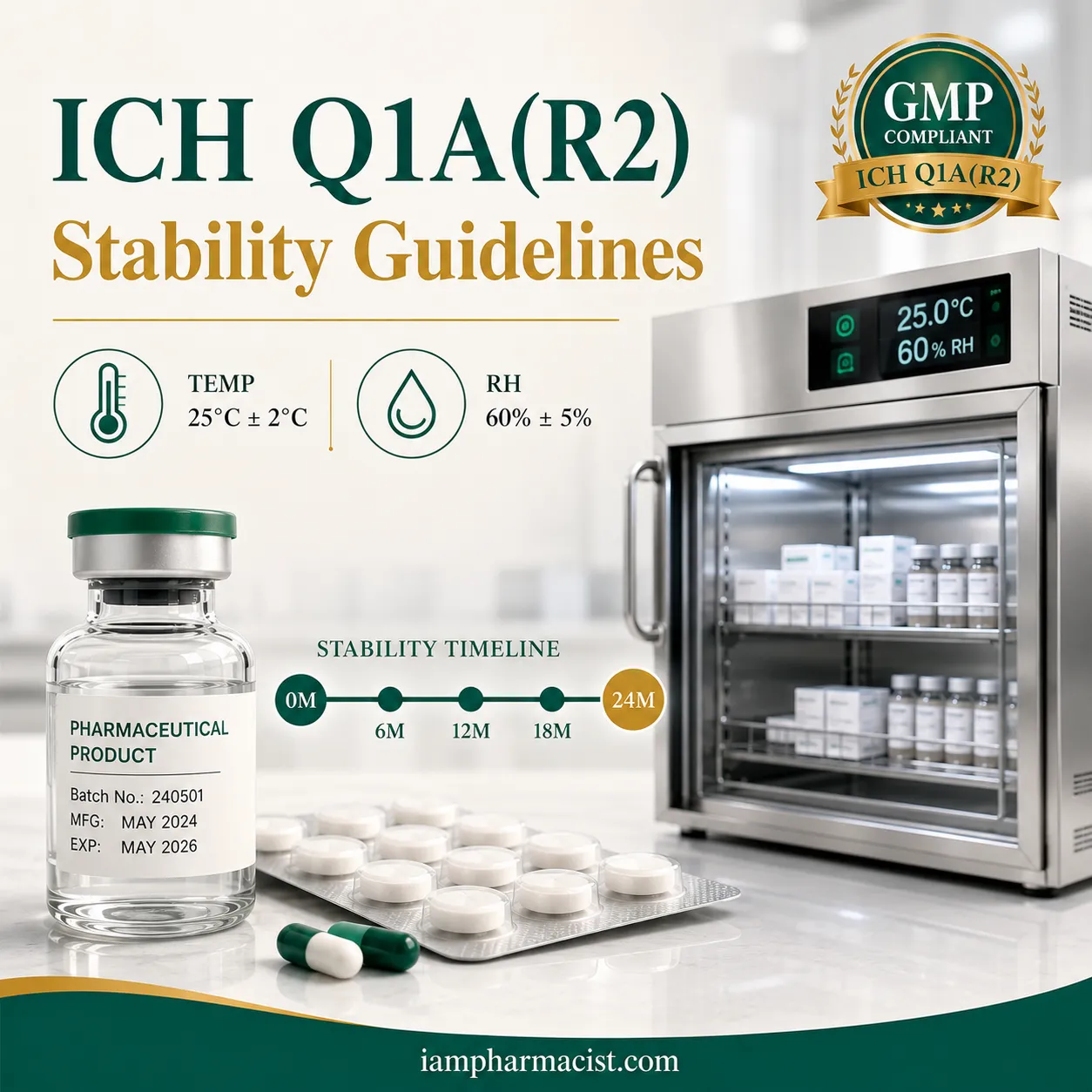

Learn ICH Q1A(R2) stability guidelines, testing conditions, batch requirements, shelf-life determination, and GMP compliance for pharmaceuticals.
Definition
ICH Q1A(R2) is the internationally harmonized guideline that defines stability testing requirements for new drug substances and products. It establishes standard storage conditions, testing durations, and data requirements used to determine retest periods, shelf life, and storage recommendations for global regulatory submissions.
Introduction
Stability testing is one of the most critical components of pharmaceutical development and regulatory approval. Before a drug product reaches the market, manufacturers must demonstrate that it maintains its identity, strength, quality, purity, and performance throughout its intended shelf life.
The ICH Q1A(R2) Stability Testing of New Drug Substances and Products guideline provides the global framework for generating stability data acceptable to regulatory authorities including the FDA, EMA, MHRA, Health Canada, PMDA, and WHO.
This guideline harmonizes stability requirements across major markets, reducing duplication of studies while ensuring consistent product quality throughout the supply chain.
In this guide, we’ll explain the key requirements of ICH Q1A(R2), including batch selection, storage conditions, stress testing, shelf-life determination, and GMP expectations.
What is ICH Q1A(R2)?
ICH Q1A(R2) is the foundational stability guideline issued by the International Council for Harmonisation (ICH).
Its objectives are to:
- Establish scientifically justified shelf lives
- Determine retest periods for APIs
- Assess environmental impacts on quality
- Support global registration submissions
- Ensure product safety and efficacy during storage
Why Stability Testing Matters
Stability testing demonstrates how environmental factors affect pharmaceutical products over time.
Key Environmental Factors
| Factor | Impact on Product |
|---|---|
| Temperature | Chemical degradation |
| Humidity | Moisture uptake/loss |
| Light | Photodegradation |
| Oxygen | Oxidative degradation |
| Packaging | Protection from environment |
Without adequate stability data, manufacturers cannot scientifically justify expiration dates or storage conditions.
Primary Batch Requirements Under ICH Q1A(R2)
The guideline requires stability data from representative batches manufactured using commercial processes.
Drug Substance Requirements
| Requirement | Details |
|---|---|
| Number of batches | Minimum 3 primary batches |
| Manufacturing scale | At least pilot scale |
| Process | Representative of commercial manufacturing |
Drug Product Requirements
| Requirement | Details |
|---|---|
| Number of batches | Minimum 3 primary batches |
| Pilot scale batches | At least 2 |
| Third batch | Smaller scale may be justified |
Regulatory Insight
Regulators expect stability data to accurately represent future commercial production. Significant process changes may require additional stability studies.
Standard Stability Testing Conditions
ICH Q1A(R2) establishes three study categories.
Stability Storage Conditions
| Study Type | Storage Condition | Minimum Duration |
|---|---|---|
| Long-Term | 25°C ± 2°C / 60% RH ± 5% RH OR 30°C ± 2°C / 65% RH ± 5% RH | 12 Months |
| Accelerated | 40°C ± 2°C / 75% RH ± 5% RH | 6 Months |
| Intermediate | 30°C ± 2°C / 65% RH ± 5% RH | 6 Months |
Understanding the Three Study Types
Long-Term Studies
These studies establish actual product shelf life under intended storage conditions.
Accelerated Studies
Accelerated conditions stress the product to predict long-term stability and identify potential degradation mechanisms.
Intermediate Studies
Intermediate testing is triggered when significant change occurs during accelerated studies conducted at 40°C/75% RH.
When is Intermediate Testing Required?
Intermediate testing is required if significant change occurs during accelerated storage while using:
25°C ± 2°C / 60% RH ± 5% RHas the long-term condition.
Example
A tablet product shows:
- Assay reduction from 100% to 94%
- Increased degradation impurities
after 6 months at 40°C/75% RH.
In this case, additional testing at:
30°C ± 2°C / 65% RH ± 5% RHmust be performed.
Stress Testing (Forced Degradation Studies)
Stress testing identifies degradation pathways and supports analytical method development.
Objectives
- Identify degradation products
- Establish degradation mechanisms
- Validate stability-indicating methods
- Support formulation development
Typical Stress Conditions
| Stress Type | Examples |
|---|---|
| Thermal | Elevated temperatures |
| Hydrolytic | Acidic, neutral, alkaline pH |
| Oxidative | Hydrogen peroxide |
| Photolytic | Light exposure |
| Reduction | Reducing agents |
Thermal Stress Recommendation
Testing is typically conducted in increments of:
10°C above accelerated conditionsto evaluate degradation trends.
Special Storage Conditions for Certain Products
Products in Semi-Permeable Containers
Examples:
- Oral solutions
- Eye drops
- Nasal products
Additional Testing
| Condition | Example |
|---|---|
| Low humidity studies | 25°C/40% RH |
Purpose:
- Evaluate moisture loss
- Assess packaging effectiveness
Refrigerated Products
| Study Type | Storage Condition |
|---|---|
| Long-Term | 5°C ± 3°C |
| Accelerated | 25°C ± 2°C / 60% RH ± 5% RH |
Examples
- Vaccines
- Biological products
- Certain injectable formulations
Frozen Products
| Study Type | Storage Condition |
|---|---|
| Long-Term | -20°C ± 5°C |
Examples
- Cell therapies
- Some biologics
- Specialty injectables
Determining Shelf Life and Retest Periods
Stability data is evaluated according to ICH Q1E.
Data Evaluation Considerations
- Assay trends
- Degradation product growth
- Dissolution performance
- Physical appearance
- Microbiological quality
Statistical Analysis
Manufacturers may use regression analysis to estimate:
- Retest periods for APIs
- Expiration dates for drug products
What Constitutes a Significant Change?
According to ICH Q1A(R2), significant change may include:
| Parameter | Significant Change |
|---|---|
| Assay | ≥5% potency loss |
| Impurities | Exceeding specification |
| Dissolution | Failure to meet criteria |
| pH | Outside acceptance range |
| Physical attributes | Significant change in appearance |
Post-Approval Stability Commitments
If available long-term data does not cover the proposed shelf life at submission, manufacturers must commit to continuing studies after approval.
Typical Commitment
Continue stability studies until:
- Proposed shelf life is reached
- Additional data confirms product stability
- Regulatory commitments are fulfilled
Step-by-Step Guide to Implementing ICH Q1A(R2)
Step 1
Select representative stability batches.
Step 2
Develop a stability protocol.
Step 3
Qualify stability chambers.
Step 4
Place samples under long-term and accelerated conditions.
Step 5
Conduct forced degradation studies.
Step 6
Test samples using validated stability-indicating methods.
Step 7
Trend and evaluate data.
Step 8
Establish shelf life and storage statements.
Step 9
Maintain ongoing stability studies.
Step 10
Support regulatory submissions with complete data packages.
GMP and Regulatory Insights
During inspections, regulators commonly review:
Stability Program Controls
- Chamber qualification (IQ/OQ/PQ)
- Environmental monitoring
- Calibration records
- Sample accountability
- Data integrity compliance
Regulatory Expectations
- ALCOA+ data principles
- Stability-indicating analytical methods
- OOS investigation procedures
- Trend analysis programs
- Annual Product Quality Review integration
Practical Example
Immediate-Release Tablet
| Parameter | Value |
|---|---|
| Product | Paracetamol 500 mg Tablet |
| Batches | 3 Pilot Batches |
| Long-Term | 25°C/60% RH |
| Accelerated | 40°C/75% RH |
| Duration | 24 Months |
| Tests | Assay, Dissolution, Impurities |
| Shelf Life Assigned | 24 Months |
Result:
No significant change observed. Shelf life supported with long-term data.
FAQs
1. What is ICH Q1A(R2)?
ICH Q1A(R2) is the primary guideline governing stability testing of new drug substances and drug products.
2. What is the purpose of stability testing?
To determine shelf life, retest periods, and recommended storage conditions.
3. How many batches are required?
A minimum of three primary batches.
4. What are standard accelerated conditions?
40°C ± 2°C and 75% RH ± 5% RH for six months.
5. When is intermediate testing required?
When significant change occurs during accelerated testing.
6. What is a significant change?
Typically a 5% potency loss or failure of critical specifications.
7. What is stress testing?
Forced degradation studies used to identify degradation pathways.
8. What guideline covers photostability?
ICH Q1B.
9. How is shelf life determined?
Using stability data and statistical evaluation under ICH Q1E.
10. Are ongoing stability studies required after approval?
Yes, ongoing stability programs are expected under GMP requirements.