


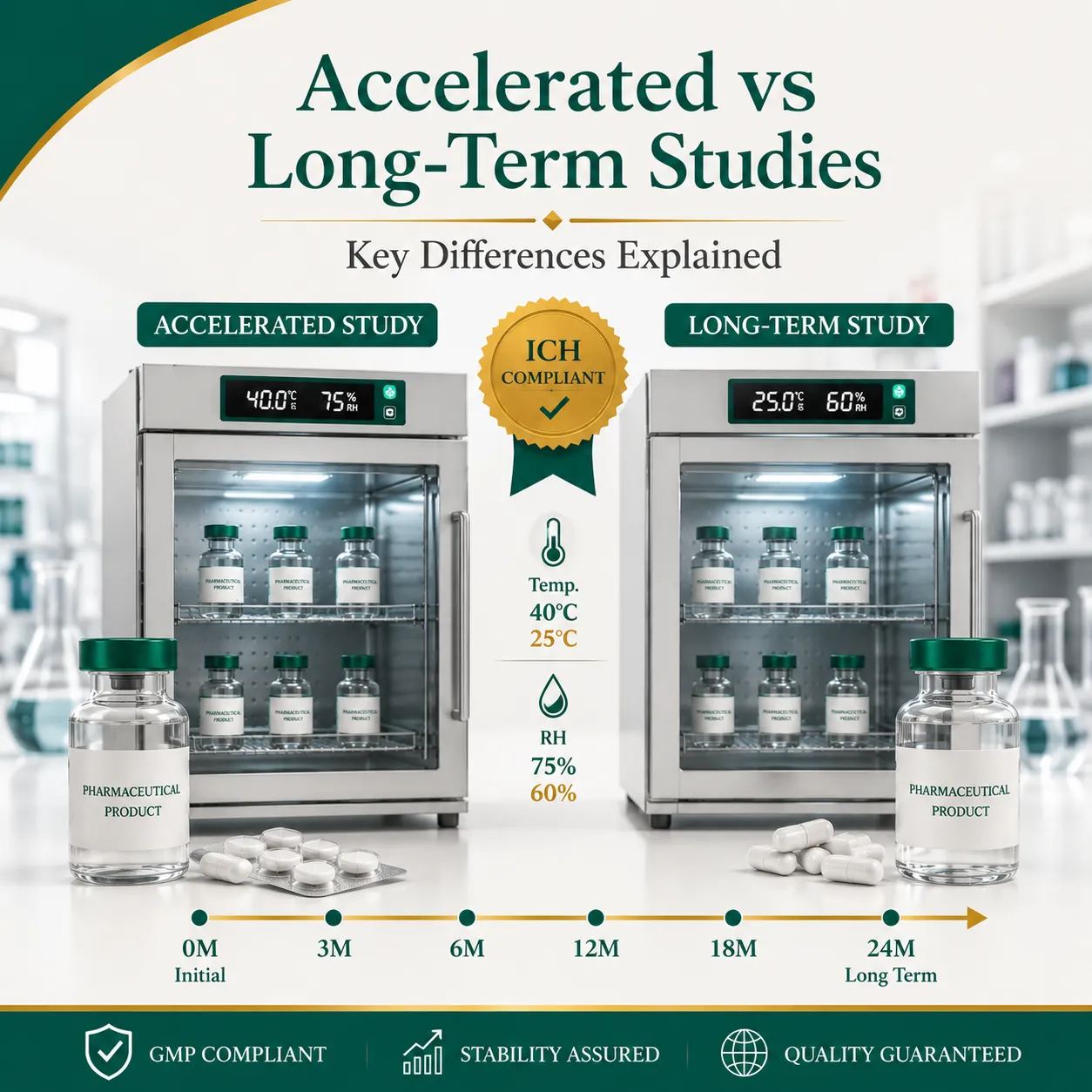

Learn the differences between accelerated vs long-term stability studies, ICH requirements, storage conditions, shelf-life determination, and GMP compliance.
Definition
Accelerated and long-term stability studies are pharmaceutical testing programs used to evaluate how drug substances and drug products degrade over time. Accelerated studies expose products to elevated temperature and humidity to predict stability and estimate shelf life quickly, while long-term studies evaluate products under recommended storage conditions to establish and confirm their official expiration date.
Introduction
Stability testing is a fundamental requirement in pharmaceutical development, quality assurance, and regulatory approval. Before a medicine can be marketed, manufacturers must demonstrate that it remains safe, effective, and within specification throughout its intended shelf life.
To achieve this, pharmaceutical companies conduct two complementary studies:
- Accelerated Stability Studies
- Long-Term Stability Studies
Although both assess product stability, they serve different scientific and regulatory purposes. Accelerated testing provides rapid insights into degradation behavior, while long-term testing generates the real-time evidence required for regulatory approval and expiry dating.
Understanding how these studies differ—and how they work together—is essential for professionals involved in formulation development, QA, QC, validation, regulatory affairs, and manufacturing.
What Are Stability Studies?
Stability studies evaluate how environmental factors affect pharmaceutical products over time.
Key factors include:
- Temperature
- Relative Humidity (RH)
- Light Exposure
- Oxygen Exposure
- Packaging Systems
- Transportation Conditions
The primary objectives are to:
✓ Establish shelf life
✓ Determine retest periods
✓ Verify packaging suitability
✓ Support regulatory submissions
✓ Ensure patient safety
Accelerated vs Long-Term Stability Studies: Quick Comparison
| Feature | Accelerated Stability Studies | Long-Term Stability Studies |
|---|---|---|
| Primary Goal | Predict degradation and estimate shelf life | Confirm actual shelf life |
| Storage Conditions | High stress conditions | Recommended storage conditions |
| Typical Duration | 6 Months | 12–24 Months or full shelf life |
| Regulatory Role | Supports development and provisional dating | Mandatory for registration |
| Batch Requirement | Often 1 batch during development | Usually 3 primary batches |
| Data Generation | Predictive | Confirmatory |
| Decision Making | Early formulation optimization | Final expiry assignment |
Understanding Accelerated Stability Studies
Accelerated studies expose products to exaggerated environmental conditions to speed up degradation.
Because chemical reactions generally occur faster at higher temperatures and humidity levels, manufacturers can predict long-term behavior within a shorter timeframe.
Standard ICH Accelerated Conditions
| Parameter | Condition |
|---|---|
| Temperature | 40°C ± 2°C |
| Relative Humidity | 75% RH ± 5% RH |
| Duration | 6 Months |
Purpose of Accelerated Testing
- Early shelf-life estimation
- Formulation screening
- Packaging evaluation
- Transportation risk assessment
- Identification of degradation pathways
Practical Example: Accelerated Stability Study
A tablet formulation is stored at:
40°C/75% RH
for six months.
Results
| Parameter | Initial | 6 Months |
|---|---|---|
| Assay | 100.0% | 97.2% |
| Total Impurities | 0.10% | 0.35% |
| Dissolution | Pass | Pass |
Outcome:
✓ Product remains within specifications
✓ Supports provisional shelf-life assignment
✓ Long-term study continues for confirmation
Understanding Long-Term Stability Studies
Long-term studies evaluate products under expected storage conditions throughout the proposed shelf life.
These studies generate the definitive evidence used by regulatory agencies to approve expiry dating.
Standard Long-Term Conditions
General Climatic Conditions
| Parameter | Condition |
|---|---|
| Temperature | 25°C ± 2°C |
| Relative Humidity | 60% RH ± 5% RH |
| Duration | 12 Months or Longer |
Alternative Long-Term Condition
| Parameter | Condition |
|---|---|
| Temperature | 30°C ± 2°C |
| Relative Humidity | 65% RH ± 5% RH |
Practical Example: Long-Term Stability Study
A coated tablet is stored at:
25°C/60% RH
for 24 months.
Results
| Parameter | Initial | 24 Months |
|---|---|---|
| Assay | 100.0% | 98.4% |
| Total Impurities | 0.10% | 0.45% |
| Dissolution | Pass | Pass |
Outcome:
✓ Product remains compliant
✓ 24-month shelf life supported
✓ Suitable for commercial registration
How Accelerated and Long-Term Studies Work Together
Accelerated and long-term studies are not alternatives—they are complementary.
Development Phase
Accelerated studies:
- Identify potential risks
- Support formulation decisions
- Predict shelf life
Registration Phase
Long-term studies:
- Confirm product stability
- Justify expiry dating
- Support marketing authorization
Workflow Overview
Formulation Development ↓ Accelerated Stability Testing ↓ Risk Assessment ↓ Long-Term Stability Testing ↓ Shelf-Life Assignment ↓ Regulatory SubmissionStep-by-Step Guide to Stability Study Planning
Step 1: Define Product and Packaging
Determine:
- Drug substance characteristics
- Dosage form
- Container closure system
Step 2: Develop Stability Protocol
Include:
- Storage conditions
- Testing intervals
- Acceptance criteria
- Sampling plan
Step 3: Select Representative Batches
ICH generally requires:
- Three primary batches
- Pilot-scale or production-scale manufacture
Step 4: Place Samples in Qualified Chambers
Stability chambers must be qualified through:
- DQ
- IQ
- OQ
- PQ
Step 5: Perform Periodic Testing
Evaluate:
- Assay
- Related substances
- Dissolution
- Moisture
- Appearance
- Microbiology (if applicable)
Step 6: Analyze Trends and Assign Shelf Life
Trend data using:
- Statistical evaluation
- Degradation modeling
- Regulatory acceptance criteria
When Is Intermediate Testing Required?
Intermediate testing is triggered when significant changes occur during accelerated studies.
Standard Intermediate Conditions
| Parameter | Condition |
|---|---|
| Temperature | 30°C ± 2°C |
| Relative Humidity | 65% RH ± 5% RH |
| Duration | 6 Months |
What Is Considered a Significant Change?
According to ICH Q1A(R2), significant changes include:
| Event | Example |
|---|---|
| Potency Loss | >5% Reduction |
| Impurity Increase | Exceeds Limit |
| Dissolution Failure | OOS Result |
| Physical Change | Color or Appearance Failure |
| pH Change | Outside Specification |
Regulatory Requirements Under ICH Q1A(R2)
Both studies must comply with ICH stability guidance.
Key Regulatory Expectations
✓ Qualified chambers
✓ Stability-indicating analytical methods
✓ Representative batches
✓ Controlled storage conditions
✓ Data integrity compliance
✓ Investigation of OOS and OOT results https://iampharmacist.com/sop-for-raw-data-sheet-documentation/
GMP Considerations for Stability Programs
A robust stability program should comply with:
- ICH Q1A(R2)
- FDA 21 CFR Part 211
- EU GMP
- WHO GMP
- PIC/S Guidelines
Common Inspection Findings
| Observation | Regulatory Impact |
|---|---|
| Chamber Excursions | GMP Deficiency |
| Missing Stability Points | Data Gap |
| Unqualified Chambers | Major Observation |
| Incomplete Investigations | Compliance Risk |
| Unsupported Shelf Life | Registration Delay |
Advantages and Limitations
Accelerated Stability Studies
Advantages
- Faster results
- Early risk identification
- Supports formulation optimization
Limitations
- Predictive only
- May not reflect all real-time degradation mechanisms
Long-Term Stability Studies
Advantages
- Real-world data
- Regulatory acceptance
- Definitive shelf-life support
Limitations
- Time-consuming
- Higher resource requirements
Best Practices for Stability Studies
- Use validated stability-indicating methods.
- Qualify all chambers before use.
- Monitor temperature and humidity continuously.
- Investigate OOS and OOT results promptly.
- Apply ALCOA+ data integrity principles.
- Trend results periodically.
- Maintain detailed GMP documentation.
FAQs
1. What is the difference between accelerated and long-term stability studies?
Accelerated studies predict degradation under stressed conditions, while long-term studies confirm product stability under actual storage conditions.
2. What are accelerated stability testing conditions?
Typically 40°C ± 2°C and 75% RH ± 5% RH for six months.
3. What are long-term stability testing conditions?
Usually 25°C ± 2°C/60% RH ± 5% RH or 30°C ± 2°C/65% RH ± 5% RH.
4. Why are accelerated stability studies performed?
To estimate shelf life, assess formulation robustness, and identify degradation risks quickly.
5. Are accelerated studies sufficient for regulatory approval?
No. Long-term stability studies are required for official registration and expiry dating.
6. How many batches are required for long-term stability studies?
Typically three primary batches manufactured using representative processes.
7. What is intermediate stability testing?
Testing performed at 30°C/65% RH when significant changes occur during accelerated studies.
8. What is considered a significant change in stability studies?
A potency loss greater than 5%, impurity increase beyond limits, or specification failure.
9. Can accelerated studies predict shelf life?
Yes, but predictions must be confirmed with long-term stability data.
10. Which guideline governs pharmaceutical stability studies?
ICH Q1A(R2) is the primary global guideline for stability testing.