


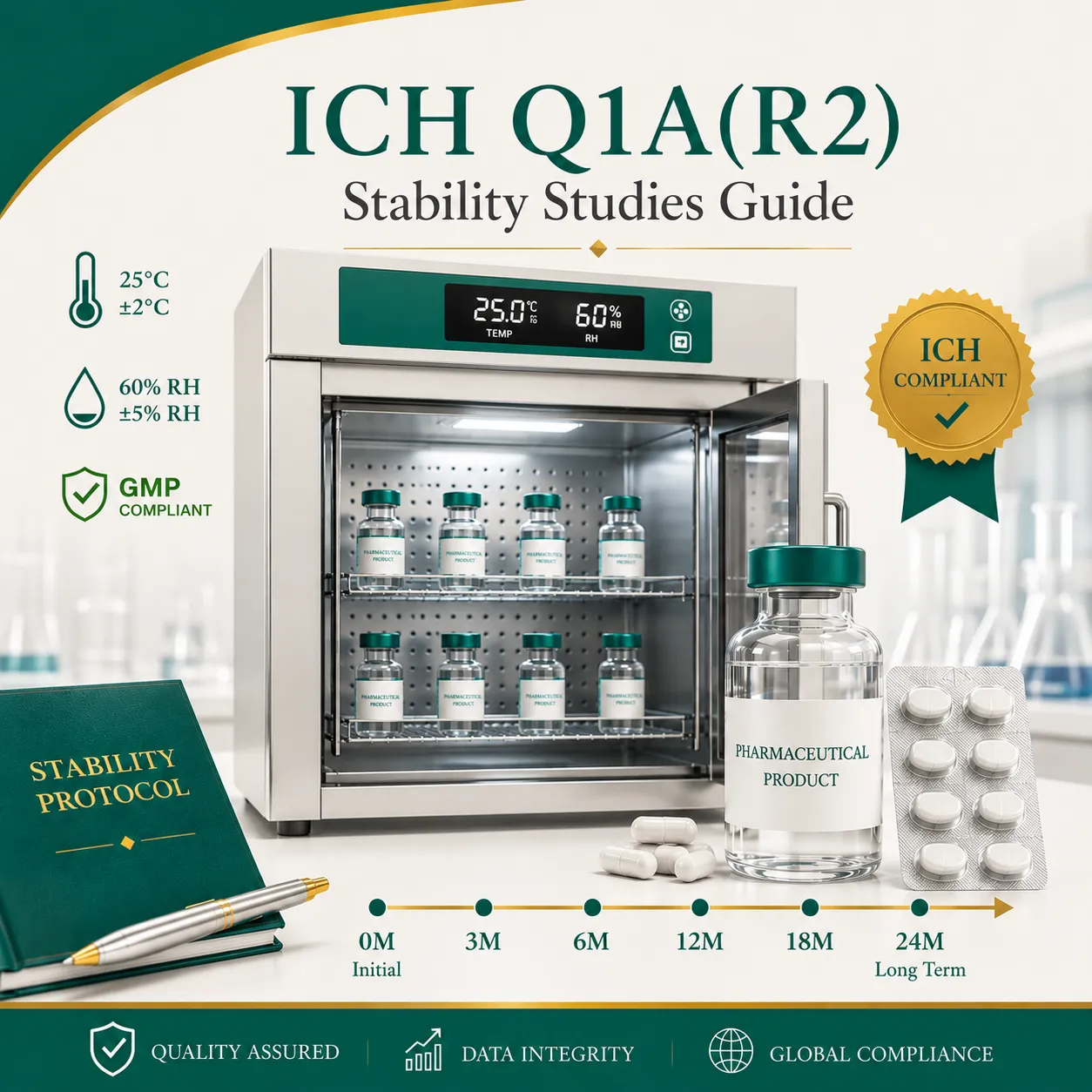

Learn ICH Q1A(R2) Pharmaceutical Stability study requirements, storage conditions, testing schedules, shelf-life determination, and GMP compliance.
Definition
Pharmaceutical stability studies are systematic tests conducted under controlled environmental conditions to evaluate how the quality, safety, and efficacy of a drug substance or drug product change over time. ICH Q1A(R2) provides globally accepted requirements for storage conditions, testing frequencies, study durations, and data evaluation used to establish shelf life and retest periods.
Introduction
Stability studies are among the most critical components of pharmaceutical development and regulatory compliance. Every marketed medicine must demonstrate that it maintains its identity, strength, quality, purity, and performance throughout its intended shelf life.
To ensure global harmonization, the International Council for Harmonisation (ICH) published ICH Q1A(R2): Stability Testing of New Drug Substances and Products, which remains the cornerstone guideline for pharmaceutical stability programs worldwide.
Whether you work in Quality Assurance (QA), Quality Control (QC), Regulatory Affairs, Formulation Development, Validation, or Manufacturing, understanding ICH Q1A(R2) is essential for successful product registration and lifecycle management.
This guide explains the key requirements, testing conditions, study design, batch selection, data evaluation criteria, and GMP expectations associated with pharmaceutical stability studies.
What Are Pharmaceutical Stability Studies?
Stability studies evaluate how environmental factors affect pharmaceutical products over time.
These factors include:
- Temperature
- Relative humidity
- Light exposure
- Oxygen exposure
- Packaging interactions
- Transportation conditions
The primary objectives are to:
✓ Establish shelf life
✓ Determine retest periods
✓ Support regulatory submissions
✓ Verify packaging suitability
✓ Demonstrate product quality throughout storage
https://iampharmacist.com/sop-for-raw-data-sheet-documentation/
Regulatory Basis of ICH Q1A(R2)
The guideline applies to:
| Product Type | Applicable |
|---|---|
| New Drug Substances | Yes |
| New Drug Products | Yes |
| Generic Drug Products | Generally Referenced |
| Biological Products | Covered under ICH Q5C |
| Vaccines | Separate Guidelines Apply |
ICH Q1A(R2) is recognized by:
- FDA (United States)
- EMA (European Union)
- PMDA (Japan)
- MHRA (United Kingdom)
- WHO
- Most global health authorities
Core Stability Testing Conditions Under ICH Q1A(R2)
The guideline establishes standardized testing conditions for worldwide regulatory acceptance.
Stability Storage Conditions
| Study Type | Temperature | Relative Humidity | Duration |
|---|---|---|---|
| Long-Term | 25°C ± 2°C | 60% RH ± 5% RH | 12 Months or Proposed Shelf Life |
| Alternative Long-Term | 30°C ± 2°C | 65% RH ± 5% RH | 12 Months or Proposed Shelf Life |
| Intermediate | 30°C ± 2°C | 65% RH ± 5% RH | 6 Months |
| Accelerated | 40°C ± 2°C | 75% RH ± 5% RH | 6 Months |
When Is Intermediate Testing Required?
Intermediate testing becomes necessary when a significant change occurs during accelerated studies.
Example
A tablet product shows:
- Assay at initial: 100.0%
- Assay at 6 months accelerated: 94.0%
Since potency loss exceeds 5%, intermediate testing must be initiated and evaluated.
Stability Requirements for Semi-Permeable Containers
Products packaged in:
- HDPE bottles
- LDPE bottles
- Plastic containers
may lose water through packaging.
Therefore, lower humidity conditions are often used.
| Container Type | Humidity Consideration |
|---|---|
| Glass | Standard RH Conditions |
| Semi-Permeable Plastic | Reduced RH Conditions |
| LDPE Containers | Water Loss Evaluation Required |
Step-by-Step Stability Study Design
Step 1: Perform Stress Testing
Before formal stability studies, stress testing identifies degradation pathways and confirms analytical method suitability.
Stress Conditions
| Stress Factor | Typical Condition |
|---|---|
| Heat | +10°C Increments Above Accelerated |
| Humidity | ≥75% RH |
| Oxidation | Hydrogen Peroxide Exposure |
| Acid Hydrolysis | Acidic Media |
| Base Hydrolysis | Alkaline Media |
| Photolysis | As Per ICH Q1B |
Step 2: Select Stability Batches
ICH requires stability data from:
Minimum Requirements
- Three primary batches
- Pilot-scale or production-scale
- Manufactured using representative commercial process
| Batch Type | Requirement |
|---|---|
| Drug Substance | Three Batches |
| Drug Product | Three Batches |
| Scale | Pilot or Commercial |
Step 3: Develop Stability Protocol
A GMP-compliant protocol should define:
- Storage conditions
- Testing intervals
- Sample quantities
- Analytical methods
- Acceptance criteria
- OOS/OOT handling procedures
Step 4: Place Samples in Qualified Chambers
Stability chambers must be qualified through:
- Design Qualification (DQ)
- Installation Qualification (IQ)
- Operational Qualification (OQ)
- Performance Qualification (PQ)
Step 5: Conduct Periodic Testing
Recommended Testing Schedule
For shelf life ≥12 months:
| Year | Testing Points |
|---|---|
| Year 1 | 0, 3, 6, 9, 12 Months |
| Year 2 | 18, 24 Months |
| Subsequent Years | Annually |
Stability-Indicating Parameters to Monitor
Testing should focus on attributes likely to change.
Physical Tests
- Appearance
- Color
- Odor
- Clarity
- pH
Chemical Tests
- Assay
- Related substances
- Degradation products
- Preservative content
Performance Tests
- Dissolution
- Disintegration
- Drug release profile
Microbiological Tests
- Total microbial count
- Sterility
- Preservative effectiveness
Understanding Significant Change
According to ICH Q1A(R2), significant change includes:
| Criterion | Example |
|---|---|
| Assay Change | >5% Loss |
| Impurity Increase | Exceeds Limit |
| Dissolution Failure | Out of Specification |
| pH Change | Beyond Acceptance Range |
| Physical Failure | Appearance Change |
Practical Example
Initial Assay = 100%
6-Month Accelerated Assay = 94%
Potency Loss = 6%
Result:
✓ Significant change observed
✓ Intermediate testing required
✓ Additional data evaluation needed
Shelf Life Determination
Shelf life is assigned using stability data trends and statistical evaluation.
Regulators assess:
- Assay degradation rates
- Impurity growth
- Dissolution profile stability
- Product performance
Example
A tablet remains within specifications for:
- 24 months long-term
- 6 months accelerated
Regulatory shelf life assignment may be:
24 Months
subject to supporting data and statistical analysis.
GMP Requirements for Stability Programs
A robust stability program should comply with:
- ICH Q1A(R2)
- EU GMP Annex 15
- 21 CFR Part 211
- WHO GMP Guidelines
- PIC/S GMP
GMP Expectations
✓ Qualified chambers
✓ Calibrated monitoring systems
✓ Data integrity controls
✓ Controlled sample withdrawals
✓ Trend analysis
✓ Annual Product Quality Review (APQR)
Common Deficiencies Observed During Regulatory Inspections
| Observation | Impact |
|---|---|
| Incomplete Stability Protocols | Regulatory Deficiency |
| Unqualified Chambers | GMP Observation |
| Missing Time Points | Data Integrity Risk |
| Poor OOT Investigations | Inspection Finding |
| Unsupported Shelf Life | Registration Delay |
Best Practices for Successful Stability Studies
- Use stability-indicating analytical methods.
- Qualify chambers before use.
- Monitor chamber excursions continuously.
- Investigate OOS and OOT trends promptly.
- Maintain ALCOA+ data integrity principles.
- Review stability trends periodically.
- Establish scientifically justified shelf life assignments.
Regulatory Insight: Why ICH Q1A(R2) Matters
Without acceptable stability data, regulators cannot verify that a product remains safe and effective throughout distribution and storage.
ICH Q1A(R2) provides a globally harmonized framework that enables pharmaceutical companies to:
- Support international registrations
- Reduce duplicate studies
- Improve product lifecycle management
- Demonstrate consistent product quality
FAQs
1. What is ICH Q1A(R2)?
ICH Q1A(R2) is the international guideline governing stability testing requirements for new drug substances and products.
2. What is the purpose of stability studies?
To establish shelf life, retest periods, and storage conditions while ensuring product quality and safety.
3. What are the standard ICH long-term storage conditions?
25°C ± 2°C/60% RH ± 5% RH or 30°C ± 2°C/65% RH ± 5% RH.
4. What are accelerated stability conditions?
40°C ± 2°C/75% RH ± 5% RH for six months.
5. How many batches are required for registration?
At least three primary batches manufactured at pilot or production scale.
6. When is intermediate testing required?
When significant changes occur during accelerated stability studies.
7. What is considered a significant change?
A 5% potency loss, specification failure, or impurity level exceeding limits.
8. Why is stress testing performed?
To identify degradation pathways and establish stability-indicating methods.
9. How often should stability samples be tested?
Typically at 0, 3, 6, 9, 12, 18, and 24 months, then annually.
10. Which GMP regulations apply to stability studies?
ICH Q1A(R2), FDA 21 CFR Part 211, EU GMP, WHO GMP, and PIC/S guidelines.