


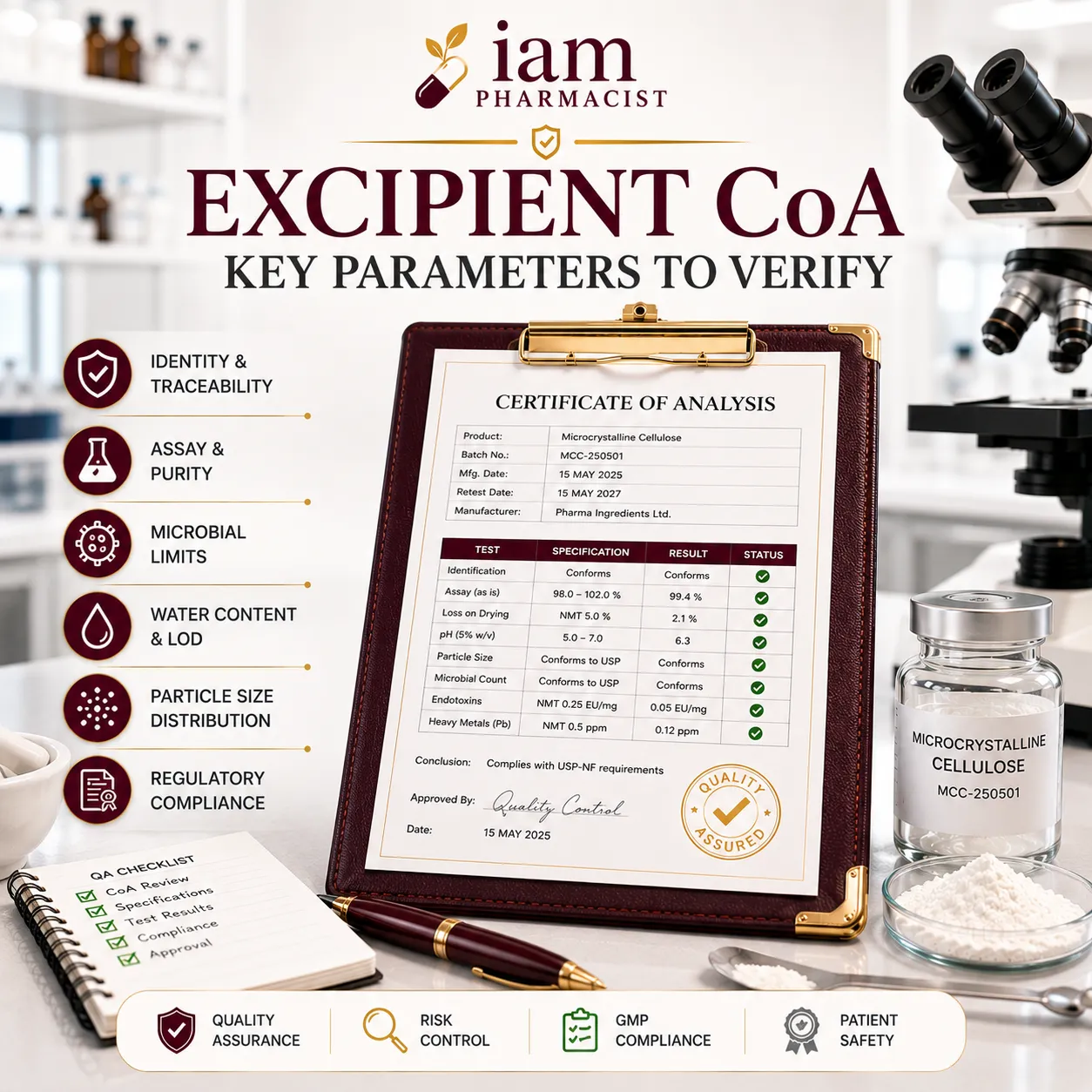

Learn the critical parameters QA professionals must verify on excipient Certificate of Analysis (CoAs) to ensure GMP compliance, quality, and patient safety.
Definition
An Excipient Certificate of Analysis (CoA) is a batch-specific quality document that confirms an excipient meets predefined pharmacopeial, regulatory, and internal specifications. QA professionals must verify traceability information, critical quality attributes (CQAs), physical and chemical characteristics, microbiological limits, and regulatory compliance statements before approving an excipient for pharmaceutical manufacturing.
Introduction
Excipients account for the majority of a pharmaceutical dosage form’s composition and play a critical role in product performance, stability, manufacturability, and patient safety. Whether functioning as diluents, binders, lubricants, disintegrants, coatings, or preservatives, excipients must consistently meet stringent quality standards.
The primary document used to assess incoming excipient quality is the Certificate of Analysis (CoA). During GMP inspections, auditors frequently review excipient CoAs to verify supplier qualification, incoming material controls, traceability, and compliance with approved specifications.
For Quality Assurance (QA) professionals, reviewing a CoA is more than a routine documentation exercise—it is a critical quality gate that helps prevent material mix-ups, contamination, stability issues, and regulatory non-compliance.
This guide explains the key parameters every QA professional should verify when reviewing an excipient Certificate of Analysis.
Why Excipient CoA Review Is Critical
An excipient CoA supports several GMP activities:
| Function | Importance |
|---|---|
| Incoming Material Release | Determines suitability for use |
| Supplier Qualification | Confirms supplier reliability |
| Batch Traceability | Links material to manufacturing records |
| Regulatory Compliance | Demonstrates GMP adherence |
| Risk Management | Identifies quality concerns early |
| Audit Readiness | Supports inspection requirements |
Without proper CoA review, defective or unsuitable materials may enter production.
What Is an Excipient Certificate of Analysis?
A Certificate of Analysis is a supplier-issued document that reports analytical testing results for a specific excipient batch.
The document demonstrates whether the material meets:
- USP-NF requirements
- European Pharmacopoeia (Ph. Eur.)
- British Pharmacopoeia (BP)
- Japanese Pharmacopoeia (JP)
- Internal specifications
- Customer-specific requirements
Section 1: Verify Document Traceability and Authenticity
Before reviewing analytical data, QA personnel must verify that the document itself is authentic and traceable.
1. Excipient Identity and Grade
Confirm the exact material name and grade.
Examples
| Excipient | Grade |
|---|---|
| Lactose Monohydrate | USP-NF |
| Microcrystalline Cellulose | Ph. Eur. |
| Magnesium Stearate | NF |
| Croscarmellose Sodium | USP |
Common Inspection Finding
Incorrect grade or outdated compendial references.
2. Batch or Lot Number Verification
The batch number must match:
- Shipping documents
- Material labels
- Warehouse records
- ERP/LIMS records
Example
| Document | Batch Number |
|---|---|
| CoA | MCC-250601 |
| Container Label | MCC-250601 |
| Goods Receipt | MCC-250601 |
Any discrepancy requires investigation.
3. Manufacturing and Expiry Dates
Verify:
- Date of manufacture
- Expiry date
- Retest date (if applicable)
QA Considerations
Check whether the material remains suitable for planned manufacturing campaigns.
4. Manufacturer Information
Ensure the CoA identifies:
- Original manufacturer
- Manufacturing site
- Contact information
Important
If the CoA is supplied through a distributor, traceability to the original manufacturer should be maintained.
5. Authorized Approval
A compliant CoA should include:
- QA/QC authorization
- Signature or electronic approval
- Approval date
GMP Requirement
The document should demonstrate formal quality review before release.
Section 2: Verify Critical Quality Attributes (CQAs)
Critical Quality Attributes directly affect product safety and performance.
6. Assay and Purity
Assay confirms the excipient’s composition and purity.
Example
| Test | Specification | Result |
|---|---|---|
| Assay | 98.0–102.0% | 99.5% |
QA Review Points
✔ Numerical result reported
✔ Within specification
✔ Method referenced
7. Impurities and Residual Solvents
Review testing for:
- Heavy metals
- Residual solvents
- Catalyst residues
- Organic impurities
Example
| Parameter | Limit | Result |
|---|---|---|
| Lead | NMT 0.5 ppm | 0.12 ppm |
| Methanol | NMT 3000 ppm | 85 ppm |
Impurity levels should meet pharmacopeial and internal requirements.
8. Microbial Limits
Especially important for:
- Oral products
- Topicals
- Ophthalmics
- Parenterals
Typical Parameters
| Test | Requirement |
|---|---|
| TAMC | Within limit |
| TYMC | Within limit |
| Specified Pathogens | Absent |
9. Endotoxins
Critical for:
- Injectable products
- Ophthalmic products
- Biopharmaceutical manufacturing
Example
| Test | Limit | Result |
|---|---|---|
| Bacterial Endotoxins | NMT 0.25 EU/mg | 0.05 EU/mg |
Section 3: Verify Physical and Chemical Characteristics
Physical properties can significantly influence manufacturing performance.
10. pH and Acidity/Alkalinity
Improper pH can affect:
- API stability
- Dissolution performance
- Product shelf life
Example
| Test | Specification | Result |
|---|---|---|
| pH | 5.0–7.0 | 6.2 |
11. Water Content and Loss on Drying (LOD)
Particularly important for:
- Hygroscopic excipients
- Moisture-sensitive formulations
Example
| Parameter | Limit | Result |
|---|---|---|
| LOD | NMT 5.0% | 2.1% |
12. Particle Size Distribution (PSD)
PSD affects:
- Blend uniformity
- Flowability
- Compressibility
- Dissolution
Critical Applications
| Dosage Form | PSD Importance |
|---|---|
| Tablets | High |
| Capsules | High |
| Dry Powder Inhalers | Critical |
13. Viscosity
Important for:
- Syrups
- Suspensions
- Creams
- Gels
Example
| Parameter | Specification | Result |
|---|---|---|
| Viscosity | 150–250 cP | 198 cP |
Section 4: Verify Regulatory and Compendial Compliance Statements
QA professionals should confirm compliance declarations.
14. Pharmacopeial Compliance
Ensure the CoA explicitly states compliance with:
- USP-NF
- Ph. Eur.
- BP
- JP
Example Statement
“Material complies with current USP-NF monograph requirements.”
15. TSE/BSE Compliance
Critical for excipients derived from animal sources.
Verify statements regarding:
- BSE-free status
- TSE-free status
16. GMO and Allergen Statements
Required depending on:
- Product type
- Regulatory region
- Customer requirements
Common Declarations
✔ GMO-Free
✔ Allergen-Free
✔ Latex-Free
Excipient CoA Review Checklist for QA
| Verification Item | Check |
|---|---|
| Excipient Identity | ✔ |
| Grade Verification | ✔ |
| Batch Number Match | ✔ |
| Manufacturing Date | ✔ |
| Expiry/Retest Date | ✔ |
| Supplier Qualification Status | ✔ |
| Assay Compliance | ✔ |
| Impurity Review | ✔ |
| Microbial Limits | ✔ |
| Endotoxin Status | ✔ |
| Water Content | ✔ |
| PSD Review | ✔ |
| Regulatory Statements | ✔ |
| QA Approval Signature | ✔ |
Step-by-Step Guide to Reviewing an Excipient CoA
Step 1: Verify Supplier Status
Confirm supplier remains approved.
Step 2: Confirm Material Identity
Review:
- Product name
- Grade
- Compendial designation
Step 3: Verify Traceability
Match batch information across all records.
Step 4: Review Analytical Results
Evaluate:
- Assay
- Purity
- Impurities
- Microbial limits
Step 5: Review Physical Characteristics
Assess:
- PSD
- Moisture
- Viscosity
- pH
Step 6: Verify Regulatory Statements
Confirm compliance declarations are current.
Step 7: Approve or Reject Material
Document QA disposition decision.
Practical Example: Microcrystalline Cellulose CoA Review
Incoming Material
Microcrystalline Cellulose USP
CoA Results
| Test | Specification | Result |
|---|---|---|
| Identification | Pass | Pass |
| pH | 5.0–7.5 | 6.3 |
| LOD | NMT 5.0% | 2.0% |
| PSD | Complies | Complies |
| Microbial Limits | Complies | Complies |
QA Outcome
✔ Batch number verified
✔ Supplier approved
✔ Specifications met
✔ Material released
Common GMP Audit Findings Related to Excipient CoAs
Regulators frequently identify:
- Missing manufacturer information
- Incomplete traceability
- Expired CoAs
- Missing signatures
- Unsupported specifications
- Lack of supplier qualification
- Inadequate review documentation
GMP and Regulatory Insights
FDA Expectations
FDA inspectors evaluate:
- Incoming material controls
- Supplier qualification
- Identity verification
- CoA reliability
EU GMP Expectations
EU GMP focuses on:
- Traceability
- Supplier oversight
- Data integrity
- Documentation completeness
IPEC Expectations
The International Pharmaceutical Excipients Council (IPEC) promotes:
- Excipient GMP compliance
- Risk management
- Supplier quality systems
Best Practices for QA Professionals
Use Standardized Review Checklists
Improve consistency.
Verify Supplier Qualification Annually
Maintain approved vendor status.
Trend Excipient Quality Data
Identify emerging risks.
Utilize Electronic Review Systems
Improve traceability and audit readiness.
Train QA Personnel Regularly
Ensure current GMP knowledge.
FAQs
1. What is an excipient Certificate of Analysis?
An excipient CoA is a batch-specific document that reports analytical results and confirms compliance with approved specifications.
2. Why should QA review excipient CoAs?
To verify material quality, traceability, regulatory compliance, and suitability for manufacturing.
3. What information should appear on an excipient CoA?
Material identity, batch number, analytical results, specifications, dates, manufacturer details, and approval signatures.
4. What are the most important parameters on an excipient CoA?
Assay, purity, microbial limits, water content, particle size distribution, pH, and regulatory compliance statements.
5. Why is particle size distribution important?
PSD affects flowability, content uniformity, compressibility, and dissolution performance.
6. Are microbial limits required for all excipients?
Requirements depend on dosage form and intended use, but microbiological testing is often critical.
7. What is the role of endotoxin testing?
Endotoxin testing helps ensure the safety of excipients used in injectable and ophthalmic products.
8. What are common GMP deficiencies related to excipient CoAs?
Missing traceability, absent signatures, incomplete specifications, and poor supplier qualification.
9. What pharmacopeias are commonly referenced on excipient CoAs?
USP-NF, Ph. Eur., BP, and JP.
10. How does supplier qualification support CoA review?
Qualified suppliers provide greater confidence in analytical results and material quality.