


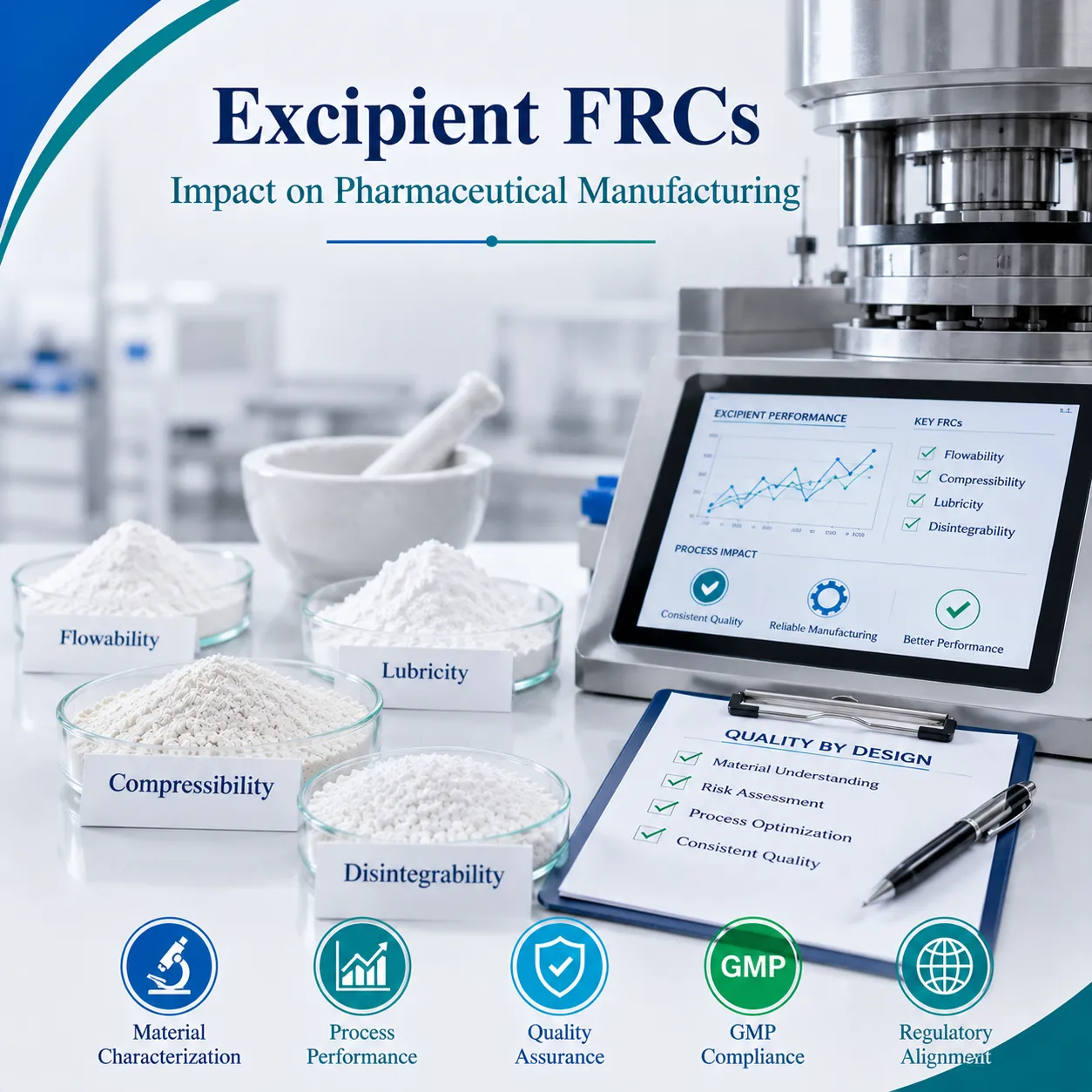

Learn Excipient Functionality-Related Characteristics (FRCs), their impact on pharmaceutical manufacturing, GMP compliance, quality by design, and regulatory expectations.
Definition
Excipient Functionality-Related Characteristics (FRCs) are the physical, chemical, and performance attributes of pharmaceutical excipients that influence their behavior during manufacturing and their contribution to drug product quality, stability, processability, and performance. While pharmacopeial specifications confirm identity and purity, FRCs help predict how an excipient performs within a specific formulation and manufacturing process.
Introduction
Pharmaceutical manufacturers have long recognized a critical reality: compliance with pharmacopeial specifications alone does not guarantee excipient performance in a formulation. Two batches of an excipient may meet the same monograph requirements yet behave differently during granulation, compression, coating, or dissolution.
This challenge has led to increasing industry focus on Excipient Functionality-Related Characteristics (FRCs)—the material attributes that directly influence manufacturing efficiency and finished product quality.
As Quality by Design (QbD), Process Analytical Technology (PAT), and modern GMP expectations evolve, understanding excipient functionality is becoming increasingly important for formulators, quality professionals, regulatory teams, and excipient suppliers. Discussions around FRCs in pharmacopeias such as the European Pharmacopoeia and USP have highlighted both the importance and complexity of defining excipient functionality.
What Are Excipient Functionality-Related Characteristics (FRCs)?
FRCs are measurable material properties that affect how an excipient performs within a pharmaceutical formulation and manufacturing process.
Unlike traditional pharmacopeial tests that focus on:
- Identity
- Purity
- Assay
- Chemical composition
FRCs focus on:
- Processability
- Manufacturability
- Dosage form performance
- Product consistency
Why FRCs Matter
A Certificate of Analysis (CoA) may confirm that an excipient meets USP, NF, or Ph. Eur. requirements, but it often provides limited information about how that material will perform during production. Industry experience shows that excipients meeting identical specifications can produce significantly different manufacturing outcomes.
Understanding Excipient Functionality
Functionality Is More Than Purity
Excipient functionality refers to the contribution an excipient makes to:
- Drug product stability
- Product identity
- Drug delivery
- Processability
- Manufacturability
Importantly, functionality is not solely an intrinsic property of the excipient.
Functionality Depends On
- Formulation composition
- Manufacturing process
- Dosage form design
- API properties
- Processing conditions
Therefore, the same excipient may exhibit different functionality in different formulations.
Common Excipient Functionality-Related Characteristics
Particle Size Distribution
Impact
- Powder flow
- Blend uniformity
- Compression behavior
- Dissolution performance
Example
Fine lactose grades may improve content uniformity but reduce flowability.
Bulk Density and Tapped Density
Impact
- Die filling
- Compression consistency
- Tablet weight variation
Flow Properties
Critical Parameters
- Angle of repose
- Compressibility index
- Hausner ratio
Impact
- Feeding efficiency
- Continuous manufacturing
- High-speed tableting
Compactability
Impact
- Tablet hardness
- Mechanical strength
- Friability
Example
Microcrystalline cellulose (MCC) is valued for excellent compactability.
Lubricity
Impact
- Ejection force
- Tool wear
- Sticking and picking
Disintegration Performance
Impact
- Drug release
- Bioavailability
- Therapeutic effectiveness
Example
Superdisintegrants such as croscarmellose sodium rely heavily on functionality characteristics.
Examples of FRCs in Common Pharmaceutical Excipients
| Excipient | Important FRCs |
|---|---|
| Microcrystalline Cellulose | Compactability, water uptake, particle size |
| Lactose | Particle size, density, flowability |
| Magnesium Stearate | Lubricity, particle morphology |
| Crospovidone | Swelling behavior, particle size |
| HPMC | Viscosity, hydration characteristics |
| Dicalcium Phosphate | Flowability, density |
Why Pharmacopeial Compliance Alone Is Not Enough
Traditional Specifications Focus on Purity
Pharmacopeial standards generally evaluate:
- Identity
- Purity
- Assay
- Contaminants
These tests verify that the material meets quality requirements.
However, they may not fully predict:
- Compression behavior
- Granulation performance
- Drug release behavior
- Process robustness
As a result, manufacturers increasingly characterize excipients beyond compendial requirements.
The Debate Around FRCs in Pharmacopeias
European Pharmacopoeia (Ph. Eur.) Approach
The European Pharmacopoeia proposed including non-mandatory Functionality-Related Characteristics within certain excipient monographs.
The objective was to provide users with additional information regarding excipient performance.
Potential Benefits
- Improved excipient understanding
- Better material selection
- Enhanced process consistency
Industry Concerns
Many excipient manufacturers expressed concerns that including FRCs in monographs could:
- Increase unnecessary testing
- Create regulatory confusion
- Complicate harmonization efforts
- Encourage inappropriate specification setting
Industry groups argued that functionality is application-specific and cannot be universally defined for every formulation.
FRCs and Quality by Design (QbD)
The QbD Perspective
Under ICH Q8 and Quality by Design principles, manufacturers are expected to understand:
- Critical Material Attributes (CMAs)
- Critical Process Parameters (CPPs)
- Critical Quality Attributes (CQAs)
Many FRCs are considered Critical Material Attributes.
Relationship Between FRCs and CQAs
| FRC | Potential Impact on CQA |
|---|---|
| Particle Size | Dissolution |
| Compactability | Tablet Hardness |
| Flowability | Weight Uniformity |
| Lubricity | Compression Efficiency |
| Swelling Behavior | Disintegration Time |
High-Functionality Excipients (HFEs)
What Are HFEs?
High-Functionality Excipients are materials engineered to provide multiple formulation benefits simultaneously.
Characteristics
- Multifunctionality
- Improved performance
- Lower usage levels
- Enhanced process flexibility
Examples
| Excipient | Functions |
|---|---|
| MCC | Binder + Disintegrant |
| Co-Processed Excipients | Flow + Compression |
| HPMC | Binder + Release Modifier |
Critical Excipients vs Functional Excipients
Critical Excipients
Critical excipients directly affect:
- Bioavailability
- Stability
- Drug release
- Product performance
Examples
- Surfactants
- Release modifiers
- Preservatives
- Antioxidants
- Buffers
Functional Excipients
Functional excipients improve manufacturing efficiency and dosage form performance but may not directly impact therapeutic performance.
How to Evaluate Excipient Functionality
Step 1: Identify Intended Function
Determine whether the excipient serves as:
- Binder
- Diluent
- Lubricant
- Disintegrant
- Coating agent
Step 2: Define Critical Material Attributes
Identify relevant FRCs such as:
- Particle size
- Density
- Viscosity
- Compressibility
- Lubricity
Step 3: Conduct Experimental Characterization
Evaluate using:
- Flow testing
- Compression studies
- Rheology testing
- Dissolution studies
- Particle size analysis
Step 4: Assess Formulation Impact
Determine how changes in FRCs affect:
- Process performance
- Product quality
- Stability
Step 5: Establish Control Strategy
Develop specifications and supplier agreements for critical functionality parameters.
Practical Example: MCC in Direct Compression
Scenario
A manufacturer sources MCC from two suppliers.
Results
Both grades:
- Meet USP specifications
- Pass identity testing
- Meet moisture limits
However:
| Parameter | Supplier A | Supplier B |
|---|---|---|
| Flowability | Excellent | Moderate |
| Compactability | Excellent | Lower |
| Tablet Hardness | Higher | Lower |
Conclusion
Despite pharmacopeial equivalence, differences in FRCs significantly impact manufacturing performance.
GMP and Regulatory Insights
Current Regulatory Position
Most regulators recognize that:
- Excipient functionality matters
- Functionality is application-specific
- User responsibility remains critical
IPEC Perspective
The International Pharmaceutical Excipients Council (IPEC) supports functionality testing but generally advocates evaluating FRCs within formulation development rather than prescribing universal functionality requirements in monographs.
PAT and 21st Century GMP
FDA’s Process Analytical Technology (PAT) initiative encourages:
- Material understanding
- Process understanding
- Risk-based controls
- Scientific decision-making
FRC characterization aligns directly with these principles.
Future of Excipient Functionality
Emerging Trends
Advanced Material Characterization
- Near-Infrared Spectroscopy (NIR)
- Dynamic powder testing
- Surface energy analysis
Data-Driven Formulation Development
- Artificial Intelligence
- Predictive modeling
- Digital twins
Enhanced Supplier Collaboration
- Functional specifications
- Material fingerprinting
- Real-time quality monitoring
FAQs
1. What are Excipient Functionality-Related Characteristics (FRCs)?
FRCs are material properties that influence how excipients perform during pharmaceutical manufacturing and within finished dosage forms.
2. Why are FRCs important?
They help predict manufacturing performance, product quality, and formulation robustness beyond standard pharmacopeial specifications.
3. Are FRCs included in pharmacopeias?
Some pharmacopeias have explored including non-mandatory FRC guidance, but their use remains a topic of industry debate.
4. How do FRCs differ from pharmacopeial specifications?
Pharmacopeial specifications focus on identity and purity, while FRCs focus on performance and functionality.
5. What are examples of FRCs?
Particle size, compactability, flowability, density, lubricity, viscosity, and swelling behavior.
6. What is the relationship between FRCs and QbD?
FRCs are often considered Critical Material Attributes (CMAs) within Quality by Design frameworks.
7. Can two excipients meeting the same monograph perform differently?
Yes. Differences in FRCs can lead to different manufacturing and product performance outcomes.
8. What are high-functionality excipients?
These are multifunctional excipients engineered to provide enhanced formulation and manufacturing benefits.
9. Does IPEC support functionality testing?
Yes. IPEC supports functionality evaluation but generally favors application-specific assessment rather than universal monograph requirements.
10. How can manufacturers control FRC variability?
Through supplier qualification, material characterization, risk assessment, and robust control strategies.