


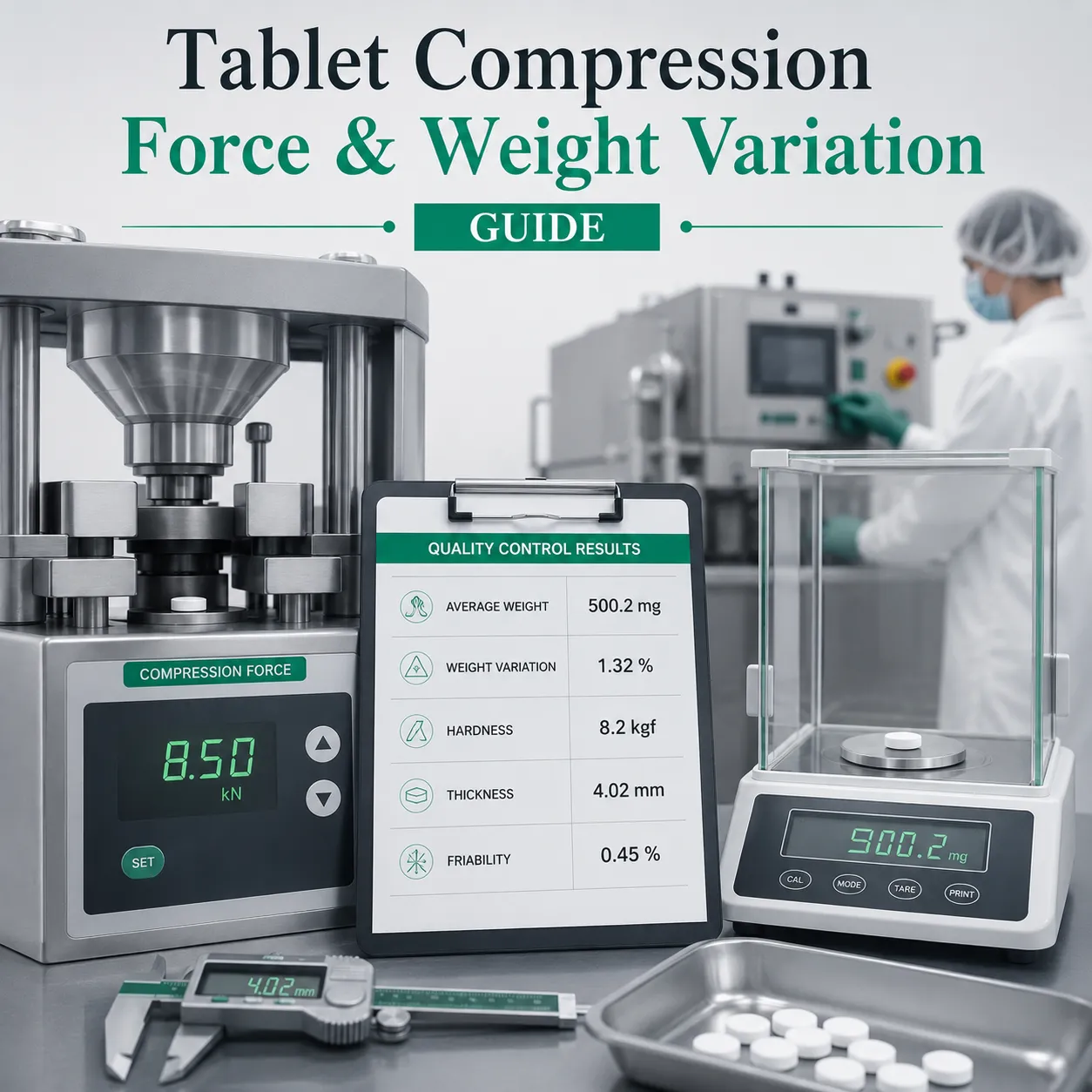

Learn Tablet Compression Force & Weight Variation, hardness, friability, and thickness calculations with GMP examples and adjustment tips.
Definition
Compression force and tablet weight variation calculations are essential pharmaceutical in-process quality control checks used during tablet manufacturing to ensure consistent tablet weight, hardness, thickness, friability, and mechanical strength while maintaining proper drug release characteristics.
Compression Force and Tablet Weight Variation Calculations
Tablet compression is one of the most critical stages in pharmaceutical solid dosage manufacturing. During compression, powder or granules are compacted into tablets using controlled punch pressure inside a tablet press.https://iampharmacist.com/granulation-defects/
Maintaining accurate:
- Compression force
- Tablet weight
- Hardness
- Thickness
- Friability
ensures consistent product quality, mechanical integrity, and regulatory compliance.
This guide explains pharmaceutical tablet compression calculations with formulas, USP limits, troubleshooting examples, GMP considerations, and practical production adjustments.
Understanding Tablet Compression Parameters
Key Tablet Compression Variables
| Parameter | Importance |
|---|---|
| Tablet Weight | Dose uniformity |
| Compression Force | Tablet hardness & density |
| Hardness | Mechanical strength |
| Thickness | Dimensional consistency |
| Friability | Resistance to abrasion |
Tablet Weight Variation Calculation
Tablet weight variation testing verifies dose consistency between tablets.
Weight Variation Formula
% Deviation=Average WeightIndividual Weight−Average Weight×100
USP Acceptance Criteria
| Average Tablet Weight | USP Limit |
|---|---|
| 80 mg or less | ±10% |
| More than 80 mg to less than 250 mg | ±7.5% |
| 250 mg or more | ±5% |
The batch passes if:
- Not more than 2 tablets exceed limits
- No tablet exceeds twice the percentage limit
Weight Variation Example
Given:
- Average tablet weight = 200 mg
- Individual tablet weight = 180 mg
Calculation:
200180−200×100=−10%
Result
Deviation = −10%
For a 200 mg tablet, USP limit is ±7.5%.
Conclusion
This tablet would fail USP weight variation criteria.
Compression Force in Tablet Manufacturing
Compression force refers to the pressure applied by punches to compact granules into tablets.
Common Compression Units
| Unit | Equivalent |
|---|---|
| 1 kp | 1 kgf |
| 1 kgf | 9.806 N |
| 1 kN | 1000 N |
Impact of Compression Force
| Increased Compression Force | Effect |
|---|---|
| Higher hardness | Stronger tablets |
| Reduced thickness | Denser tablets |
| Lower friability | Better durability |
| Slower disintegration | Possible dissolution issues |
Tablet Hardness Calculation & Control
Tablet hardness measures crushing strength and resistance to breakage.
Typical Hardness Limits
| Tablet Type | Hardness Range |
|---|---|
| Conventional Tablets | 4–10 kgf |
| Chewable Tablets | 3–5 kgf |
| Sustained Release Tablets | 10–20 kgf |
Hardness Adjustment Guidelines
| Observation | Adjustment |
|---|---|
| Tablets too soft | Increase compression force |
| Tablets too hard | Decrease compression force |
| High friability | Increase hardness |
| Slow dissolution | Reduce hardness |
Tablet Thickness Control
Tablet thickness depends on:
- Die fill volume
- Granule density
- Compression pressure
Thickness Acceptance Criteria
Typical pharmaceutical tolerance:
- ±5% of target thickness
Thickness Troubleshooting
| Problem | Possible Cause | Adjustment |
|---|---|---|
| Tablets too thick | Low compression | Increase force |
| Tablets too thin | Excess compression | Reduce force |
| Variable thickness | Poor die filling | Improve flow |
Friability Calculation
Friability testing measures resistance to abrasion during handling and transport.
Friability Formula
% Friability=W1W1−W2×100
Where:
- W1 = Initial tablet weight
- W2 = Final tablet weight
Friability Acceptance Criteria
| Product Type | Typical Limit |
|---|---|
| Standard Tablets | ≤1.0% |
| Optimized Formulations | ≤0.8% |
Friability Calculation Example
Given:
- Initial weight = 10.50 g
- Final weight = 10.42 g
Calculation:
10.5010.50−10.42×100=0.76%
Result
Friability = 0.76%
Conclusion
The tablets pass friability requirements.
Compression Adjustment Examples
1. Tablets Too Hard & Thin
Problem
- Slow disintegration
- Excessive hardness
Root Cause
High compression force
Adjustment
- Reduce main compression force
- Increase tablet thickness
2. High Tablet Weight Variation
Problem
Inconsistent tablet weight
Root Cause
Poor granule flow
Adjustment
- Synchronize feeder speed
- Optimize hopper level
- Improve granule flowability
3. Tablet Capping or Lamination
Problem
Tablets split apart after compression
Root Cause
- Entrapped air
- Overcompression
Adjustment
- Reduce compression force
- Increase pre-compression
- Optimize granule moisture
Tablet Compression Calculators
1. Tablet Weight Variation Calculator
2. Compression Force Converter
3. Friability Calculator
4. Tablet Thickness Variation Calculator
5. Compression Adjustment Advisor
GMP & Regulatory Considerations
GMP Expectations for Tablet Compression
Equipment Qualification
- IQ/OQ/PQ completed
- Calibrated compression force sensors
In-Process Controls
- Weight checks
- Hardness monitoring
- Thickness verification
- Friability testing
Documentation
- Batch manufacturing records
- Compression parameter logs
- IPC records
Regulatory References
- USP <1216>
- FDA cGMP guidelines
- EU GMP Annex 15
FAQs
1. What is tablet compression force?
Compression force is the pressure applied by punches to compact powder into tablets.
2. Why is tablet weight variation important?
Weight variation ensures each tablet contains the correct drug dose.
3. What is acceptable friability for tablets?
Most tablets should have friability less than or equal to 1.0%.
4. How does compression force affect hardness?
Increasing compression force generally increases tablet hardness.
5. What causes tablet capping?
Capping usually occurs due to entrapped air or excessive compression.
6. What is the acceptable hardness range for tablets?
Conventional tablets typically range from 4–10 kgf.
7. How is tablet friability calculated?
Friability is calculated using percentage weight loss before and after testing.
8. What causes tablet weight variation?
Poor granule flow and inconsistent die filling are common causes.
9. Why is tablet thickness monitored?
Thickness ensures dimensional consistency and proper packaging performance.
10. Which GMP controls apply during compression?
Manufacturers must monitor weight, hardness, thickness, friability, and compression force during production.