


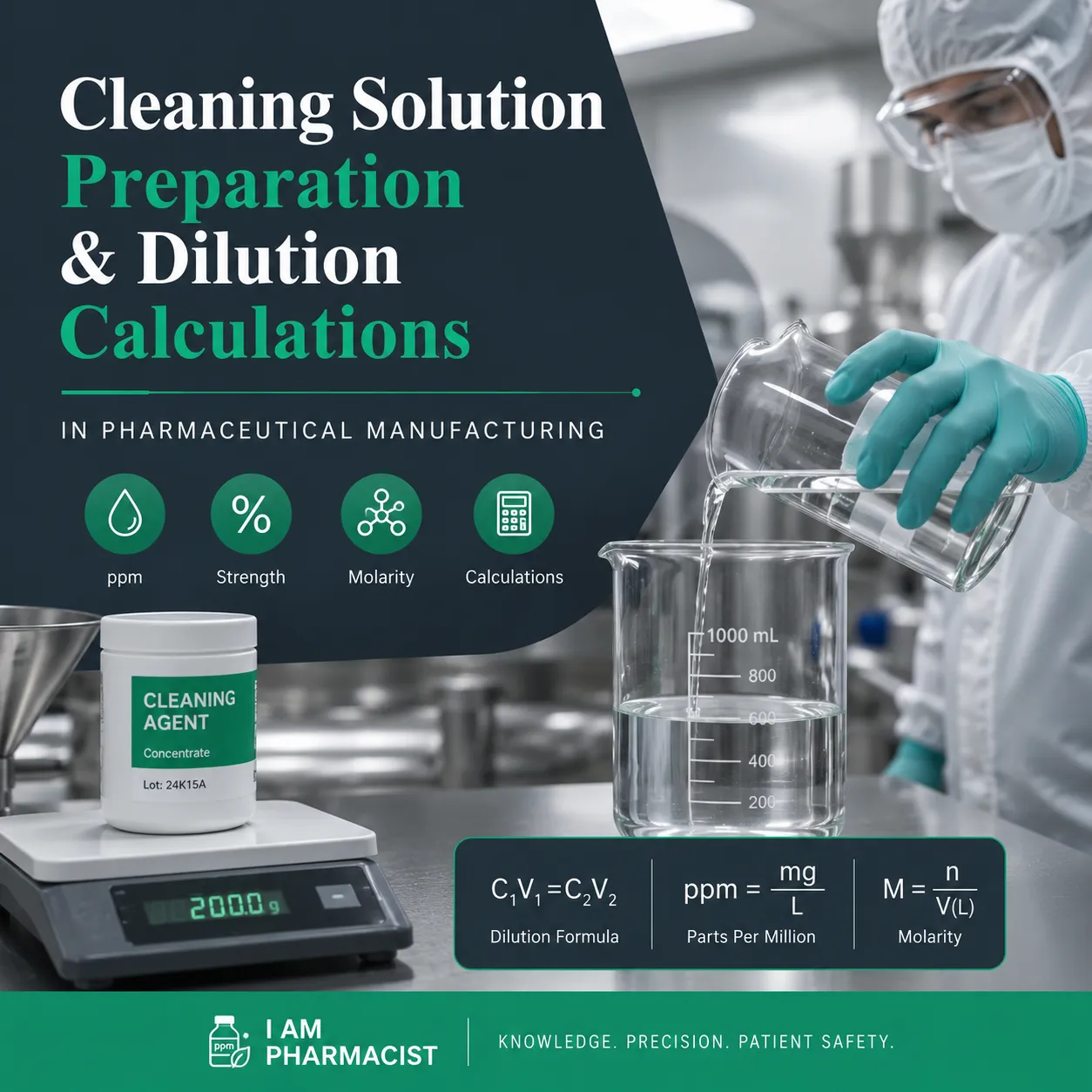

Learn cleaning solution preparation and dilution calculations in pharmaceutical manufacturing, including ppm, percentage strength, molarity, and dilution formulas.
Definition
Cleaning solution preparation and dilution calculations in pharmaceutical manufacturing involve determining the correct concentration of cleaning agents using dilution formulas, percentage strength, ppm, and molarity calculations. Accurate preparation ensures effective cleaning, prevents cross-contamination, and supports GMP compliance and cleaning validation requirements.
Maintaining a contamination-free manufacturing environment is a fundamental requirement in pharmaceutical production. Effective cleaning procedures depend not only on selecting appropriate cleaning agents but also on preparing solutions at the correct concentrations.
Incorrect dilution can lead to ineffective cleaning, residue formation, equipment damage, failed cleaning validation studies, and potential regulatory observations.
This guide explains the essential calculations used for cleaning solution preparation, including dilution formulas, percentage strength calculations, parts per million (ppm), and molarity calculations, along with practical pharmaceutical examples and GMP considerations.
Why Accurate Cleaning Solution Preparation Matters
In pharmaceutical manufacturing, cleaning solutions are routinely used for:
- Equipment cleaning
- Facility sanitization
- CIP (Clean-In-Place) systems
- COP (Clean-Out-of-Place) systems
- Surface disinfection
- Cleaning validation studies
Proper concentration ensures:
✅ Effective removal of product residues
✅ Reduction of microbial contamination
✅ Prevention of cross-contamination
✅ Compliance with GMP requirements
✅ Consistent cleaning validation results
Key Calculation Methods Used in Pharmaceutical Cleaning
The most commonly used calculation methods include:
| Calculation Type | Application |
|---|---|
| Dilution Formula | Preparing working solutions from concentrated stocks |
| Percentage Strength | Preparing cleaning agents by weight or volume |
| Parts Per Million (ppm) | Sanitizer and disinfectant preparation |
| Molarity (M) | Acid and alkali cleaning solutions |
| Specific Gravity Adjustments | Converting w/w concentrations to volumetric measurements |
1. Common Dilution Formula
When preparing a diluted cleaning solution from a concentrated stock, the standard dilution equation is used.
Formula
C1×V1=C2×V2
Where:
| Symbol | Meaning |
|---|---|
| C₁ | Stock concentration |
| V₁ | Volume of stock required |
| C₂ | Desired concentration |
| V₂ | Final solution volume |
Important: Concentrations must be expressed in the same units.
Dilution Calculator (C₁V₁ = C₂V₂)
Example: Preparing a 1% Cleaning Solution
Given
- Stock solution = 10%
- Target concentration = 1%
- Final volume = 20 L
Calculation
V1=C1C2×V2 V1=101×20 V1=2L
Result
Mix:
- 2 L of 10% concentrate
- Add purified water up to 20 L
2. Percentage Strength Calculations
Percentage strength expresses the amount of solute present in a solution.
Types of Percentage Strength
% w/w (Weight-in-Weight)
%w/w=Total Weight of SolutionWeight of Solute×100
% w/v (Weight-in-Volume)
%w/v=Volume of Solution(mL)Weight of Solute(g)×100
% v/v (Volume-in-Volume)
%v/v=Total Volume of SolutionVolume of Solute×100
% w/v Solution Calculator
Example: 10% w/v Cleaning Agent Solution
Requirement
Prepare 500 mL of 10% w/v solution.
Calculation
Mass Required=10010×500 =50g
Result
- Weigh 50 g cleaning agent.
- Dissolve and make volume up to 500 mL.
Percentage Strength Quick Reference
| Desired Strength | Quantity Required |
|---|---|
| 1% w/v | 1 g per 100 mL |
| 5% w/v | 5 g per 100 mL |
| 10% w/v | 10 g per 100 mL |
| 20% w/v | 20 g per 100 mL |
3. Parts Per Million (ppm) Calculations
PPM is widely used for disinfectants, sanitizers, chlorine solutions, and residual chemical measurements.
In aqueous solutions:1ppm=1mg/L
or1ppm=1μg/mL
Formula
ppm=Volume of Solution (L)Mass of Solute (mg)
PPM Solution Calculator
Example: Preparing a 200 ppm Sanitizer
Requirement
Prepare 10 L of sanitizer at 200 ppm.
Calculation
Mass=200mg/L×10L =2000mg =2g
Result
Dissolve:
- 2 g sanitizer
- Make up to 10 L with water
Common Pharmaceutical Sanitizer Concentrations
| Sanitizer | Typical Concentration |
|---|---|
| Chlorine | 100–500 ppm |
| Hydrogen Peroxide | 500–3000 ppm |
| Quaternary Ammonium Compounds | 200–400 ppm |
| Peracetic Acid | 100–1000 ppm |
4. Molarity (M) Calculations
Molarity represents the number of moles of solute dissolved in one liter of solution.
Formula
M=Volume (L)Moles
Where:Moles=Molecular WeightMass
Molarity Calculator
Example: Preparing 0.5 M Sodium Hydroxide Solution
Requirement
Prepare 2 L of 0.5 M NaOH.
Step 1: Calculate Moles Required
Moles=Molarity×Volume =0.5×2 =1mol
Step 2: Determine Molecular Weight
NaOH molecular weight:40g/mol
Step 3: Calculate Required Mass
Mass=Moles×MW =1×40 =40g
Result
- Weigh 40 g NaOH.
- Dissolve and dilute to 2 L.
Specific Gravity Considerations
Many commercial cleaning chemicals are supplied as:
- % w/w solutions
- Concentrated liquids
When measuring by volume, specific gravity (SG) must be considered.
Formula
Concentration(w/v)=Concentration(w/w)×SG
Specific Gravity Conversion Calculator
Example
Cleaning concentrate:
- 20% w/w
- SG = 1.10
20×1.10 =22%
The equivalent concentration becomes approximately 22% w/v.
Percentage Dilution Calculator
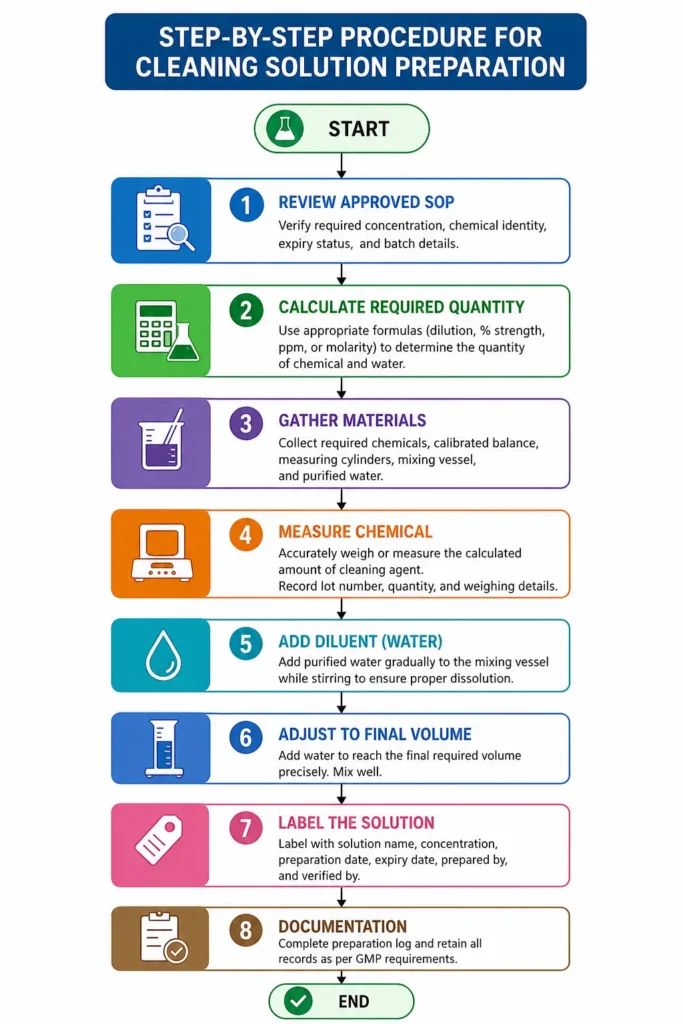
GMP and Regulatory Considerations
Pharmaceutical manufacturers should comply with:
- EU GMP Annex 15
- PIC/S Guidelines
- WHO GMP
- US FDA 21 CFR Part 211
- ISPE Cleaning Validation Guidance
Key requirements include:
Traceability
Record:
- Chemical batch numbers
- Supplier information
- Expiry dates
Calibration
Use calibrated:
- Balances
- Measuring cylinders
- Flow meters
Cleaning Validation
Demonstrate:
- Residue removal effectiveness
- Repeatability
- Acceptable carryover limits
Documentation
Maintain:
- Preparation records
- Cleaning logs
- Validation reports
Common Errors in Cleaning Solution Preparation
| Error | Impact |
|---|---|
| Incorrect dilution factor | Ineffective cleaning |
| Using expired concentrate | Reduced performance |
| Ignoring specific gravity | Wrong concentration |
| Uncalibrated measuring devices | Calculation errors |
| Poor documentation | GMP observations |
| Incomplete mixing | Non-uniform solution |
Frequently Asked Questions (FAQs)
1. What is the dilution formula used in pharmaceutical cleaning?
The standard formula is C₁V₁ = C₂V₂, used to determine the volume of concentrate needed for a target concentration.
2. What does ppm mean in cleaning solution preparation?
PPM means parts per million and typically equals mg/L in aqueous solutions.
3. Why is ppm important in sanitization?
It ensures disinfectants are prepared at effective concentrations without overdosing.
4. How do you prepare a 10% w/v solution?
Dissolve 10 g of material and make the final volume up to 100 mL.
5. What is molarity?
Molarity is the number of moles of solute per liter of solution.
6. Why is NaOH commonly prepared using molarity calculations?
Its cleaning effectiveness is often specified in molar concentration.
7. What is the difference between w/w and w/v?
w/w uses total solution weight, while w/v uses solution volume.
8. Why is specific gravity important?
It helps convert weight-based concentrations into volume-based measurements.
9. What GMP records should be maintained during solution preparation?
Preparation logs, batch details, lot numbers, calibration records, and verification records.
10. How does cleaning solution concentration affect cleaning validation?
Incorrect concentration can cause validation failures due to inadequate residue removal.