


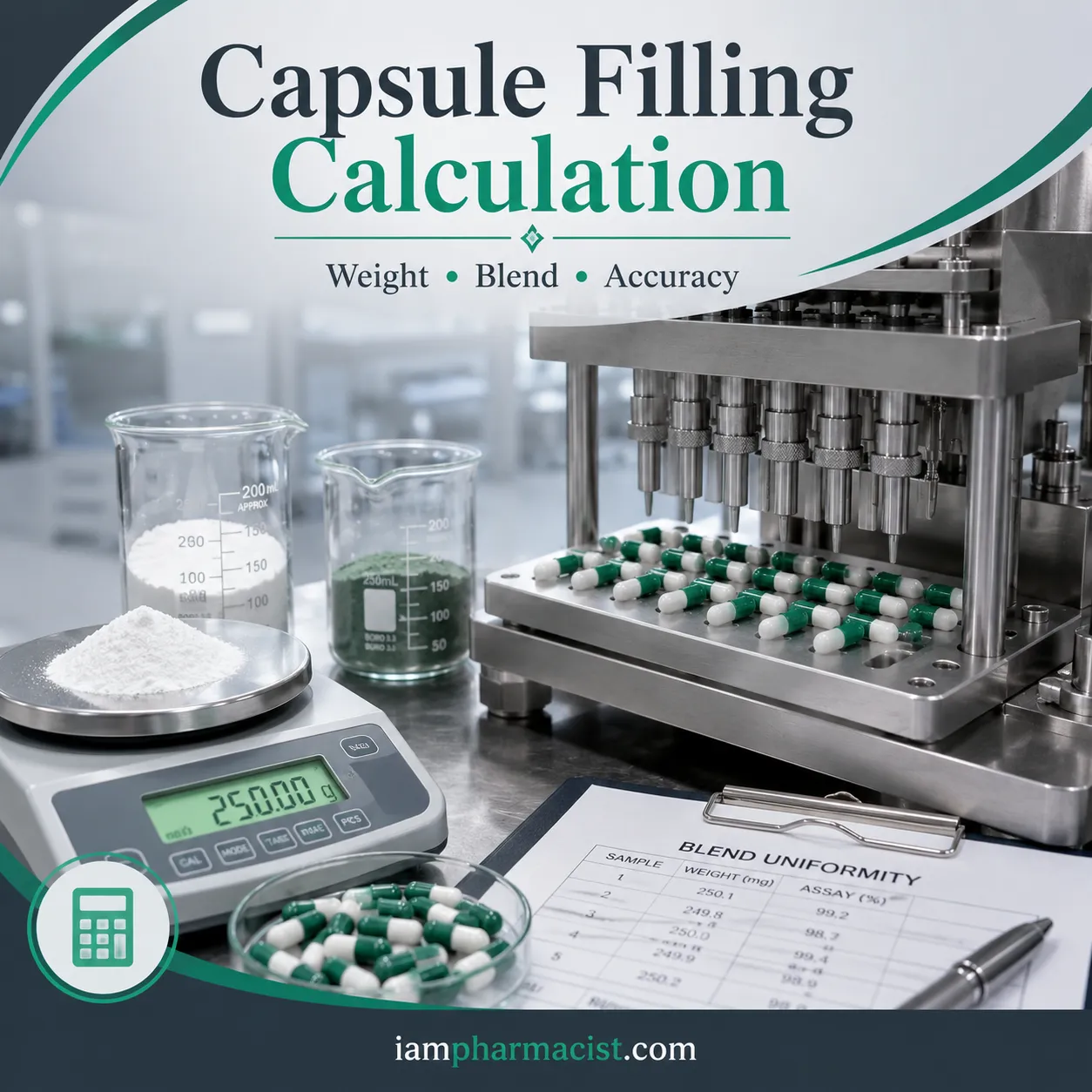

Learn capsule filling weight and blend calculations including capsule size capacity, fill weight adjustment, and blend uniformity for pharma manufacturing.
Definition
Capsule filling weight and blend calculations determine capsule size capacity, powder fill weight, excipient quantity, and blend uniformity to ensure accurate dosing, proper capsule filling, and GMP-compliant pharmaceutical manufacturing.
Capsule Filling Weight and Blend Calculation
Capsule filling is one of the most widely used pharmaceutical manufacturing processes for oral solid dosage forms. Accurate capsule filling calculations are critical to ensure dose uniformity, proper capsule closure, and consistent therapeutic performance.
Errors in capsule filling calculations may lead to:
- Overfilling or underfilling
- Dose variation
- Poor content uniformity
- Capsule locking issues
- Weight variation failures
- Regulatory non-compliance
This guide explains the essential pharmaceutical calculations used in capsule manufacturing, including:
- Capsule size capacity calculations
- Fill weight adjustment
- Blend uniformity calculations
- Batch formulation calculations
Practical examples and GMP insights are included for production pharmacists, formulation scientists, and quality assurance professionals.
Why Capsule Filling Calculations Matter
Accurate calculations are essential for:
- Uniform drug delivery
- Consistent capsule weight
- Proper machine setup
- Efficient batch manufacturing
- GMP compliance
- Reduced product rejection
These calculations are routinely used during:
- Formulation development
- Process validation
- Scale-up activities
- Commercial production
- Technology transfer
1. Capsule Size Capacity Calculation
What is Capsule Size Capacity?
Capsule size capacity refers to the amount of powder a capsule shell can hold based on:
- Capsule volume
- Powder bulk density
- Powder flow characteristics
The actual fill weight depends heavily on the powder’s bulk density.
Standard Hard Gelatin/HPMC Capsule Capacities
| Capsule Size | Approximate Volume | Typical Fill Capacity |
|---|---|---|
| 000 | 1.37 mL | 800–1600 mg |
| 00 | 0.95 mL | 600–1200 mg |
| 0 | 0.68 mL | 400–800 mg |
| 1 | 0.50 mL | 350–475 mg |
| 2 | 0.37 mL | 250–400 mg |
| 3 | 0.30 mL | 200–300 mg |
| 4 | 0.21 mL | 120–210 mg |
| 5 | 0.13 mL | 60–130 |
Practical Manufacturing Insight
Powders with:
- Higher bulk density produce heavier fills
- Poor flow may cause inconsistent filling
- Fine particle size may increase weight variation
Pre-formulation studies should evaluate:
- Bulk density
- Tapped density
- Compressibility index
- Hausner ratio
- Flowability
2. Fill Weight Adjustment
What is Fill Weight Adjustment?
Fill weight adjustment ensures that the capsule contains the correct quantity of active pharmaceutical ingredient (API) and excipients.
If the API dose is lower than capsule capacity, fillers or diluents must be added.
Common Capsule Excipients
| Excipient | Function |
| Lactose | Diluent |
| MCC (Microcrystalline Cellulose) | Filler |
| Magnesium Stearate | Lubricant |
| Colloidal Silicon Dioxide | Glidant |
| Starch | Disintegrant |
Industrial Capsule Filling Machine Adjustment
Dosator Machines
Fill weight is adjusted by:
- Dosing cavity depth
- Vacuum pressure
- Powder bed density
Tamping Pin Machines
Fill weight is controlled through:
- Tamping pin compression
- Dosing disc thickness
- Fill depth adjustment
Modern capsule fillers use:
- Servo motors
- Automated weight correction systems
- In-process checkweighers
3. Blend Uniformity Calculation
What is Blend Uniformity?
Blend uniformity ensures the API is evenly distributed throughout the powder blend before encapsulation.
Poor blend uniformity can result in:
- Dose inconsistency
- Therapeutic failure
- Regulatory rejection
Acceptance Criteria
Typical pharmaceutical requirement:
- RSD ≤ 2.0%
Lower RSD indicates:
- Better homogeneity
- Improved dose consistency
Acceptance Value (AV)
Regulatory authorities use Acceptance Value (AV) testing under USP <905> to evaluate content uniformity.
AV considers:
- Mean potency
- Sample variability
- Target concentration
Lower AV indicates superior uniformity.
Step-by-Step HowTo: Capsule Filling Calculations
Step 1: Determine API Dose
Define the required drug strength per capsule.
Step 2: Select Capsule Size
Choose capsule size based on:
- Fill volume
- Powder density
- Patient compliance
Step 3: Calculate Fill Weight
Use capsule volume and bulk density to determine fill capacity.
Step 4: Calculate Filler Quantity
Determine excipient requirement to achieve target fill weight.
Step 5: Prepare Batch Formula
Calculate total API and excipient quantities for batch production.
Step 6: Evaluate Blend Uniformity
Perform blend sampling and statistical evaluation.
Step 7: Adjust Machine Parameters
Optimize:
- Fill depth
- Tamping pressure
- Powder flow
- Machine speed
Common Capsule Filling Problems Related to Poor Calculations
| Problem | Possible Cause |
| Weight variation | Inconsistent flow |
| Capsule separation | Overfilling |
| Underweight capsules | Low fill depth |
| Segregation | Poor blending |
| High RSD | Inadequate mixing |
| Powder leakage | Incorrect capsule locking |
“`html id=”i0x8lf”
1. Capsule Size Capacity Calculator
2. Fill Weight Adjustment Calculator
3. Total Batch Blend Calculator
4. Blend Uniformity RSD Calculator
5. Complete Capsule Formulation Calculator
Regulatory and GMP Insights
Capsule manufacturing operations should comply with:
- cGMP requirements
- USP <905> Uniformity of Dosage Units
- Process validation guidelines
- Data integrity principles
- Cleaning validation procedures
Critical GMP recommendations:
- Validate blend mixing time
- Use calibrated balances
- Conduct in-process weight checks
- Monitor environmental humidity
- Verify capsule shell integrity
Regulatory inspectors frequently review:
- Blend uniformity studies
- Weight variation data
- Machine setup records
- Batch manufacturing records
- Cleaning logs
FAQs
1. What is capsule fill weight calculation?
Capsule fill weight calculation determines the amount of powder a capsule shell can hold based on volume and bulk density.
2. How is capsule capacity calculated?
Capsule capacity is calculated using capsule volume multiplied by powder bulk density.
3. Why is bulk density important in capsule filling?
Bulk density directly affects capsule fill weight and filling consistency.
4. What causes capsule weight variation?
Poor powder flow, inconsistent fill depth, and improper machine settings commonly cause weight variation.
5. What is blend uniformity?
Blend uniformity ensures even distribution of API throughout the powder mixture.
6. What is acceptable RSD for blend uniformity?
Pharmaceutical blend uniformity generally requires RSD ≤ 2.0%.
7. What is USP <905>?
USP <905> is a pharmacopeial guideline for uniformity of dosage units.
8. Why are fillers added in capsules?
Fillers help achieve target fill weight when API quantity is lower than capsule capacity.
9. Which excipients are commonly used in capsules?
Common excipients include lactose, MCC, starch, magnesium stearate, and colloidal silicon dioxide.
10. Why are capsule filling calculations important?
They ensure accurate dosing, batch consistency, GMP compliance, and patient safety.