



Explore recent advances in functional and Smart Coatings for Tablets, including stimuli-responsive polymers, PAT systems, and controlled drug delivery.
What Are Functional and Smart Tablet Coatings?
Functional and smart tablet coatings are advanced pharmaceutical coating systems designed to improve drug stability, modify release behavior, enhance patient compliance, and enable targeted drug delivery through responsive polymer technologies and precision-controlled manufacturing processes.
Introduction
Tablet coating has transformed from a simple cosmetic process into one of the most sophisticated technologies in pharmaceutical manufacturing. Modern coating systems are engineered not only to improve product appearance but also to deliver precise therapeutic outcomes, enhance drug stability, optimize bioavailability, and improve patient adherence.
Recent innovations in polymer science, automation, nanotechnology, and process analytical technology (PAT) have significantly advanced pharmaceutical coating capabilities. Today’s smart coating systems can respond to physiological triggers such as pH, temperature, enzymes, and moisture, enabling site-specific and controlled drug release.
The pharmaceutical industry is increasingly adopting intelligent coating technologies, continuous manufacturing systems, and Quality by Design (QbD) approaches to achieve higher coating uniformity, reduced material waste, and superior product reproducibility.
Evolution of Pharmaceutical Tablet Coating
The coating process has evolved considerably since the 19th century. Traditional sugar coatings have largely been replaced by highly functional film coatings capable of delivering multiple therapeutic and protective functions simultaneously.
Key Evolutionary Milestones
| Era | Coating Technology | Primary Function |
|---|---|---|
| Early pharmaceutical era | Sugar coating | Taste masking and appearance |
| Mid-20th century | Film coating | Faster processing and protection |
| Modern era | Functional coatings | Controlled release and stability |
| Current innovations | Smart coatings | Stimuli-responsive drug delivery |
Why Functional Tablet Coatings Matter
Modern pharmaceutical coatings perform several critical roles:
- Improve chemical stability
- Protect against moisture and light
- Mask unpleasant taste and odor
- Enable enteric protection
- Control drug release kinetics
- Enhance patient compliance
- Support targeted drug delivery
These advanced coating systems are now essential in oral solid dosage formulation development. https://www.webofpharma.com/2025/11/a-comprehensive-guide-to-pharmaceutical.html
Recent Advances in Functional Tablet Coatings
1. Stimuli-Responsive Smart Coatings
One of the most important breakthroughs in pharmaceutical coating technology is the development of stimuli-responsive polymers.
These “smart” coatings release drugs only under specific physiological conditions such as:
- pH changes
- Temperature variations
- Enzymatic activity
- Ionic concentration
- Moisture exposure
Example Applications
| Smart Trigger | Coating Response | Pharmaceutical Benefit |
|---|---|---|
| pH-responsive polymers | Dissolve in intestine | Enteric drug delivery |
| Temperature-sensitive coatings | Trigger release at body temperature | Targeted therapy |
| Enzyme-responsive systems | Controlled degradation | Colon-targeted delivery |
Advanced pH-sensitive coatings now achieve dissolution precision within ±0.2 pH units.
Advanced Polymeric Materials in Tablet Coating
Modified Cellulose Derivatives
Hydroxypropyl methylcellulose (HPMC) remains one of the most widely used coating polymers due to its excellent film-forming ability, flexibility, and moisture protection properties.
Modern HPMC grades offer:
- Optimized viscosity profiles
- Enhanced mechanical strength
- Improved adhesion
- Better dissolution control
Acrylic Polymer Systems
Polymethacrylate-based coatings such as Eudragit® polymers provide sophisticated control over drug release kinetics.
Key Advantages
- pH-dependent release
- Gastric resistance
- Controlled permeability
- Tunable dissolution behavior
These systems are extensively used in:
- Delayed-release tablets
- Sustained-release formulations
- Colon-targeted therapies
Biodegradable Coating Polymers
Sustainability has become a major focus in pharmaceutical coating development.
Modern biodegradable coating systems include:
- Chitosan
- Starch derivatives
- Polylactic acid (PLA)
- Polycaprolactone (PCL)
- Polyhydroxyalkanoates (PHA)
These materials improve biocompatibility while reducing environmental impact.
Smart Moisture-Protective Coatings
Moisture-sensitive drugs require advanced barrier systems that minimize water vapor transmission while preserving tablet integrity.
Features of Modern Moisture Barriers
- Hydrophobic polymer blends
- Multi-layer film structures
- Controlled coating thickness
- Enhanced flexibility through optimized plasticizers
Advanced systems now achieve water vapor transmission rates below 100 g/m²/24h.
Recent Innovations in Enteric Coating
Modern enteric coatings are engineered to remain intact in gastric environments while dissolving rapidly in the intestine.
Benefits of Advanced Enteric Systems
- Precise pH-triggered release
- Superior acid resistance
- Improved coating integrity
- Reduced gastric irritation
These systems typically dissolve above pH 6 while remaining stable below pH 3.
Modern Coating Equipment and Automation
Advanced Coating Pans
Contemporary perforated coating pans use engineered airflow systems and CFD-optimized baffle designs to improve coating uniformity and reduce tablet attrition.
Key Features
- Automated RPM control
- Uniform airflow distribution
- Reduced coating variability
- Enhanced drying efficiency
Spray Systems and Atomization Technology
High-precision spray systems now generate droplets in the 20–50 µm range for superior coating distribution.
Modern Innovations
- Anti-bearding nozzles
- Pulse-width modulation
- Electromagnetic spray control
- Multi-nozzle optimization
Process Analytical Technology (PAT) in Tablet Coating
PAT systems have transformed coating operations from empirical processes into highly controlled manufacturing systems.
Common PAT Tools
| Technology | Function |
|---|---|
| Near-infrared spectroscopy (NIR) | Coating thickness monitoring |
| Raman spectroscopy | Structural analysis |
| LIBS | Coating layer evaluation |
| Terahertz imaging | Non-destructive mapping |
Modern PAT systems enable coating uniformity variation below 2%.
Continuous Coating Technologies
Continuous manufacturing is one of the biggest advances in pharmaceutical processing.
Advantages of Continuous Coating
- Reduced processing time
- Lower material waste
- Better batch consistency
- Real-time process adjustment
- Higher manufacturing efficiency
Modern systems reduce processing times by up to 60% compared to conventional batch coating.
Electrostatic Coating Technology
Electrostatic coating systems use controlled electric fields to improve coating deposition efficiency.
Key Benefits
- Coating efficiency above 90%
- Reduced overspray
- Uniform coating thickness
- Lower material consumption
These systems typically operate at 30–60 kV with particle sizes ranging from 15–30 µm.
Nanotechnology in Tablet Coatings
Nanostructured coating systems represent a major advancement in pharmaceutical coating science.
Applications of Nanotechnology
- Enhanced barrier protection
- Improved mechanical strength
- Controlled permeability
- Better bioavailability
Nanoparticles ranging from 20–100 nm are increasingly incorporated into advanced coating systems.
How Smart Tablet Coatings Are Developed
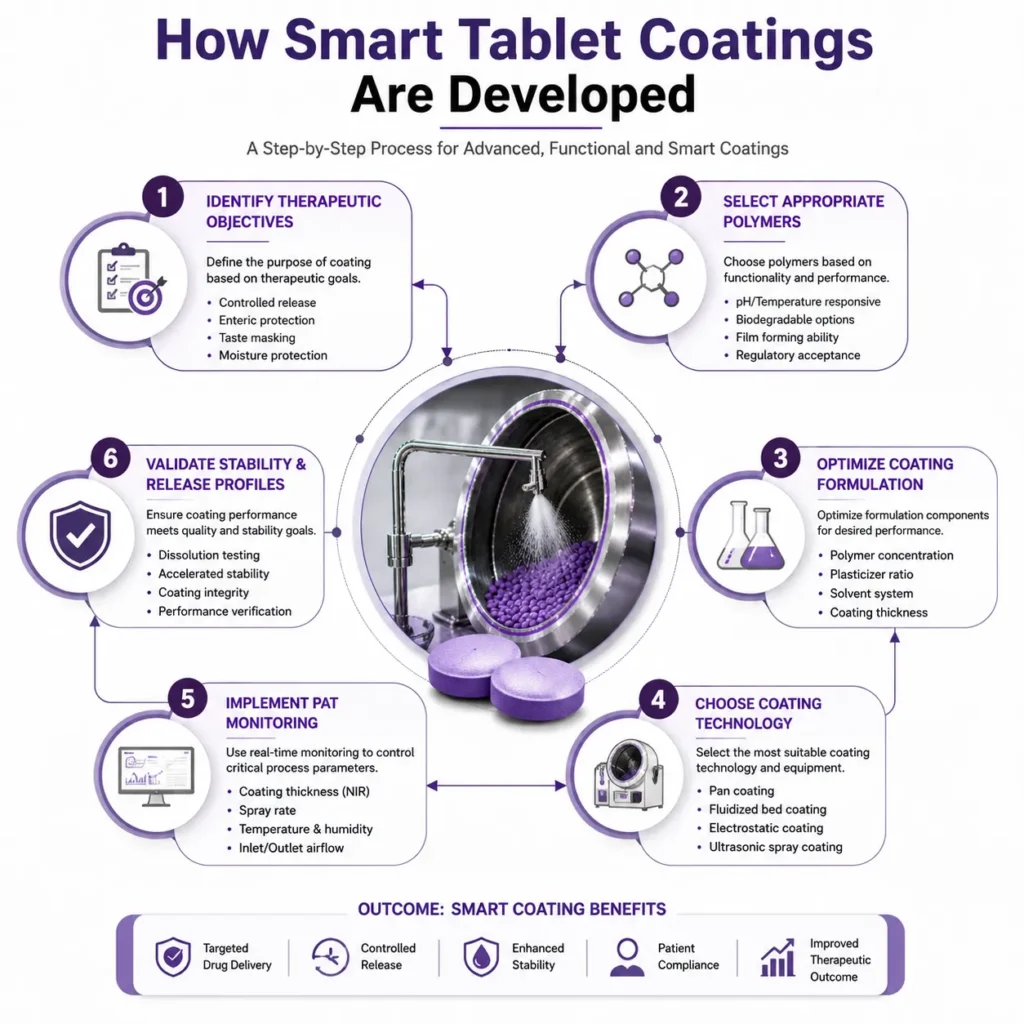
Step 1: Identify Therapeutic Objectives
Determine whether the formulation requires:
- Controlled release
- Enteric protection
- Taste masking
- Moisture resistance
Step 2: Select Appropriate Polymers
Choose polymers based on:
- Solubility profile
- Trigger responsiveness
- Mechanical properties
- Regulatory acceptance
Step 3: Optimize Coating Formulation
Adjust:
- Polymer concentration
- Plasticizer ratio
- Solvent system
- Coating thickness
Step 4: Choose Coating Technology
Options include:
- Pan coating
- Fluidized bed coating
- Electrostatic coating
- Ultrasonic spray coating
Step 5: Implement PAT Monitoring
Use real-time monitoring tools to control:
- Spray rate
- Coating thickness
- Temperature
- Humidity
Step 6: Validate Stability and Release Profiles
Perform:
- Dissolution testing
- Accelerated stability studies
- Coating integrity analysis
Quality by Design (QbD) in Coating Processes
QbD approaches have significantly improved coating consistency and manufacturing reliability.
Benefits of QbD
- Reduced batch variability
- Faster optimization
- Improved process understanding
- Enhanced regulatory compliance
Advanced statistical models now predict coating quality with accuracy above 95%.
Industrial Applications of Smart Coatings
Modified Release Systems
Smart coatings enable:
- Delayed release
- Sustained release
- Pulsatile release
- Chronotherapeutic delivery
Multi-Particulate Coatings
Modern fluid bed systems provide excellent coating uniformity for pellets and multiparticulates.
Bi-Layer Tablet Coating
Advanced spray systems can independently coat different tablet layers while maintaining clear separation zones.
Sustainability Trends in Pharmaceutical Coating
Environmental sustainability is becoming a major focus in coating technology.
Green Coating Innovations
- Aqueous coating systems
- Reduced solvent usage
- Biopolymer-based films
- Water recycling systems
- Energy-efficient drying systems
Modern coating operations now achieve water consumption reductions exceeding 50%.
Conclusion
Recent advances in functional and smart tablet coatings have transformed pharmaceutical manufacturing into a highly precise, technology-driven discipline. Modern coating systems now combine advanced polymers, automated process controls, PAT integration, nanotechnology, and intelligent release mechanisms to achieve superior therapeutic outcomes.
The rise of stimuli-responsive polymers, electrostatic coating technologies, continuous manufacturing, and biodegradable materials has opened new possibilities for targeted drug delivery and sustainable pharmaceutical production. As coating science continues to evolve, smart coating technologies will play an increasingly important role in improving drug efficacy, stability, patient compliance, and manufacturing efficiency.
FAQs
1. What are smart tablet coatings?
Smart tablet coatings are stimuli-responsive coating systems that release drugs under specific physiological conditions such as pH or temperature changes.
2. Why are functional coatings important in pharmaceuticals?
Functional coatings improve drug stability, control release profiles, protect APIs, and enhance patient compliance.
3. What polymers are commonly used in tablet coating?
Common coating polymers include HPMC, Eudragit®, PVA, chitosan, PLA, and cellulose derivatives.
4. What is the role of PAT in coating processes?
Process Analytical Technology enables real-time monitoring and control of coating parameters to ensure consistent quality.
5. How does electrostatic coating work?
Electrostatic coating uses electrical fields to attract charged coating particles onto tablet surfaces for improved efficiency.
6. What are enteric coatings?
Enteric coatings protect tablets from gastric acid and release drugs in the intestine at higher pH levels.
7. What is continuous tablet coating?
Continuous coating is an automated manufacturing process that continuously coats tablets with improved efficiency and consistency.
8. How does nanotechnology improve tablet coatings?
Nanotechnology enhances barrier properties, mechanical strength, and controlled drug release behavior.
9. What is QbD in pharmaceutical coating?
Quality by Design is a systematic approach to coating process development that improves consistency and process understanding.
10. Are modern coating systems environmentally sustainable?
Yes. Modern systems increasingly use aqueous formulations, biodegradable polymers, and energy-efficient technologies.
{ “@context”: “https://schema.org”, “@graph”: [ { “@type”: “Article”, “headline”: “Recent Advances in Functional and Smart Coatings for Tablets”, “description”: “Explore advanced pharmaceutical coating technologies including smart coatings, PAT systems, and controlled release polymers.”, “author”: { “@type”: “Person”, “name”: “Editorial Team” }, “publisher”: { “@type”: “Organization”, “name”: “iampharmacist.com” }, “mainEntityOfPage”: { “@type”: “WebPage”, “@id”: “https://iampharmacist.com/recent-advances-functional-smart-tablet-coatings” }, “keywords”: [ “smart tablet coatings”, “functional coating”, “PAT”, “controlled release”, “enteric coating”, “pharmaceutical coating” ] }, { “@type”: “HowTo”, “name”: “How Smart Tablet Coatings Are Developed”, “step”: [ { “@type”: “HowToStep”, “name”: “Identify Therapeutic Objectives” }, { “@type”: “HowToStep”, “name”: “Select Appropriate Polymers” }, { “@type”: “HowToStep”, “name”: “Optimize Coating Formulation” }, { “@type”: “HowToStep”, “name”: “Choose Coating Technology” }, { “@type”: “HowToStep”, “name”: “Implement PAT Monitoring” }, { “@type”: “HowToStep”, “name”: “Validate Stability and Release Profiles” } ] }, { “@type”: “FAQPage”, “mainEntity”: [ { “@type”: “Question”, “name”: “What are smart tablet coatings?”, “acceptedAnswer”: { “@type”: “Answer”, “text”: “Smart tablet coatings are stimuli-responsive systems that release drugs under specific physiological conditions.” } }, { “@type”: “Question”, “name”: “Why are functional coatings important?”, “acceptedAnswer”: { “@type”: “Answer”, “text”: “Functional coatings improve stability, control release, and enhance patient compliance.” } } ] } ] }