



Explore sustained release coating technologies, polymers, innovations, drug delivery mechanisms, advantages, and pharmaceutical applications.
Definition of Sustained Release Coatings
Sustained release coatings are specialized pharmaceutical coating systems designed to control and prolong drug release over an extended period, maintaining therapeutic drug concentrations while reducing dosing frequency and improving patient compliance. These systems commonly utilize biodegradable polymers, diffusion barriers, and matrix technologies to achieve controlled drug delivery.
Introduction
Sustained release drug delivery systems have revolutionized modern pharmaceutical therapy by enabling prolonged therapeutic action, reducing dosing frequency, and improving patient adherence. As pharmaceutical research advances toward more precise and patient-centered therapies, sustained release coatings continue to play a critical role in enhancing drug efficacy and minimizing side effects.https://iampharmacist.com/enteric-coating/
Unlike conventional dosage forms that release drugs rapidly after administration, sustained release formulations are engineered to release active pharmaceutical ingredients (APIs) gradually over time. This controlled drug delivery helps maintain plasma drug concentrations within the therapeutic window for extended periods.
Modern sustained release technologies combine polymer science, nanotechnology, pharmaceutical engineering, and advanced coating systems to improve drug targeting, stability, and bioavailability. These systems include polymer-coated tablets, hydrogels, implants, nanoparticles, injectable depots, and membrane-controlled devices. https://iampharmacist.com/key-scale-up-challenges-in-tablet-coating/
Research into sustained release coatings continues to expand rapidly due to their clinical and commercial advantages in chronic disease management, oncology, cardiovascular therapy, diabetes treatment, and central nervous system disorders. Source context provided by user:
Importance of Sustained Release Coatings
Sustained release coatings are designed to optimize therapeutic performance while improving patient convenience.
Major Benefits
- Reduced dosing frequency
- Improved patient compliance
- Stable plasma drug concentrations
- Reduced peak-trough fluctuations
- Enhanced therapeutic effectiveness
- Minimized side effects
- Better site-specific targeting
- Improved bioavailability
How Sustained Release Coatings Work
Sustained release coatings regulate the rate at which a drug diffuses, dissolves, or erodes from the dosage form.
Sustained Release Mechanisms
| Mechanism | Description |
|---|---|
| Diffusion Controlled | Drug diffuses through polymer membrane |
| Dissolution Controlled | Polymer slowly dissolves |
| Erosion Controlled | Polymer gradually degrades |
| Osmotic Controlled | Water influx controls release |
| Swelling Controlled | Polymer hydration regulates release |
Controlled Drug Release Principle
Drug Release Rate∝Membrane ThicknessDiffusion Coefficient×Surface Area
This principle explains how coating thickness and polymer characteristics influence drug release kinetics.
Types of Sustained Release Coating Systems
1. Matrix Systems
In matrix systems, the drug is uniformly dispersed within a polymer matrix.
Advantages
- Simple manufacturing
- Cost-effective
- Flexible drug loading
Limitations
- Dose dumping risk
- Variable release kinetics
2. Reservoir Systems
Reservoir systems use a polymer membrane surrounding the drug core.
Advantages
- Precise release control
- Predictable kinetics
- Better sustained release performance
Limitations
- Complex manufacturing
- Risk of membrane rupture
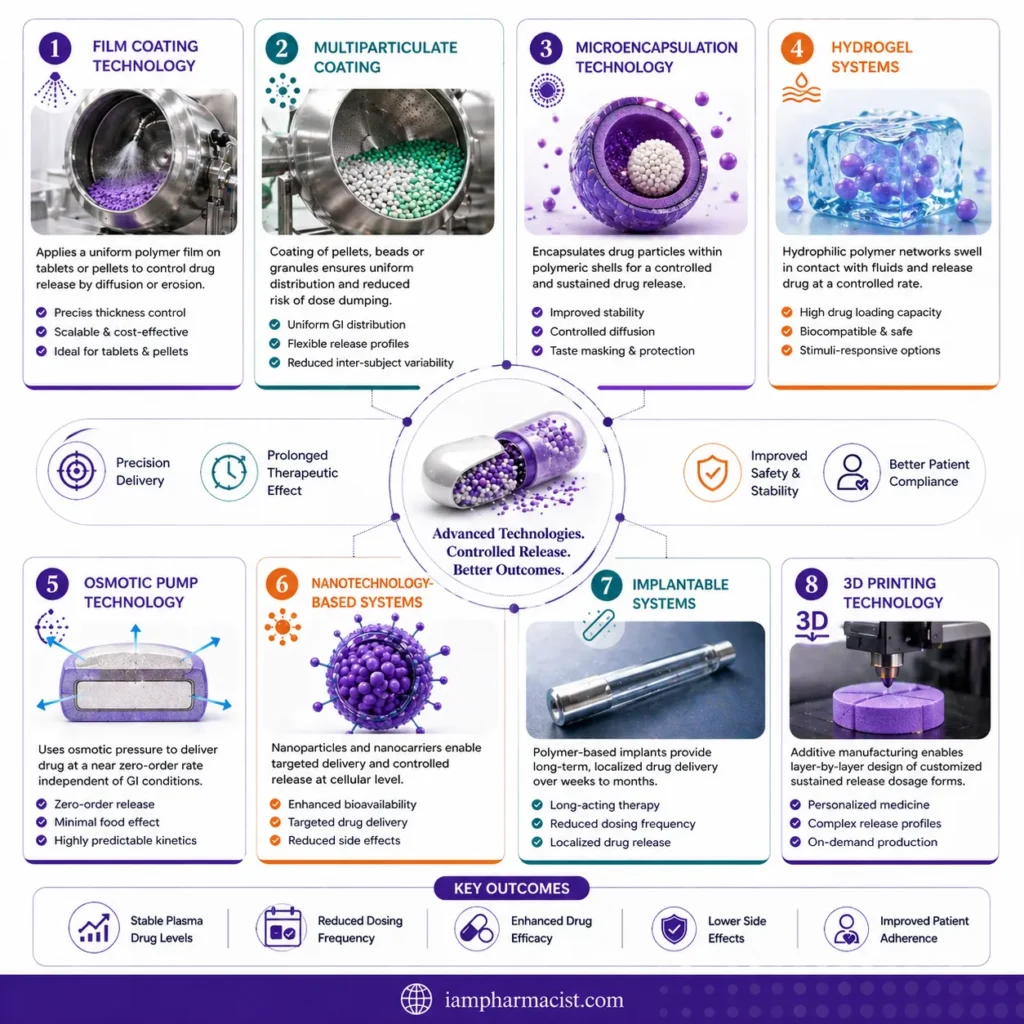
3. Osmotic Pump Systems
Drug release occurs through osmotic pressure generated within the tablet.
Benefits
- Zero-order release
- Minimal food effect
- Highly predictable release
4. Multiparticulate Systems
These systems contain coated pellets, beads, microspheres, or nanoparticles.
Advantages
- Uniform GI distribution
- Reduced dose dumping
- Improved bioavailability
- Flexible release profiles
Common Polymers Used in Sustained Release Coatings
Hydrophilic Polymers
| Polymer | Application |
|---|---|
| HPMC | Matrix tablets |
| PEO | Swelling-controlled release |
| Carbopol | Mucoadhesive systems |
Hydrophobic Polymers
| Polymer | Application |
|---|---|
| Ethyl Cellulose | Membrane coating |
| Eudragit RS/RL | Controlled permeability |
| Polyvinyl Acetate | Extended release coating |
Biodegradable Polymers
| Polymer | Biomedical Application |
|---|---|
| PLA | Implantable systems |
| PLGA | Injectable depots |
| PCL | Long-term release implants |
Biodegradable polymers are widely used because of their excellent biocompatibility and controlled degradation properties.
Technologies Used in Sustained Release Coatings
Applications of Sustained Release Coatings
| Therapeutic Area | Application |
|---|---|
| Cardiovascular Diseases | Once-daily antihypertensives |
| Diabetes | Extended-release antidiabetics |
| Pain Management | Controlled opioid release |
| CNS Disorders | Sustained antidepressants |
| Oncology | Targeted chemotherapy |
| Hormonal Therapy | Long-acting implants |
Advantages of Sustained Release Coatings
Major Advantages
- Improved therapeutic efficacy
- Reduced dosing frequency
- Better patient adherence
- Lower toxicity risk
- Enhanced bioavailability
- Stable pharmacokinetics
- Improved chronic disease management
Limitations of Sustained Release Systems
Common Challenges
- Complex formulation development
- Higher manufacturing cost
- Dose dumping risk
- Variable GI transit
- Difficult scale-up
- Regulatory complexity
Factors Affecting Sustained Drug Release
| Factor | Impact |
|---|---|
| Polymer Type | Determines release kinetics |
| Coating Thickness | Controls diffusion rate |
| Drug Solubility | Influences dissolution |
| Particle Size | Affects surface area |
| GI pH | Alters polymer behavior |
| Tablet Porosity | Impacts penetration |
Role of Biodegradable Polymers
Biodegradable polymers degrade safely within the body while maintaining controlled drug release.
Advantages
- Reduced surgical removal
- Improved safety
- Controlled degradation
- Excellent biocompatibility
Biodegradable polymers have become essential in implantable and injectable sustained-release systems.
How to Develop Sustained Release Coating Formulations
Step 1: Define Therapeutic Objectives
Determine:
- Desired release duration
- Dosing frequency
- Target plasma concentration
Step 2: Evaluate Drug Properties
Assess:
- Solubility
- Stability
- Half-life
- Dose size
Step 3: Select Suitable Polymer
Choose polymer based on:
- Drug compatibility
- Release mechanism
- Biocompatibility
- Degradation profile
Step 4: Optimize Coating Parameters
Control:
- Spray rate
- Coating thickness
- Drying temperature
- Polymer concentration
Step 5: Conduct Dissolution Studies
Evaluate:
- Release kinetics
- Diffusion profile
- Sustained release behavior
Step 6: Perform Stability Testing
Assess:
- Coating integrity
- Drug potency
- Moisture stability
- Long-term release consistency
Quality Control Tests for Sustained Release Coatings
Essential QC Tests
| Test | Purpose |
|---|---|
| Dissolution Testing | Evaluate release profile |
| Coating Thickness | Ensure uniformity |
| Friability | Assess durability |
| Hardness Testing | Mechanical strength |
| Stability Testing | Long-term performance |
Regulatory Considerations
Manufacturers must comply with:
- FDA modified-release guidance
- ICH Q8 Pharmaceutical Development
- ICH Q9 Risk Management
- USP dissolution requirements
- cGMP regulations
Proper validation and dissolution profiling are critical for approval. https://www.sciencedirect.com/science/article/abs/pii/S0378517300006724
FAQs
1. What are sustained release coatings?
Sustained release coatings are pharmaceutical coating systems designed to release drugs gradually over extended periods.
2. Why are sustained release formulations important?
They improve patient compliance and maintain stable therapeutic drug levels.
3. Which polymers are used in sustained release coatings?
Common polymers include HPMC, ethyl cellulose, PLGA, PEO, and Eudragit.
4. What is the difference between sustained release and immediate release?
Immediate-release formulations release drugs rapidly, while sustained-release systems provide gradual release.
5. What are biodegradable polymers in drug delivery?
These polymers safely degrade within the body while controlling drug release.
6. How do sustained release coatings work?
They regulate drug diffusion, dissolution, swelling, or polymer erosion over time.
7. What are multiparticulate sustained release systems?
They contain coated pellets or beads that provide controlled drug release.
8. What are the advantages of sustained release drug delivery?
Advantages include reduced dosing frequency, improved adherence, and stable plasma drug concentrations.
9. What is dose dumping in sustained release systems?
Dose dumping is the unintended rapid release of the entire drug dose.
10. What are the latest innovations in sustained release coatings?
Smart polymers, nanotechnology, 3D printing, and implantable systems are major innovations.
Conclusion
Sustained release coatings have transformed pharmaceutical drug delivery by enabling prolonged therapeutic action, improved patient compliance, and controlled pharmacokinetic performance. Modern innovations in polymer science, nanotechnology, smart materials, and implantable systems continue to advance sustained drug delivery technologies.
As research progresses, sustained release systems are expected to play an even greater role in personalized medicine, chronic disease management, targeted drug delivery, and advanced biomedical applications.
{ “@context”: “https://schema.org”, “@type”: “Article”, “headline”: “Sustained Release Coatings: Technologies and Innovations”, “description”: “Comprehensive guide to sustained release coating technologies, polymers, innovations, and pharmaceutical applications.”, “author”: { “@type”: “Person”, “name”: “Pharmaceutical Drug Delivery Expert” }, “publisher”: { “@type”: “Organization”, “name”: “iampharmacist.com” } } { “@context”: “https://schema.org”, “@type”: “FAQPage”, “mainEntity”: [ { “@type”: “Question”, “name”: “What are sustained release coatings?”, “acceptedAnswer”: { “@type”: “Answer”, “text”: “Sustained release coatings are pharmaceutical systems designed to gradually release drugs over an extended period.” } }, { “@type”: “Question”, “name”: “Which polymers are used in sustained release coatings?”, “acceptedAnswer”: { “@type”: “Answer”, “text”: “Common polymers include HPMC, ethyl cellulose, PLGA, PEO, and Eudragit.” } } ] } { “@context”: “https://schema.org”, “@type”: “HowTo”, “name”: “How to Develop Sustained Release Coating Formulations”, “step”: [ { “@type”: “HowToStep”, “name”: “Define Therapeutic Objectives” }, { “@type”: “HowToStep”, “name”: “Evaluate Drug Properties” }, { “@type”: “HowToStep”, “name”: “Select Suitable Polymer” }, { “@type”: “HowToStep”, “name”: “Optimize Coating Parameters” }, { “@type”: “HowToStep”, “name”: “Conduct Dissolution Studies” } ] }