


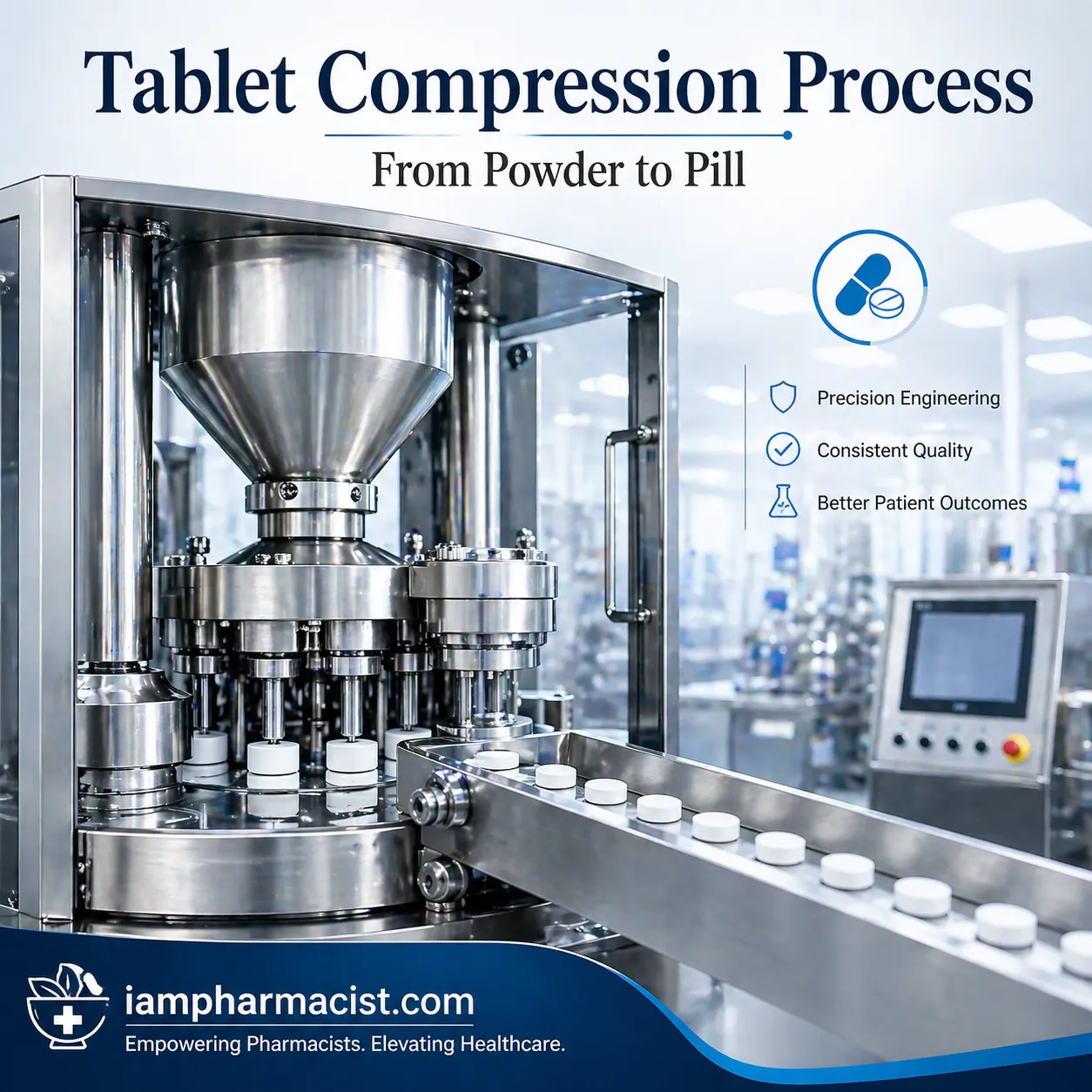

Learn the tablet compression process step by step—from powder to pill. Explore stages, machines, and quality tips in this pharma guide.
📌 Definition
Tablet compression is the pharmaceutical process of converting powder or granules into solid tablets by applying pressure using a punch and die system within a compression machine.
💊 Introduction
The journey from powder to pill is one of the most critical steps in pharmaceutical manufacturing. Tablet compression transforms carefully formulated granules into precise, durable, and effective dosage forms.
Modern advancements in tablet compression machines allow manufacturers to produce over 500,000 tablets per hour, ensuring both speed and consistency. However, behind this efficiency lies a highly controlled process involving pressure, precision tooling, and strict quality standards.
Whether you’re a pharmacy student, production engineer, or content creator, understanding this process helps bridge theory with real-world pharmaceutical operations.
⚙️ Principle of Tablet Compression
Tablet compression operates on the principle of hydraulic pressure transmission, where force applied to a confined material is distributed evenly in all directions.
This ensures:
- Uniform density
- Consistent tablet hardness
- Accurate drug dosage
The compression force is applied through upper and lower punches, compressing granules inside a die cavity to form tablets.
📊 Key Stages of Tablet Compression
| Stage | Purpose | Key Control Factor |
|---|---|---|
| Filling | Load granules into die cavity | Die volume & powder flow |
| Metering | Adjust and control tablet weight | Lower punch position |
| Compression | Apply force to form tablet | ضغط (compression force) |
| Ejection | Remove tablet from die | Punch movement & timing |
🛠️ Step-by-Step: How Tablet Compression Works
🧩 Step 1: Filling
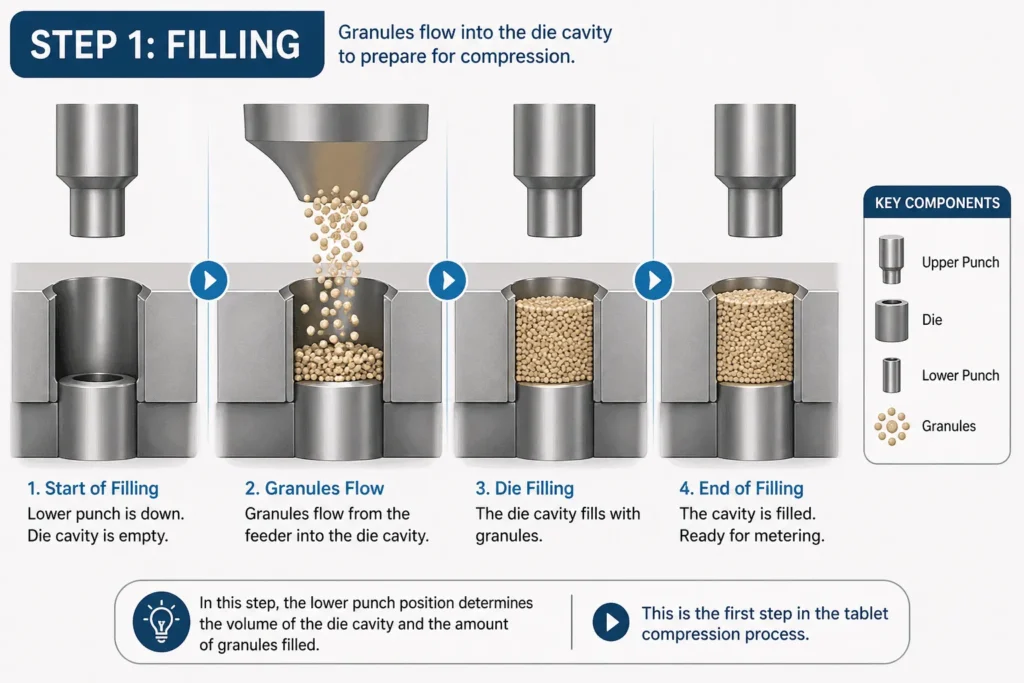
The Filling begins with transferring granules into the die cavity. The lower punch position determines the volume of powder filled, which directly affects tablet weight.
A uniform blend ensures consistent drug distribution—critical for dosage accuracy.
⚖️ Step 2: Metering
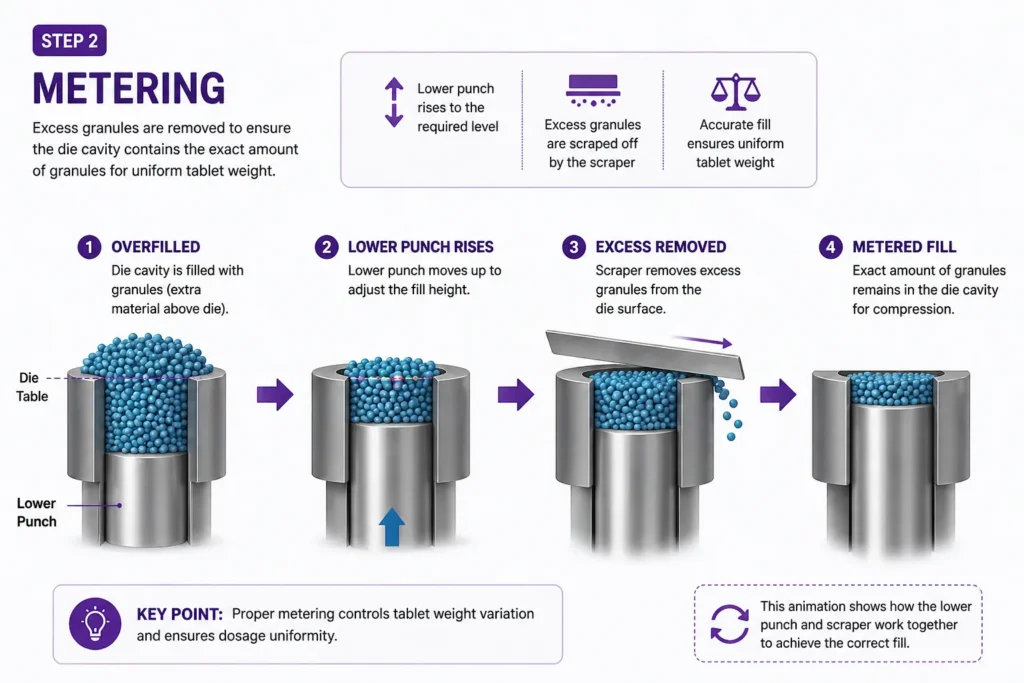
In this stage, excess granules are removed to achieve precise weight control.
- Lower punch rises to adjust volume
- Excess material is scraped off
- Ensures uniform tablet weight
Think of it like leveling flour while baking—precision matters.
🧱 Step 3: Compression
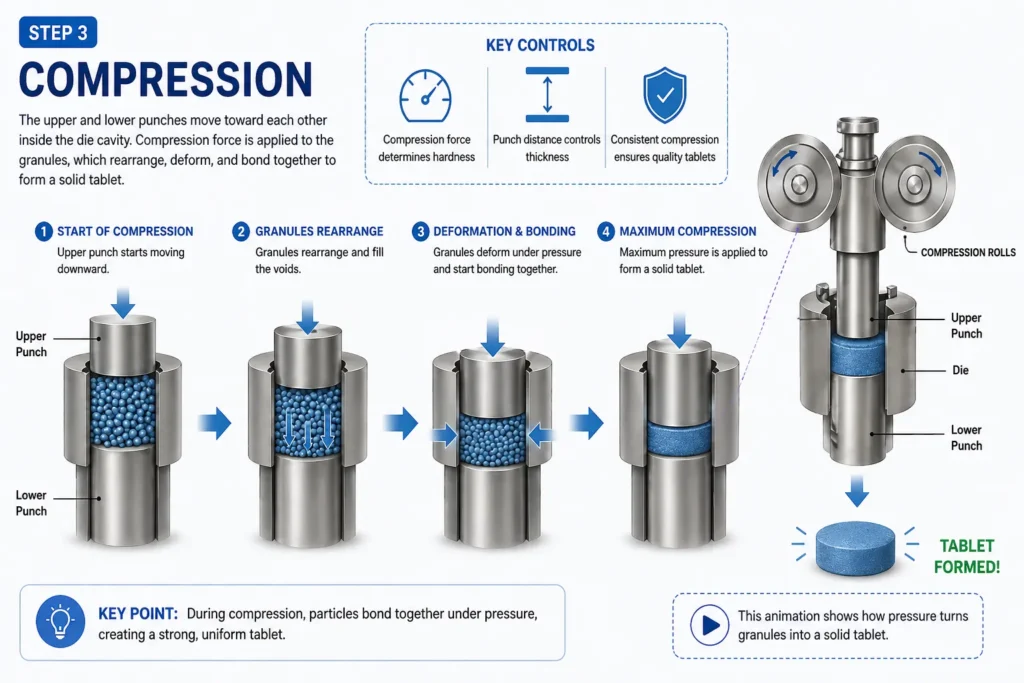
Here, upper and lower punches compress the granules under high pressure.
- Compression rolls apply force
- Punch distance controls thickness & hardness
- Modern systems use Auto Weight Control (AWC)
This is where powder becomes a solid tablet.
⬆️ Step 4: Ejection
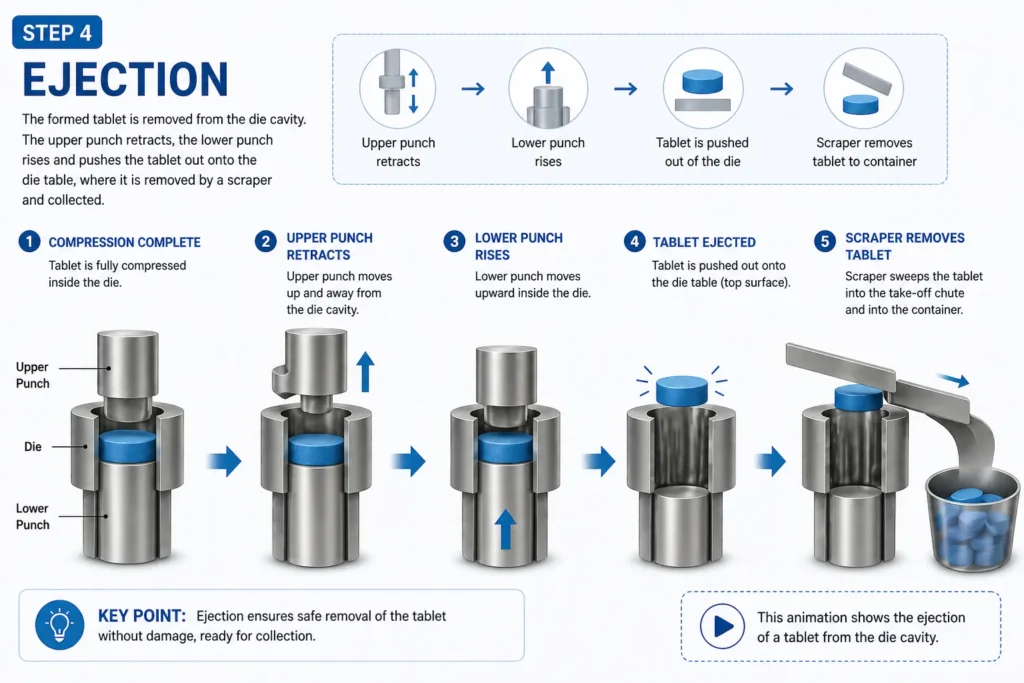
After compression:
- Upper punch retracts
- Lower punch pushes tablet upward
- Tablet is removed and collected
This stage ensures smooth خروج without damaging the tablet.
🏭 Types of Tablet Compression Machines
- Single Punch Press: Ideal for small-scale or R&D
- Rotary Tablet Press: High-speed production with multiple stations (25, 35, 55+)
- High-Speed Press: Used in large-scale pharma manufacturing
📈 Why Tablet Compression Matters
- Ensures dose accuracy
- Improves patient compliance
- Enables mass production
- Maintains product stability
⚠️ Common Challenges
- Capping and lamination
- Sticking to punches
- Weight variation
- Hardness inconsistency
❓ FAQs
1. What is tablet compression?
Tablet compression is the process of converting powder into tablets using الضغط in a machine.
2. What are the main stages of tablet compression?
Filling, metering, compression, and ejection.
3. How does a tablet compression machine work?
It uses upper and lower punches to compress granules داخل a die cavity.
4. What is the role of punches and dies?
They shape and compress the tablet.
5. What affects tablet hardness?
Compression force and punch distance.
6. What is metering in tablet compression?
It controls the exact weight of granules before compression.
7. What type of machines are used?
Single punch and rotary tablet presses.
8. Why is uniform filling important?
It ensures consistent dosage in each tablet.
9. What is AWC in tablet compression?
Auto Weight Control system for precision.
10. How many tablets can be produced per hour?
Modern machines can exceed 500,000 tablets/hour.
{ “@context”: “https://schema.org”, “@type”: “Article”, “headline”: “Tablet Compression Process: From Powder to Pill”, “description”: “Step-by-step guide to tablet compression in pharmaceutical manufacturing.”, “author”: { “@type”: “Person”, “name”: “Senior SEO Strategist & Technical Writer” }, “publisher”: { “@type”: “Organization”, “name”: “Pharma Insights Blog” } } { “@context”: “https://schema.org”, “@type”: “HowTo”, “name”: “Tablet Compression Process”, “step”: [ {“@type”: “HowToStep”,”name”: “Filling”,”text”: “Granules are filled into die cavity.”}, {“@type”: “HowToStep”,”name”: “Metering”,”text”: “Excess granules removed to control weight.”}, {“@type”: “HowToStep”,”name”: “Compression”,”text”: “Punches apply pressure to form tablet.”}, {“@type”: “HowToStep”,”name”: “Ejection”,”text”: “Tablet is pushed out and collected.”} ] } { “@context”: “https://schema.org”, “@type”: “FAQPage”, “mainEntity”: [ {“@type”:”Question”,”name”:”What is tablet compression?”,”acceptedAnswer”:{“@type”:”Answer”,”text”:”It is the process of converting powder into tablets using pressure.”}}, {“@type”:”Question”,”name”:”What are stages of compression?”,”acceptedAnswer”:{“@type”:”Answer”,”text”:”Filling, metering, compression, and ejection.”}} ] }